
SATURDAY, OCTOBER 10, 2026
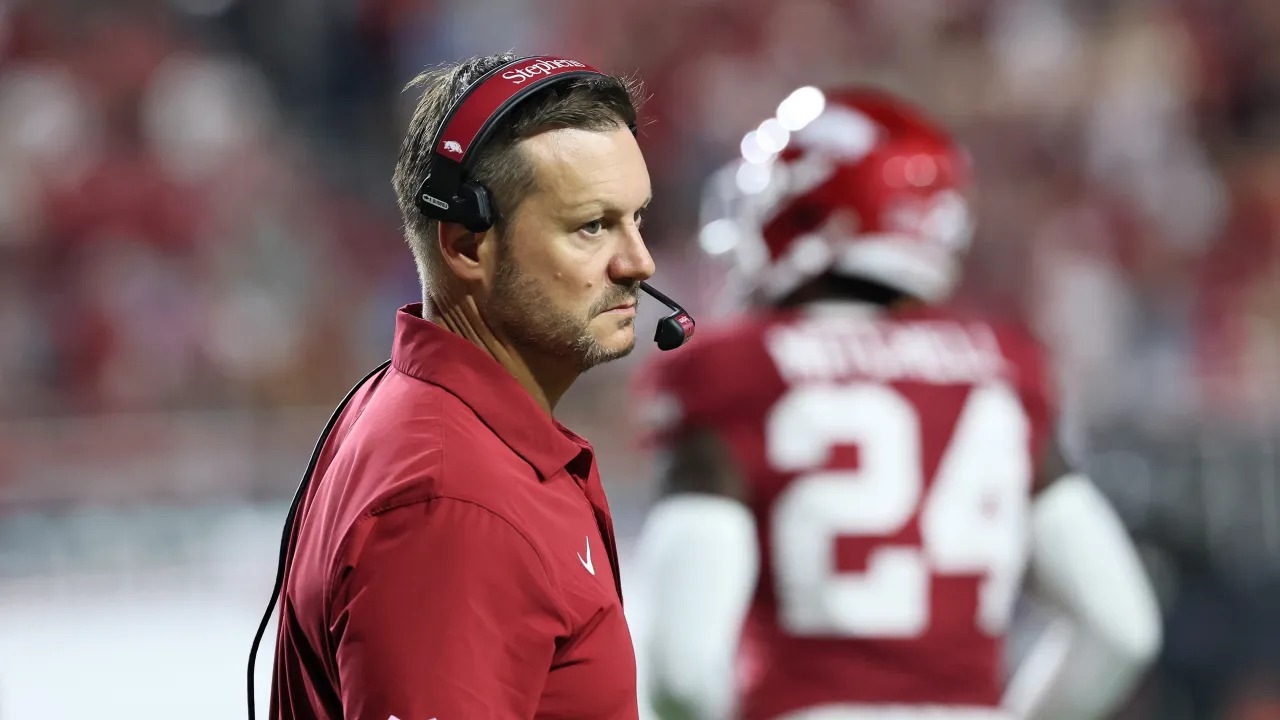
Let’s rewind the tape. Not to a trick play, not to a blown call by the officials, and not to a quarterback making a hero throw into double coverage. Rewind it to a decision — a clean, deliberate, head-coach decision — made with the game still sitting right there in front of everybody. Arkansas is down seven at home. The clock says roughly a minute and forty-five seconds left. The Razorbacks have all three timeouts in their pocket. They have the ball. And their head coach looks at fourth-and-10 from his own 25 and sends the punt team onto the field.
Say the situation out loud slowly, because the slowness is the point. Arkansas had just fought its way back into this game. A 55-yard field goal tied it 17-17 with 5:42 remaining, per the Arkansas Traveler’s account of the afternoon. The defence then gave up the kind of drive that breaks a building’s heart: Tennessee went 94 yards and took the lead back on an 8-yard DeSean Bishop run with 1:57 left. That hurts. It does not end anything. One touchdown ties it. Arkansas gets the ball back at its own 25, with time, with timeouts, and with a home crowd of 69,038 ready to lose its mind in the good way for once. This is the exact moment a coaching staff spends all week preparing for. Two-minute drill. Season on the table. Here we go.
What happened next took about ten seconds of game clock. Three passes. Three incompletions. Quarterback KJ Jackson threw, and threw, and threw again, and the ball kept hitting the ground. Suddenly it is fourth-and-10, and now the whole stadium can feel the fork in the road. Go for it, and a failure probably ends the argument about the outcome — Tennessee would take over already in range to kick a field goal and push the lead to ten. That risk is real, and nobody in this space is going to pretend otherwise. But punt it, and you are choosing a different chain of miracles: your defence, the same defence that just marched 94 yards in the wrong direction, has to stop Tennessee cold; you have to spend your timeouts perfectly; you have to get the ball back deep in your own end; and then you have to drive the length of the field anyway, now with almost no time and no timeouts left, just to tie.
Silverfield chose the punt. Gavin Rush came on. The boos came down before the ball was even kicked — the home fans understood in real time what the maths on the sideline was trying not to say. A punt in that spot is not a plan to win the game. It is a plan to ask permission to try to win the game later, from a worse position, if the other team agrees to give you the ball back. Tennessee did not agree. Bishop carried twice, picked up the one first down the Volunteers needed, and that was that. Tennessee knelt it out. Arkansas never touched the ball again. The three timeouts Silverfield had saved so carefully went home unused in any way that mattered, like a gift card you keep in a drawer until after the store closes. Final score: Tennessee 24, Arkansas 17. Arkansas falls to 2-4 overall and 0-3 in the SEC. Tennessee leaves at 5-1 and 2-1.
Now, the Rewind is fair before it is funny, so let us give the coach his full hearing — because he gave it himself, twice. After the game Saturday, and again on Monday, Silverfield walked reporters through his reasoning in detail. Arkansas, he noted, had converted only two of eleven third downs at that point in the game, and the finished line was no kinder: both conversions came on third-and-1, and on third-and-3 or longer the Razorbacks went 0-for-9, as Sports Illustrated’s Monday follow-up reported. Protection late in the game was a problem. In his estimate, the chance of converting that fourth-and-10 was in the low single digits. Fail there, he argued, and Tennessee kicks the field goal, you are down ten with about a minute and twenty seconds left and no timeouts, and now you need a touchdown, an onside recovery and another field goal just to tie — a parlay he rated even lower. Punt, stop the run three times, get it back, and take one last shot: that was the road he picked. On Monday he added the line that tells you where his line in the sand was: at fourth-and-8 or less, he said, he would have gone for it. Two yards. The whole season’s most argued decision came down, in his own telling, to two yards.
Here is the problem, and the fans in that stadium named it without needing a spreadsheet. A low chance is not the same thing as no chance — unless you punt, in which case you have voluntarily traded the chance you control for a chance somebody else controls. Going for it at least keeps the ball, the clock and the decision in Arkansas hands for one more snap. Ten yards is a hard ask for an offence that had struggled to move it on money downs all afternoon, yes. But the alternative asked for more things to go right, in sequence, against a ranked team that had just shown it could run the ball when it mattered. And the reward for the safer road, even if every single piece had worked? Getting the ball back pinned deep, out of timeouts, needing the same long touchdown drive you were too afraid to start ninety seconds earlier. That is not caution. That is paying full price for a smaller prize, later, with less time to enjoy it.
Credit where the tape says credit is due. Silverfield did not hide. He owned that the call was his, said he had talked it through with his coordinators, and then stood in front of the same questions again on Monday and explained himself a second time instead of burying it. That matters — plenty of coaches in this league would have mumbled about execution and vanished. Jackson, to his credit, publicly backed his head coach rather than feeding the fire. And the larger Arkansas performance was not a joke: the Razorbacks hung with the No. 14 team in the country into the final two minutes, ran the ball well for a second straight week, and made Tennessee’s quarterback work for most of the afternoon. None of that is nothing. A team that gets blown out by halftime does not get to have a fourth-down argument at all. Arkansas earned the right to have this decision matter.
Which is exactly why it matters so much. This programme, in the first year of a new era, is trying to convince a fan base that has watched a long SEC losing streak — Saturday’s loss was the fourteenth straight in league play, per Pro Football Network’s reporting — that the new era will be braver and sharper than the old one. You do not sell a new era by surrendering the last possession of a one-score home game against a ranked rival and then explaining, for two days, why surrender was the percentages play. Supporters can live with a failed fourth-down try. They will argue about the play call on the drive home, they will second-guess the route, and then most of them will say at least we went down swinging. What they cannot live with — what they booed in real time, before the result was even in — is watching the offence walk off the field while the game is still winnable. They understood the assignment the moment the punt team trotted out. The assignment was: go get ten yards or go home trying.
And so the Sporting News headline that was still doing the rounds on Wednesday morning — fans left confused, asking why he punted — is not really a question about analytics at all. It is a question about what a head coach is for in the last two minutes. The chart cannot make the call for you when the chart’s answer requires your tired defence to be perfect and the other team’s running back to be generous. At some point the job is feel, nerve and responsibility to the 69,038 people who showed up believing the last drive belonged to them. Silverfield had the ball, the timeouts and the moment. He gave all three back and kept the explanation. Fayetteville will be reciting that explanation back to him for a long time.
The verdict
So let us hand the verdict down clean. It does not go to KJ Jackson, who backed his coach in public when it would have been easy not to. It does not go to the defence, which had a rough final drive but had kept Arkansas in a ranked fight all afternoon. It goes to the decision itself, and to the man who made it and owned it: down seven, at home, with time and every timeout you could ask for, you do not punt the season’s best chance into the other team’s hands and call the surrender a strategy. Keep the offence on the field. If you fail, you fail reaching for the tie. Arkansas never got to fail reaching. It just watched Tennessee kneel.
THE VERDICT — After review: Ryan Silverfield is outta pocket.
Sources · 4 sources
- Why did he punt? Fans left confused after controversial decision by Arkansas head coach Ryan Silverfield Sporting News · Oct 14, 2026
- Ryan Silverfield Explains Decision To Punt On Arkansas' Final Drive In Loss To Vols Sports Illustrated / HogHQ · Oct 2026
- Ryan Silverfield on controversial late-game decisions in loss to Tennessee 247Sports · Oct 2026
- Ryan Silverfield defends late punt in Arkansas loss Arkansas Traveler · Oct 2026