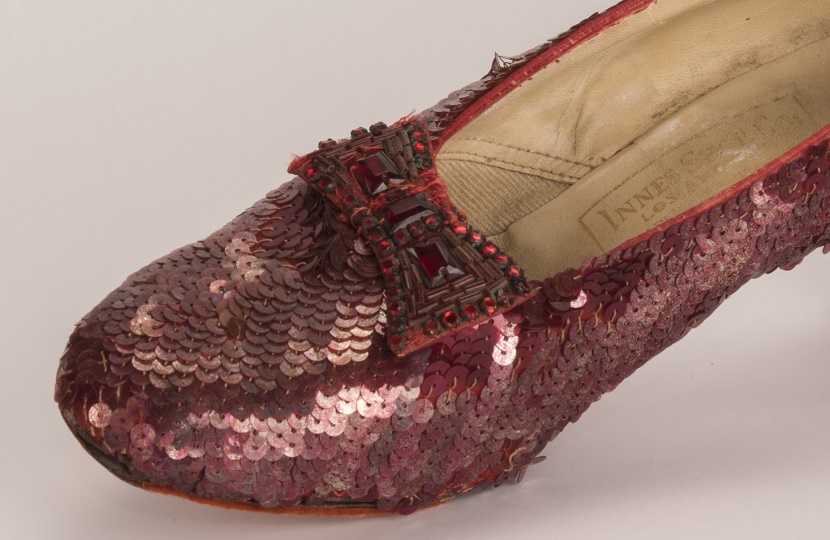
The rubies are not real. The shoes are white silk pumps from the Innes Shoe Company of Los Angeles, dyed red and covered in hand-sequined silk georgette by MGM's costume department because the budget did not stretch to stones. On 7 December 2024, at Heritage Auctions in Dallas, a pair of them sold for $32,500,000 — a $28 million hammer, after about fourteen minutes of bidding mostly between two phone bidders, against an estimate of $3 million and up. Heritage declared them, in December 2024, the most valuable movie memorabilia ever sold at auction, and the price powered the whole sale to $38,615,188. The buyer was never named.
Several pairs of ruby slippers were made for The Wizard of Oz in 1939. Four are known to have survived. This price belongs to exactly one of them — and the lot essay can prove which, down to the numbers stamped inside the shoes.
A pair that doesn't match itself
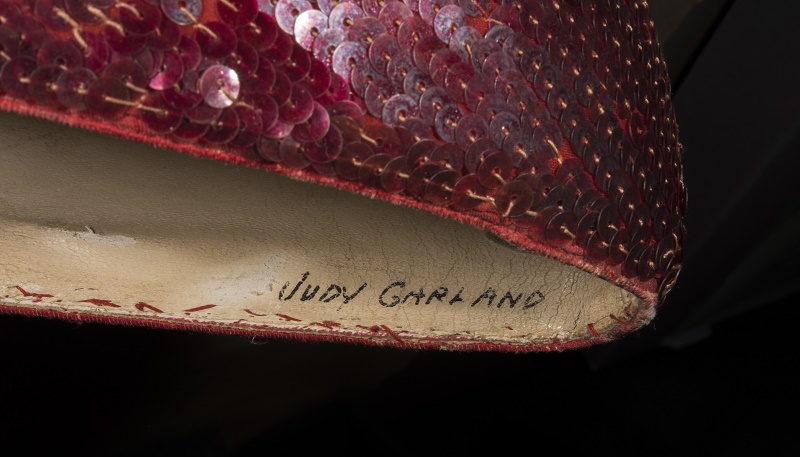
The slippers were designed by Gilbert Adrian, MGM's chief costume designer, who took the white Innes pumps and had uppers and heels covered in hand-sequined georgette over red silk faille, soles painted red, orange felt on the front foundation, and bows of hand-cut buckram rimmed with rhinestones and bugle beads around three center jewels. Judy Garland's name is written inside both shoes in black ink. The two shoes of this pair are not identical: the left has a slightly thicker, shorter heel with a Cat's Paw rubber top lift; the right a taller, thinner heel with a leather top lift. Heritage notes this pair is a darker burgundy than any other known pair, probably from decades of careful storage out of the light.
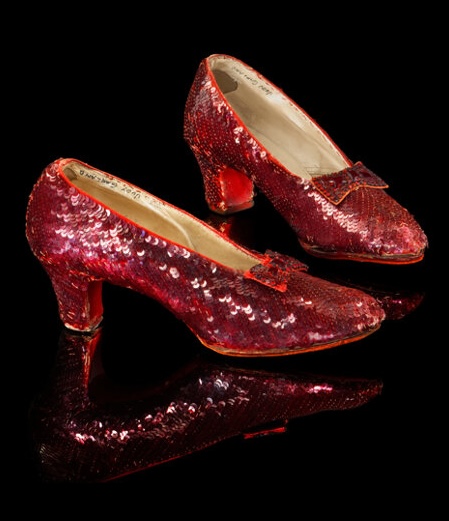
The asymmetry turned out to be a fingerprint. When the FBI recovered this pair in 2018, Smithsonian conservators compared it against the pair the National Museum of American History has held since 1979 — and the two pairs proved to be cross-matched twins: the manufacturer's numbers inside this pair's left shoe (5BC 15250) match the Smithsonian's right shoe, and its right shoe (5C 11869 D536) matches the Smithsonian's left. The pairs were mixed up somewhere after filming, most likely around the 1970 MGM dispersal. And a forensic frame-by-frame study of the film, by Smithsonian consultant Randy Struthers, places this pair's shoes on Garland's feet through most of the picture — including the three close-ups that matter: the shock to the Witch's hands, the Gates of Oz, and the heel-tapping that takes Dorothy home.
Found in a barn, sold in 1970, stolen in 2005
Costumer Kent Warner, hired to sort MGM's wardrobe for the studio's 1970 auction, found the surviving slippers in a dusty bin in a backlot barn. He sold this pair, around the time of the auction, to collector Michael Shaw, who spent three decades exhibiting them in his travelling Hollywood shows — which is how they earned their first name, the Traveling Shoes. In the summer of 2005 Shaw lent them to the Judy Garland Museum in Grand Rapids, Minnesota, Garland's hometown. On the night of 27–28 August, a thief smashed the display case and took them, leaving, by the oft-retold account, a single sequin behind. The pair was insured for $1 million. A $1 million reward offered in 2015 did not bring them back.
The end came through an extortion attempt: in 2017 a man approached the shoes' insurer claiming he could get them back, and in July 2018 the FBI recovered the pair in a sting in Minneapolis. The thief, Terry Jon Martin, 76, pleaded guilty in October 2023 and told the court he had taken them for 'one last score,' believing the sequins were genuine rubies he could pry off and sell. They were not — and the shoes were unsellable for the opposite reason: too famous to fence. The FBI returned the pair to Shaw in February 2024, and he consigned them to Heritage within the year.
What the thirteen years added
Ordinarily a theft is damage. Here it was a second provenance laid over the first: the film, the 1970 dispersal, the travelling years, the smashed case, the sting, the courtroom. The market's arithmetic on 7 December is in the numbers — an estimate of $3 million and up, online bidding already at $1.55 million before the live session opened, and a hammer $25 million above the low estimate. The same sale's Wicked Witch hat, from Shaw's collection, made a reported $2.93 million as a separate lot; it is not in this total, and neither is any other pair. The Smithsonian's shoes did not sell for $32.5 million. These did.
The replica costs $349.99
The look is for sale officially: Paragon FX Group's Warner Bros.-licensed museum-quality replica, built from Smithsonian reference and limited to 1,500 pairs, lists at $349.99. The ladder from there to $32,500,000 runs to roughly 93,000 times. There is an older footnote that sharpens it: in 1989 Western Costume, the company behind the originals' manufacture, produced authorised reproductions hand-cast on Garland's own foot mould, planning 500 pairs at $5,000 each; the project stopped after 16 pairs sold. Even the maker's own near-identical shoes, from the original mould, could not hold a $5,000 price — because what buyers pay for was never the shoe. It is the screen, the wear, the match, and now the thirteen years in the dark.
Sources: Heritage Auctions, Lot 89182 and the house's 7 December 2024 release; Associated Press sale and case reporting; the FBI's recovery account (September 2018, updated March 2024); Paragon FX Group via the Warner Bros. shop.
Sources · 4 sources
- {'outlet': 'Heritage Auctions'}
- {'outlet': 'Associated Press'}
- {'outlet': 'FBI'}
- {'outlet': 'Antique Trader'}