PHOENIX — Taiwan's foreign minister touched down in Phoenix on Saturday evening with an itinerary that says a great deal about where American industry is headed. Lin Chia-lung is here for the opening of Taiwan's new representative office in the Valley — a de facto consulate in a city that didn't have one — and he'll spend the visit touring TSMC's sprawling Arizona fabs and meeting with municipal and state leaders, according to his office and two officials familiar with the trip.

The office matters more than its modest name suggests. The United States has no formal diplomatic ties with Taiwan, so Taipei's missions in America operate as "representative offices" rather than embassies or consulates. Taiwan's foreign ministry called the new Phoenix post a "milestone in Taiwan-US economic and trade partnership," and said it would continue linking diplomacy, trade and economics to deepen what it described as the mutually "beneficial and symbiotic partnership between Taiwan and the United States based on mutual trust."
Beyond the ribbon-cutting, the trip has a clear industrial mission. One official familiar with the matter, speaking on condition of anonymity because of the sensitivity of the discussions, said the core of Lin's visit is bolstering support for Taiwanese businesses operating in the United States and building collaborative industrial hubs with American academic institutions and government agencies — with an eye toward enticing more domestic chip-supply companies to set up shop stateside. Lin is expected to walk the floors of TSMC's Arizona facilities himself.
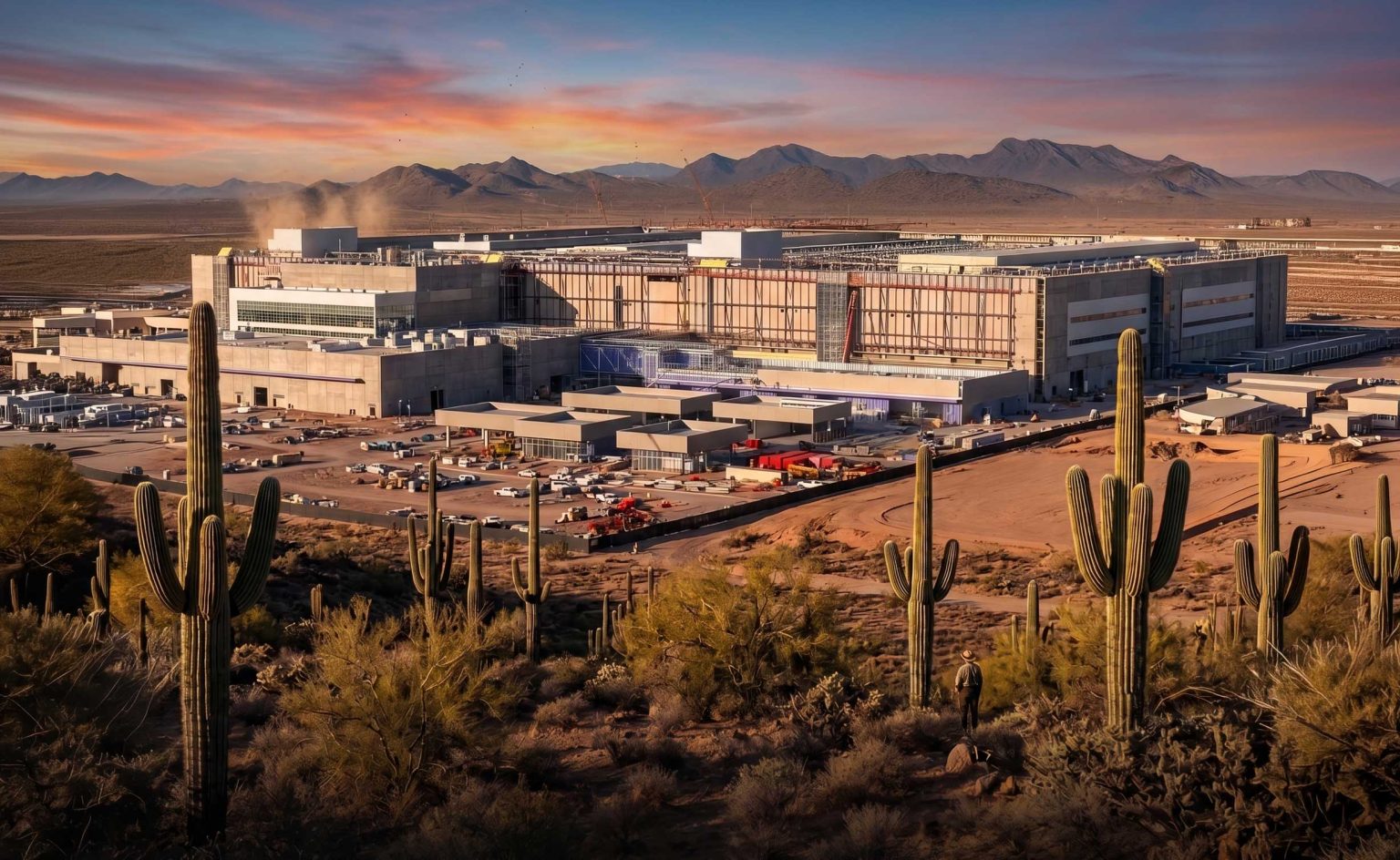
That Arizona keeps showing up in Taipei's plans is no accident. Taiwan Semiconductor Manufacturing Co.'s commitment to the state now stands at a staggering $265 billion — a figure announced in stages, most recently with a $100 billion expansion this July — and its campus near Loop 303 and Interstate 17 in north Phoenix has become the centerpiece of America's effort to make leading-edge chips on domestic soil. The first fab is already in high-volume production of 4-nanometer chips, the kind powering Nvidia's Blackwell AI accelerators, with more fabs under construction. The company has added hundreds of acres to its original 1,100-acre footprint, bringing the total to more than 2,000.
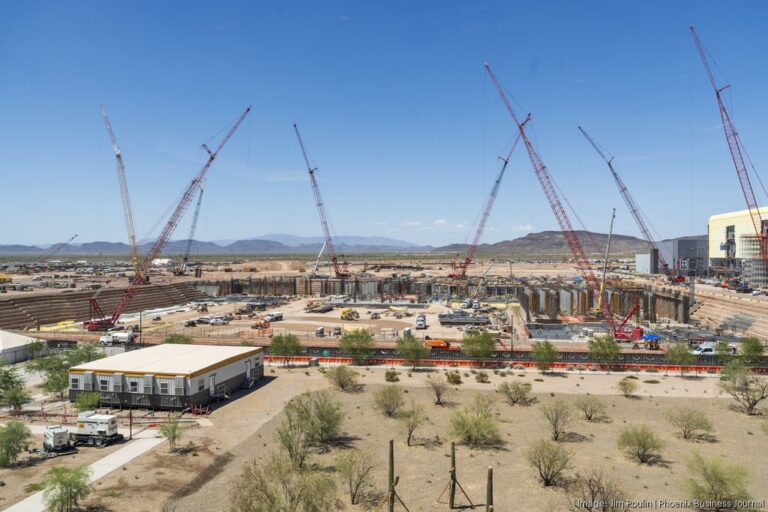
It's worth pausing on how extraordinary that number is. The Arizona project began as a $12 billion announcement. It is now a quarter-trillion-dollar bet on a single state — one that has pulled an entire supply chain into the Valley's orbit. Amkor is building a $12 billion advanced-packaging campus in Peoria that is expected to employ more than 3,500 people and has already signed a 10-year packaging deal with TSMC; Nvidia has put down $1.5 billion with Amkor in a multi-year deal. Apple says it is on track to buy "well over 100 million" advanced chips from TSMC Arizona's fabs this year. When Lin sits down with state and municipal leaders this week, he'll be talking to the stewards of arguably the most consequential industrial project in modern American history.
The academic piece of the mission fits the Phoenix landscape neatly. One of the trip's stated aims — building collaborative industrial hubs with American academic bodies — lands in a state where Arizona State University has become a serious semiconductor player in its own right, co-leading a CHIPS-funded packaging research project and anchoring the region's engineering pipeline. For Taiwanese engineers and their families relocating to the Valley — and there are now thousands — the new Phoenix office means consular-style services without a flight to Los Angeles or San Francisco.

The visit also arrives in a charged geopolitical season. While senior Taiwanese officials do travel to the United States from time to time, President Lai Ching-te has yet to do so under the second administration of U.S. President Donald Trump. Trump said in May, after a visit to Beijing to meet Chinese President Xi Jinping, that he was keeping a new arms-sales package for Taiwan on hold, describing it as a good negotiating chip. The two leaders then met in Washington last month, after which Trump said only that Xi understands his position on Taiwan. China has repeatedly demanded that U.S. arms sales to the island end.
And the timing is conspicuous in another way: Lin's Arizona stop comes roughly a week after Trump hosted Xi in Washington, where the two agreed to maintain a trade truce into early 2027 — a meeting that still surfaced friction over the self-governed island. Against that backdrop, a foreign minister's public appearance in Phoenix to open an office and walk a chip fab reads as Taipei playing its strongest card: the one thing Washington cannot get anywhere else. Taiwan's government has argued, in essence, that American reindustrialization runs through Taipei.
Lin's route to Phoenix also tells a story. The trip follows stops in Belize and Guatemala — the last two Central American countries that still recognize Taiwan rather than Beijing. Over the past decade, Panama, El Salvador, Nicaragua and Honduras have all switched recognition to China, leaving Taipei's remaining allies in the region down to two. It's a reminder that while Taiwan loses formal diplomatic ground in one hemisphere, it is building a different kind of footprint in the American Southwest — measured in fabs, supply chains and engineers rather than flags.
For Phoenix, the visit is a marker of how far the city's transformation has come. A decade ago, the idea that a foreign minister would fly into the Valley to open a de facto consulate — not in Los Angeles, not in Houston, but here — would have been improbable. Now the logic is self-evident: the diplomats follow the fabs. If the chip-supply companies Taipei is courting take the hint, the next decade could see the Valley's semiconductor cluster grow from extraordinary to genuinely dominant.
Reporting this story is based on
- Taiwan foreign minister visits US for opening of new Arizona office
Reuters — 2026-10-04 - Taiwan Foreign Minister Lin Chia-lung Visits Arizona for Semiconductor Ties
archyde — 2026-10-04 - TSMC Arizona Megaproject Grows to $265 Billion
Engineering News-Record — 2026-07-28 - TSMC's $165B Arizona GigaFab: Reshaping US Chips [2026]
tech-insider.org — 2026-10-02 - Some Assembly Required: Arizona Builds the Last Step in Chipmaking
InBusiness Phoenix — 2026-09-29 - TSMC Considers New Plant in Lone Star State
The Daily Upside — 2026-10-01