The Short Version
- Tesla unveiled the redesigned second-generation Roadster Thursday night at SpaceX’s McGregor, Texas test site — nearly nine years after the 2017 prototype promised deliveries in 2020.
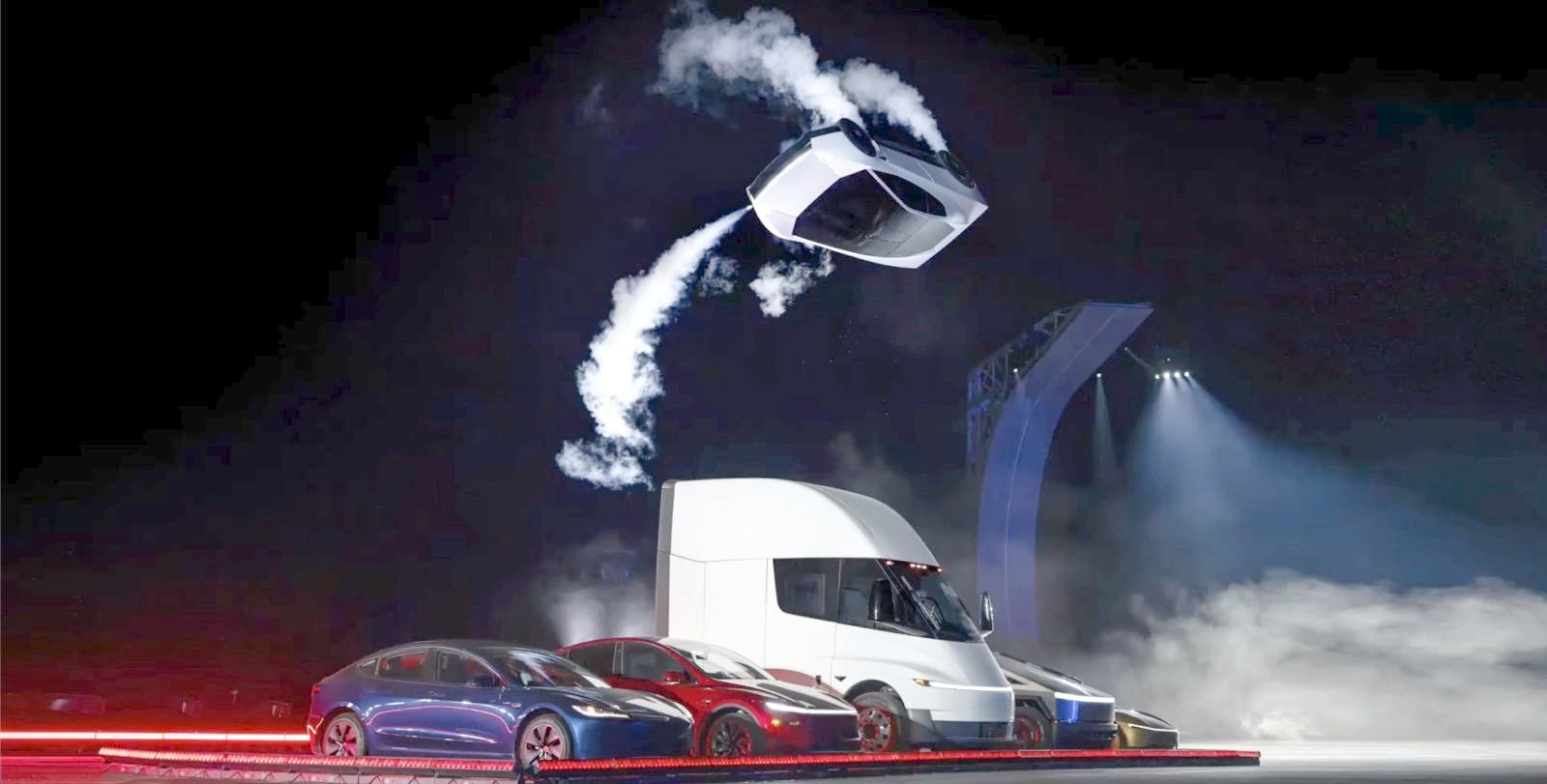
- On stage, the car ripped off a 0-to-60 mph run Tesla clocked at 0.81 seconds, drove upside down on an inverted ramp, and used SpaceX cold-gas thrusters to flip through the air and hop clean over Tesla’s current lineup.
- Three versions are planned — Performance, Thrust and an invite-only Rocket. Tesla claims up to 230-plus mph and over 300 miles of range; none of it is independently verified, and the flying Rocket is not approved for public roads.
- Elon Musk said production begins in 2028 and named no price. Reservations reopened anyway: $50,000 for the Performance, $250,000 for the Thrust.
McGREGOR, Texas
The most delayed car in modern automotive history finally had its night on Thursday — and it spent part of it upside down. Tesla unveiled the redesigned second-generation Roadster at SpaceX’s rocket test site in McGregor, Texas, and demonstrated it the way no carmaker has ever demonstrated anything: a launch Tesla clocked at 0.81 seconds from 0 to 60 mph, a drive up a curved ramp until the car hung completely inverted, and then a burst of SpaceX cold-gas thrusters that flipped the car through the air and set it back down on the pavement. According to TechCrunch, which covered the event, the Roadster also lifted itself on thrusters and hopped, in motion, clean over Tesla’s current lineup — a Cybercab, a Cybertruck, a Semi, a Model Y and a Model 3.
Tesla streamed the whole event itself. This is the company’s official video — the runs, the inverted ramp and the flip are all in there:
How a car does a kickflip
The hardware is borrowed straight from the rocket side of Elon Musk’s empire. Tesla engineering vice president Lars Moravy described a system of 10 cold-gas thrusters fed by some 600 liters of compressed air, stored in carbon-fiber pressure vessels packed into every usable void in the car, according to TechCrunch. Tesla says the thrusters produce four to five times the force the tires alone can put down — which is how the car sidesteps the traction limit that caps every other car’s launch, Electrek reported. A fan-driven suction system does the opposite job, pulling the car down hard enough, Tesla claims, to stick to the ramp upside down, even standing still.
Two honest footnotes on the show itself. The stunts were performed autonomously, for safety — Engadget’s live blog noted an Optimus robot sitting in the driver’s seat — and Musk conceded the car is “not necessarily a safety-optimized car.” What the crowd and the livestream audience saw was a prototype performing programmed maneuvers at a test site, not a customer car on a public road.

Three Roadsters, three sets of claims
Tesla detailed three versions after the stream, in a thread on its X account. The Performance is the road car: two seats, active aerodynamics and the suction system, with a Tesla-claimed 0-to-60 time under 1.6 seconds, available by reservation. The Thrust is a limited release that adds rear-mounted cold-gas thrusters and a claimed time under 0.9 seconds. The Rocket seats one, is invite-only, rings the car with thrusters for upward and rotational movement, and carries Tesla’s wildest claims — 0 to 60 in under 0.59 seconds and a top speed above 230 mph. Tesla quotes over 300 miles of range across the lineup.
Every one of those numbers is Tesla’s claim, not an independently verified figure. The only performance anyone actually watched happen on Thursday was the 0.81-second run. And the version that flies carries Tesla’s own warning label: the company’s Roadster page states the Rocket is not approved for public road use. Musk said the car on stage “will be the actual car that’s on the roads” — for the flying trim, at least, Tesla’s own fine print disagrees.
Nine years, and some specs shrank
Reuters laid out the arc. Tesla showed the second-generation Roadster prototype in November 2017, took $50,000 reservations against a $200,000 price, and promised deliveries in 2020. That date, and several after it, came and went; this year alone the unveil was promised for April, then August, then October 1, before high winds pushed Thursday’s event back two more weeks, Electrek reported. Some of the 2017 promises quietly shrank along the way: the 620-mile range claim is now “over 300 miles,” the four-seat layout is gone, and the top-speed claim eased from above 250 mph to above 230.
What Tesla did not provide Thursday: a price for any version, or a production date more specific than a year. Musk said production begins in 2028 — “actually,” he added — which would make it eleven years from unveiling to the first production car. Reservations reopened regardless: $5,000 down, which Tesla calls fully refundable, with another $45,000 due within ten days for the Performance and $250,000 in total for the Thrust. The fine print of Tesla’s reservation agreement guarantees neither a delivery date nor delivery itself.
The street’s verdict
Wall Street mostly shrugged at the spectacle. Tesla shares fell more than 1% on Thursday to close at $362.44, then rose nearly 3% in overnight trading after the event. Deepwater Asset Management’s Gene Munster called the reveal an “engineering flex” with no commercial value beyond hinting at Musk’s desire to pull Tesla and SpaceX closer together, and fund manager Gary Black warned beforehand that overhyped Tesla promises tend to end in market disappointment. Musk himself has long played the car down as a financial matter — Reuters noted he called it a “small potato situation” back in 2023 — and Morningstar analyst Seth Goldstein expects sales of roughly 2,000 cars a year, a rounding error beside the 1.6 million vehicles Tesla sold last year.
So separate what Thursday night proved from what it promised. Proven, in front of cameras and a live crowd: a car can launch to 60 in 0.81 seconds, stick itself upside down to a ramp, and flip through the air on rocket hardware. That is real, and it is astonishing. Promised: that customers will do any of it on public roads, that the car actually arrives in 2028 after nine years of slips, and that the wildest version is anything more than an invite-only halo toy. Tesla billed the Roadster as “the best of the last human-driven cars.” On Thursday it was unquestionably the most spectacular car on Earth. Whether it ever becomes a car you can buy is the part Tesla has not managed to demonstrate for nine years.
Sources · 5 sources
- Reuters — Tesla set to unveil next generation Roadster sports EV after years of delay, October 15, 2026
- TechCrunch — Tesla reveals SpaceX-powered Roadster that flies and falls with style, October 15, 2026
- Electrek — Tesla unveils Cyberfied new Roadster that can kickflip, October 15, 2026
- The Verge — The Tesla Roadster flew, drove upside down, and hit 60mph in under a second, October 15, 2026
- Tesla — Roadster Event, official event video, October 15, 2026