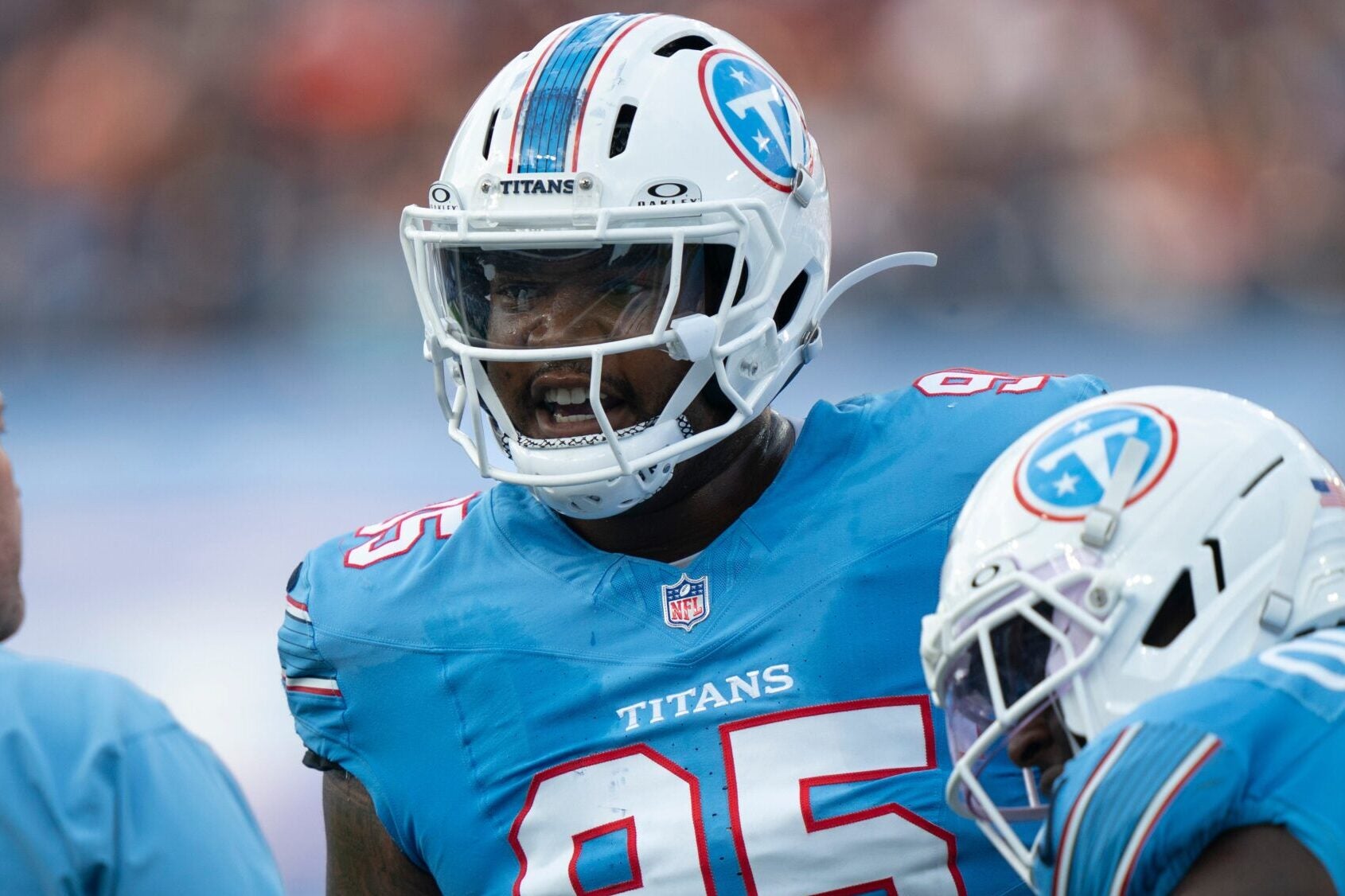

The Tennessee Titans released defensive tackle Jordan Elliott on Tuesday, and the most important words in the announcement are the ones the team refused to explain. Tennessee's entire public account of the end of Elliott's tenure is a short statement about "an incident at our team facility" — but reporting out of Nashville on Tuesday filled in what the team would not. According to A to Z Sports, citing multiple sources, the incident involved Elliott retrieving a firearm from his vehicle in the players' parking garage after a dispute with a teammate.
The statement, shared by Titans reporter Jim Wyatt, read in full: "On Thursday, October 15th, there was an incident at our team facility involving Jordan Elliott. Following our review of the incident, we have made the decision to release Elliott from our roster. We will have no further comment on the matter." That is everything the Titans have said. The team has not confirmed any of the details reported since, has not characterized what happened, and has not said whether anyone else was involved or disciplined. What is confirmed is the outcome: a starting-caliber defensive tackle signed this spring is off the roster in October.
What the reporting says happened
Per A to Z Sports' sources, Elliott grew frustrated with a Titans teammate during practice on Thursday, October 15. Friction between offensive and defensive linemen is an everyday occurrence in an NFL practice, and by itself it raised no alarms. This time, according to those sources, the frustration carried over into the locker room after practice. Elliott was seen storming out of the locker room upset, and he then went to the players' parking garage next to the facility, where he retrieved a firearm from his vehicle. The situation was de-escalated before there was any altercation involving the firearm.
The other half of that account is what did not happen afterward. The Metro Nashville Police Department told A to Z Sports by phone on Tuesday afternoon that no reports had been filed in connection with the incident, and that the team had not contacted the department about it. There has been no arrest and there are no charges. That boundary matters for how this story should be read: everything beyond the team's three sentences rests on A to Z Sports' sourcing. The firearm account has been reported by a named outlet citing multiple sources, but it has not been confirmed by the Titans or by police, and no statement from Elliott or his representatives has been reported.
The five days in between
The timeline is visible in the team's own paperwork. On Friday, the day after the incident, Elliott was listed on the practice report as not practicing for personal reasons, according to Reuters. On Sunday, he did not play in the Titans' 26–20 victory at Indianapolis — the franchise's first win of the season, lifting Tennessee to 1–5. On Tuesday, following what the statement calls the team's review, he was released. Five days from incident to exit, with "personal reasons" as the only public sign along the way that anything was wrong.
This was Robert Saleh's guy
What makes this more than a roster note is whose player Elliott was. He followed head coach Robert Saleh from San Francisco to Nashville. Saleh coached him with the 49ers, where, as A to Z Sports noted, Elliott started 16 games last season as a run-stopping defensive tackle. In March, the Titans signed him to a two-year, $8 million free-agent deal — a signing reported at the time by A to Z Sports and USA Today — built on a simple idea: a first-year head coach installing a new defense needs players who already speak its language, and Elliott could help the rest of the room learn Saleh's scheme from the inside. That is precisely what did not survive October. When a coach cuts his own import five games into the season, and the organization then declines to explain itself, nobody around the league reads it as a football decision — because the football case for the signing was the relationship itself.
The player, and the hole he leaves
Elliott, 28, entered the league as a third-round pick — 88th overall — by the Cleveland Browns in the 2020 NFL Draft out of Missouri. Across the Browns (2020–23), the 49ers (2024–25) and the Titans, he has played 102 career games with 65 starts, collecting 159 tackles, five sacks and 14 quarterback hits, according to Reuters. His Tennessee chapter lasted five games, with one start: 11 tackles across 138 snaps, 24 of them on special teams.
The defensive line room moves on without him. Jeffery Simmons remains the centerpiece of Tennessee's interior, with John Franklin-Meyers, Solomon Thomas and Timmy Horne in the rotation. The immediate replacement has, in effect, already taken the job: Nazir Stackhouse played the bulk of Elliott's snaps in Indianapolis on Sunday and performed well, according to A to Z Sports. What looked like a one-week audition is now a season-long assignment, starting Sunday when the Cleveland Browns — the team that drafted Elliott — visit Nashville.
What happens next for Elliott
Procedurally, his path back is uncomplicated. As a vested veteran in his seventh season, released before the trade deadline, Elliott is not subject to waivers — he is a free agent who can sign with any team immediately. On football alone, he would ordinarily get calls: 28-year-old defensive tackles with 65 career starts do not stay unsigned in a league that churns through interior linemen every week of the season. But any team that picks up the phone now inherits every question Tennessee declined to answer, and the reporting out of Nashville will follow Elliott into each of those conversations. A signing team will want its own account of what happened in that parking garage, and it will have to be comfortable explaining the signing in public. Until one decides the player is worth the explanation, the last public word on Jordan Elliott's Titans career belongs to the team's statement — the one that says almost nothing at all.
More sports coverage: Sports · Latest news