
Results
The Story of Brighton & Hove Albion
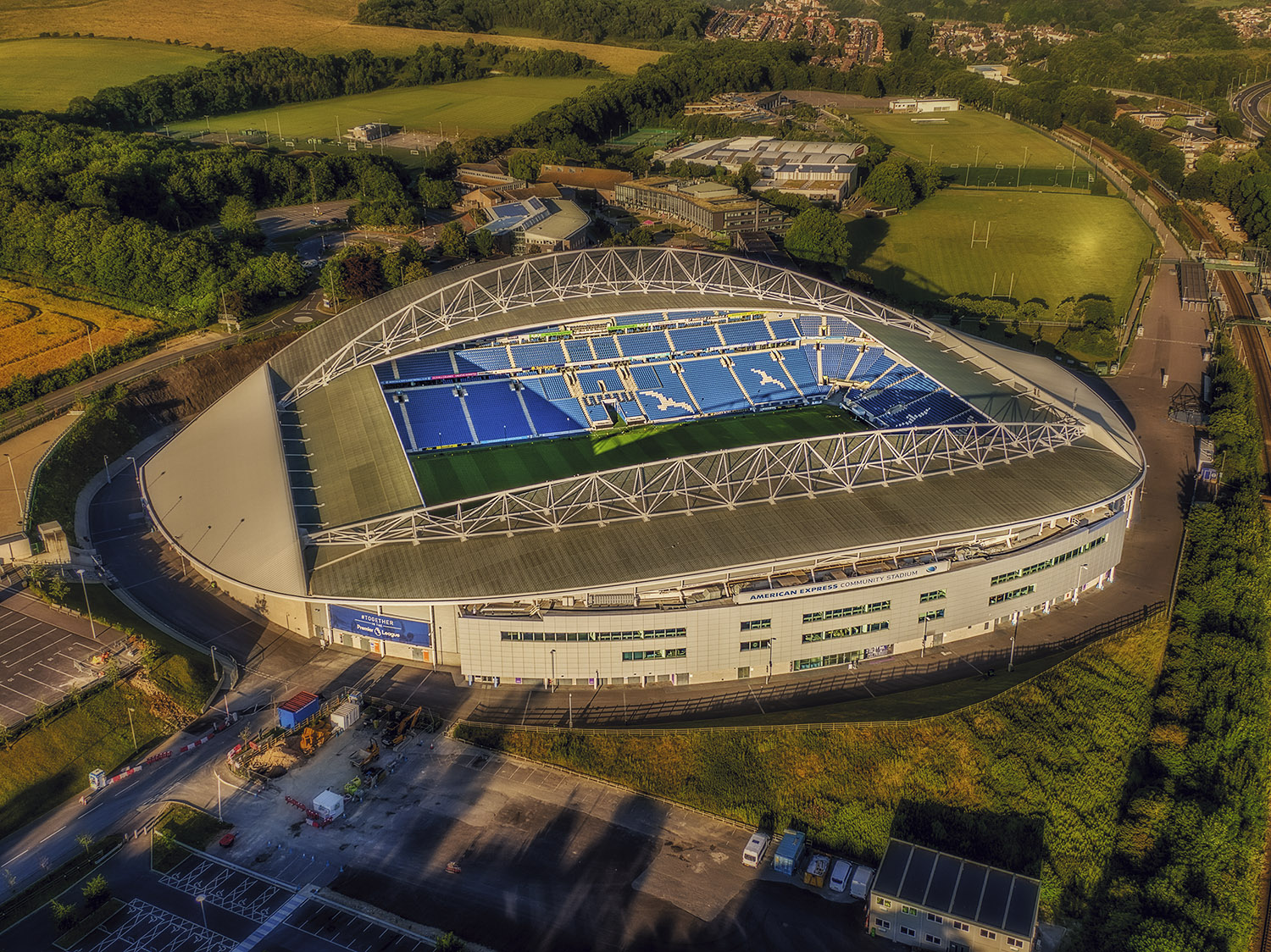
Brighton & Hove Albion are football's famous player factory — the club that sells its stars for nine-figure fees and somehow gets better. In 2026–27 they are flying again: 3-1-1 through five games, including a 5–0 demolition at Coventry, a 3–0 dismantling of Arsenal, and a 4–0 thrashing of Aston Villa. Brave, possession-heavy, high-pressing football on England's south coast, played the way the purists dream about.
It was not always like this. Founded in 1901, Brighton spent most of the 20th century as lower-league wanderers, famous mainly for reaching the 1983 FA Cup final — a 2–2 draw with Manchester United at Wembley, then a 4–0 replay defeat, the what-if moment of Gordon Smith's famous late miss in the first game. Then came the nightmare: in 1997 the board sold the Goldstone Ground from under the club, the Seagulls nearly dropped out of the Football League entirely, and for two seasons they played 'home' games 70 miles away at Gillingham before moving into the Withdean — a converted athletics stadium with temporary stands. The fans' protests saved the club from extinction; survival on the final day of the 1996–97 season, a 1–1 draw at Hereford secured by Robbie Reinelt's equaliser, remains the most celebrated result in club history.
The saviour was one of their own. Tony Bloom — lifelong fan, professional gambler, poker millionaire — took over in 2009, bankrolled the beautiful American Express Stadium at Falmer (opened 2011, 31,876 seats, one of the finest modern grounds in England) and built the smartest recruitment operation in the country. Promotion to the Premier League came in 2017 under Chris Hughton after a 34-year absence. Graham Potter took the football up a level from 2019, and then Roberto De Zerbi — who arrived in September 2022 and whom Pep Guardiola called 'one of the most influential managers of the last 20 years' — turned Brighton into a sensation: sixth place in 2022–23 and a first-ever European campaign, a Europa League adventure that took the Seagulls to Marseille, Ajax and Athens.
The sales are the legend. Ben White to Arsenal for £50 million. Marc Cucurella to Chelsea. Alexis Mac Allister to Liverpool. Moisés Caicedo to Chelsea for a British-record £115 million. João Pedro to Chelsea in 2025. Every summer the obituaries are written; every autumn the replacements are better than expected, because the scouting network simply finds the next ones — from South America, Japan, the Belgian league, the academy. It is the most admired talent pipeline in world football, and the model every smart club now copies.
The latest chapter is Fabian Hürzeler, appointed in the summer of 2024 at just 31 — the youngest permanent manager in Premier League history. The German-American kept the identity intact and sharpened it: brave build-up from the back, aggressive pressing, positional fluidity that makes Brighton a nightmare to prepare for. The 2026–27 squad blends the old guard and the new wave — captain Lewis Dunk, the one-club colossus at centre-back; Kaoru Mitoma, the winger whose dribbling breaks defensive structures for fun; Pascal Groß, the German craftsman whose 2025 return from Borussia Dortmund felt like a homecoming; Maxim De Cuyper bombing down the left; the teenage Greek striker Charalampos Kostoulas and Paraguayan midfielder Diego Gómez as the latest proof of the recruitment machine; and 6'5'' Croatian defender Luka Vušković, the next centre-back the giants are already circling.
The results this season have been electric. A 4–0 opening statement against Aston Villa on 23 August, a 5–0 rout at newly promoted Coventry on 13 September, a 3–0 masterclass against Arsenal on 19 September. The only blemishes: a 4–3 thriller lost at Chelsea and a 1–1 home draw with Leeds. Thirteen goals in five games, and a style that has the Amex rocking.
For the neutral, this is the perfect second team — beautiful football, a brilliant seaside city, and the eternal underdog story of the little club that out-thinks the giants. For everyone else in the Premier League, Brighton are the warning: the factory never stops. Sell a star, unearth the next one, and never stop believing — the south-coast way.
The Amex on a big European or big-six night is now one of English football's best atmospheres — 31,000-plus in full voice, the steep stands close to the pitch, the pre-match light show bouncing off the Downs. The rivalry with Crystal Palace, the M23 derby born of 1970s cup ties and mutual dislike, remains the fixture the fixture list is checked for first. And the model keeps evolving: the academy is producing first-team players now, the women's team is established in the top flight, and Bloom's multi-club network feeds talent in both directions. The little club that nearly died at Hereford in 1997 is now the best-run club in England. The factory never stops — and the football has never been better to watch.
Key Players
Pascal Gross
The returning hero — 35, timeless, and the heartbeat of everything Brighton build.
Kaoru Mitoma
Japan's dribbling wizard; one-v-one, there is nobody more fun to watch.
Maxim De Cuyper
The Belgian flying full-back — goals, assists, and endless running.
Malick Yalcouye
The 20-year-old Malian dynamo already bossing Premier League midfields.
Charalampos Kostoulas
The Greek teenage sensation signed to be the next great Brighton flip.
Diego Gomez
Paraguay's all-action midfielder; covers every blade of grass.
Lewis Dunk
The captain and one-club rock — Mr Brighton, nearly 500 appearances.
Luka Vuskovic
The teenage Croatian colossus already looking like the next big sale.
Club Legends
Peter Ward
The 1970s goal machine — 32 goals in the 1976-77 promotion season, still worshipped.
Bobby Zamora
Back-to-back promotion hero of 2001 and 2002; the goals that dragged Brighton upward.
Bruno Saltor
'Bruno' — the beloved Spanish full-back who became the club's soul for eight years.
Glenn Murray
The late-blooming striker whose goals fired the 2017 Premier League promotion.