Results
The Story of Crystal Palace
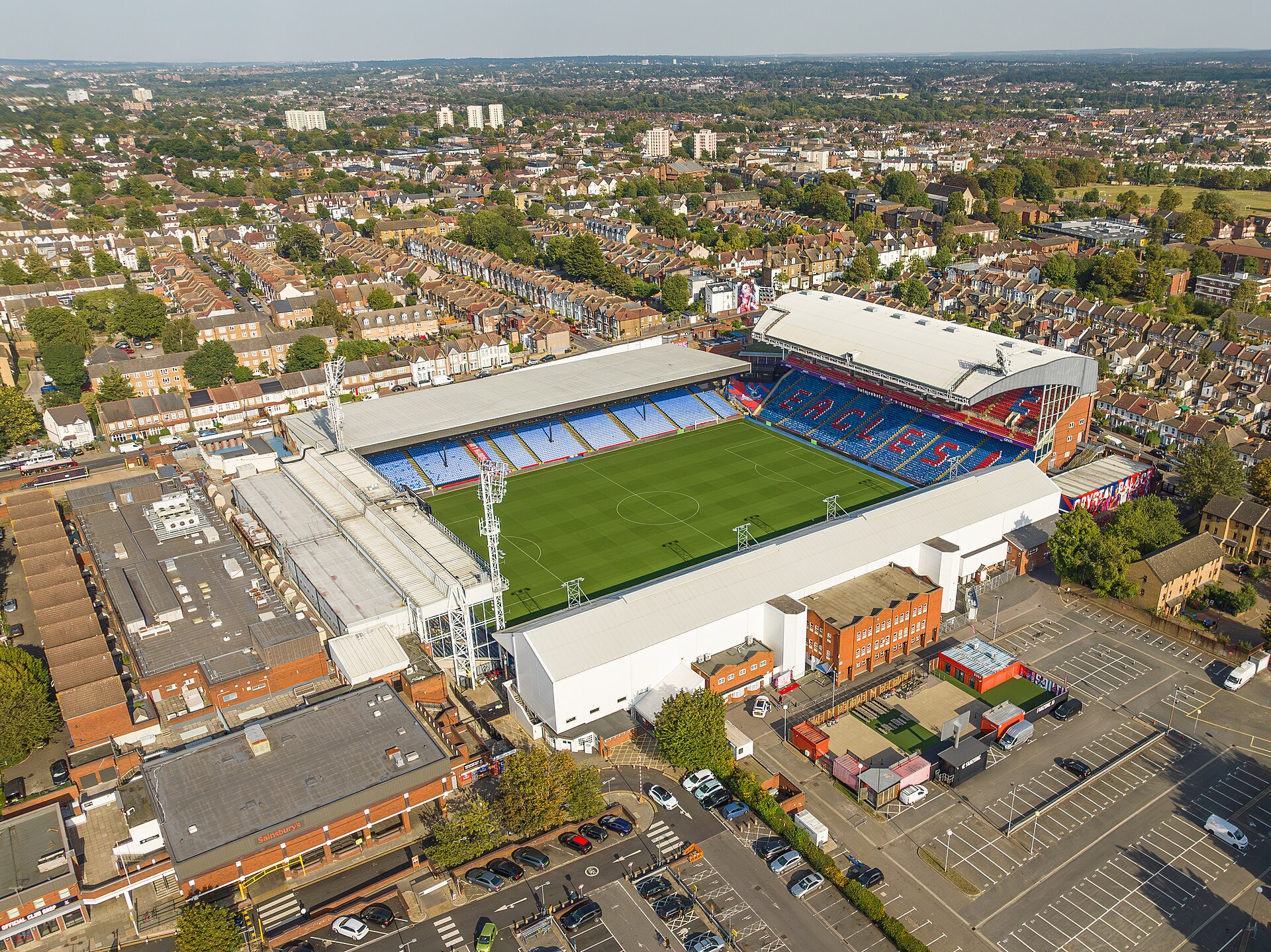
There is no neutral way to watch football at Selhurst Park. The ground sits tight in the terraced streets of South Norwood, four steep stands hemming in a pitch that feels close enough to touch, and when the Holmesdale Fanatics get going — drums, tifos, ninety minutes of wall-to-wall noise — it is one of the most intimidating atmospheres in English football. Crystal Palace are not the biggest club in London, and they have never pretended to be. They are something better: South London's footballing heartbeat, a club built on loyalty, noise and an unshakeable sense of identity. The badge says Eagles. The song says “Glad All Over.” And since May 2025, the honours list says something it never said before: FA Cup winners.
The professional club was born on 10 September 1905, named after the great glass exhibition building of the 1851 Great Exhibition — though football was being played at the Crystal Palace site as far back as 1861, when an amateur Crystal Palace FC contested the first FA Cup. The modern club spent its early decades drifting between divisions, originally known as the Glaziers, until Malcolm Allison's arrival in 1973 brought the most famous rebrand in English football: inspired by Benfica, Allison ditched the old look, adopted the red-and-blue stripes and the eagle, and gave Palace an identity that has endured for half a century.
Palace's golden years arrived under Terry Venables and Steve Coppell in the late 1980s and early 90s. Venables himself had starred in the famous 5-0 thrashing of Manchester United at Selhurst in 1972; as manager, his “Team of the 80s” — young, fearless, famously featuring Ian Wright, who had been signed from non-league Greenwich Borough — played with a swagger that announced Palace as a coming force. Then Steve Coppell's side went further. The 1990 FA Cup final, a 3-3 epic against Manchester United followed by a narrow replay defeat, remains one of Wembley's great occasions, and the following season Palace finished third in the old First Division — still the highest league finish in club history, with Wright, Mark Bright, Geoff Thomas and John Salako at their peak.
The decades after brought the full Palace experience: play-off final triumphs at Wembley in 1989, 1997, 2004 and 2013, financial crises that twice nearly killed the club, and then the Wilfried Zaha era. Zaha, the academy graduate turned talisman, almost single-handedly carried Palace through a decade of Premier League survival after the 2013 promotion — his dribbling, his penalties won, his sheer force of will the difference between staying up and going down, season after season. Selhurst's love for him is unconditional, and it is no accident the club's modern identity was built in his image: brave, skilful, never cowed.
Then came the miracle. Oliver Glasner, appointed in February 2024, turned an honest mid-table side into cup winners. Palace's 2025 FA Cup run was a thing of beauty — 3-0 at Fulham in the quarter-final, 3-0 against Aston Villa in the semi — and the final, on 17 May 2025, was the greatest day in the club's 120-year history. Eberechi Eze swept home Daniel Muñoz's cross in the 16th minute for the only goal; Dean Henderson survived a VAR red-card check for handling outside his area and then saved Omar Marmoush's 36th-minute penalty; Muñoz had a second-half strike chalked off by VAR; and Palace held on to beat Manchester City 1-0 and lift their first-ever major trophy. The open-top bus parade through South London drew hundreds of thousands. A first Community Shield followed in August, and European football — via the Conference League — brought famous nights to SE25.
Change, inevitably, followed glory. Eze departed for Arsenal in the summer of 2025, Glasner's era ended, and in June 2026 the club turned to Pierre Sage to begin the post-Glasner chapter. Sage inherited a squad that still carries the champions' DNA: Henderson, the Wembley hero, in goal; Adam Wharton, the England international metronome who makes Palace tick; Jean-Philippe Mateta, the powerful French striker who remains the focal point of the attack; Ismaila Sarr, whose pace terrifies full-backs; Daniel Muñoz, the marauding Colombian; and shrewd additions in Yeremy Pino, the Spanish playmaker signed from Villarreal, Ben Chilwell, the experienced England left-back, and Axel Disasi, the new defensive anchor brought in to solidify the back line.
The 2026-27 season has been a reality check. Five games in, Palace sit on four points from a possible fifteen: beaten 2-0 at Everton on the opening day, thumped 4-1 at home by Manchester City, then a stirring 3-2 win at Fulham on 5 September that showed what this side can still do — followed by a gutting 3-2 home defeat to Ipswich and a goalless draw at Leeds. The pattern is clear: the defensive solidity of the Glasner years has loosened, and Sage is still searching for the right balance between the counter-attacking identity that won the cup and something more expansive. The underlying numbers are better than the points suggest, but Palace fans know better than anyone that the table doesn’t do style points.
What happens next defines the era. The Holmesdale will keep singing whatever the score; that was never in doubt. The question is whether Sage can turn cup winners into consistent league winners — whether Wharton and Pino can become the creative axis of a top-half side, whether Mateta gets the service his movement deserves, and whether the new defensive unit gels before the winter. The M23 derby with Brighton, across the road in all but geography, still sets the pulse racing like nothing else. And there is a longer project humming beneath it all: the long-promised redevelopment of Selhurst Park's Main Stand, which would finally give this grand old ground the facilities its atmosphere deserves.
Crystal Palace spent 120 years waiting for their moment, and when it came, it came in the most Palace way imaginable: 1-0, backs to the wall, the goalkeeper inspired, the whole of South London bouncing. The task now is to make sure that day at Wembley was a beginning, not an ending. The Eagles have tasted glory. They have no intention of giving it back.
Key Players
Adam Wharton
The midfield metronome; England international and the team's brain.
Jean-Philippe Mateta
Powerful French striker; Palace's main goal threat.
Ismaila Sarr
Blistering Senegalese winger — pace that terrifies defences.
Dean Henderson
FA Cup final hero with the penalty save; a commanding presence.
Axel Disasi
New defensive signing brought in to anchor the back line.
Eddie Nketiah
Sharp finisher offering rotation and goals up front.
Yeremy Pino
Spanish playmaker who threads passes between the lines.
Ben Chilwell
Experienced England left-back adding quality down the flank.
Club Legends
Ian Wright
Started at Palace before becoming an Arsenal and England legend.
Wilfried Zaha
The talisman of the modern era; carried the club for a decade.
Jim Cannon
Record appearance holder (663 games); the rock of the late-70s sides.
Peter Simpson
Club-record scorer with 165 goals in the 1930s.
Geoff Thomas
Captain and midfield heart of the early-90s peak.