Results
The Story of Manchester City
City began life in 1880 as St Mark's, a church team from West Gorton, became Ardwick in 1887 and took the name Manchester City in 1894. Their first golden age came under Joe Mercer and Malcolm Allison in the late 1960s: the league title in 1968, the FA Cup in 1969, then the League Cup and European Cup Winners' Cup in 1970. The sky-blue shirts and the 'Blue Moon' anthem date back through all of it.
Then came the fall: the 1981 FA Cup final defeat, relegations, and the humiliation of dropping to the third tier in 1998 — while Manchester United ruled the world across town. The 2008 Abu Dhabi takeover changed everything. Roberto Mancini's side won the league in 2012 with Sergio Agüero's 93:20 winner against QPR, the most dramatic title decider in English history. Then Pep Guardiola arrived in 2016 and built a machine: a 100-point season, a domestic treble, the 2023 continental treble, and four straight titles.
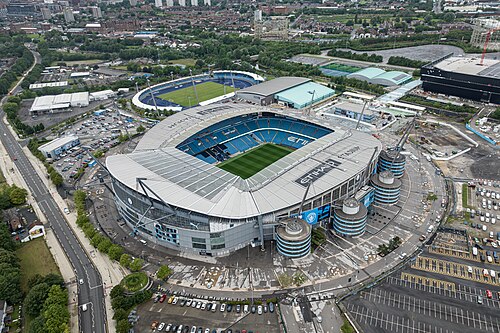
Today City are the benchmark of the modern game — elite facilities, a global football group, and the expanded Etihad holding over 61,000. The Guardiola decade ended with 20 major honours, and Enzo Maresca now leads the post-Pep era with a record-breaking squad rebuild. Erling Haaland's goals, a production line of technically perfect footballers, and the lingering question every season asks: can anyone actually stop them?
City began life in 1880 as St Mark’s, a church team from West Gorton, became Ardwick in 1887 and took the name Manchester City in 1894 — and the first golden age arrived under Joe Mercer and Malcolm Allison in the late 1960s. With Colin Bell, Francis Lee and Mike Summerbee, City won the league in 1968, the FA Cup in 1969, and then the League Cup and European Cup Winners’ Cup in 1970. The sky-blue shirts and the ‘Blue Moon’ anthem — borrowed from the musical stage and sung, mournfully and joyfully, ever since — date back through all of it. What followed was one of English football’s great falls: the 1981 FA Cup final replay defeat to Tottenham, relegation on the final day in 1983, and then the humiliation of 1998, when City dropped into the third tier while Manchester United ruled the world across town. The comeback began in the most City way imaginable — 2-0 down to Gillingham in the 1999 play-off final, saved by Paul Dickov in the 95th minute and won on penalties at Wembley — and Kevin Keegan’s swashbuckling side stormed back to the top flight in 2001-02.
The 2008 Abu Dhabi takeover changed everything, but the modern mythology was written in moments. Yaya Touré’s semi-final and final goals delivered the 2011 FA Cup, the club’s first major trophy in 35 years. Then came 13 May 2012: 93 minutes and 20 seconds, Sergio Agüero against QPR, the most dramatic title decider in English history and the goal that made City champions for the first time in 44 years. Manuel Pellegrini added another title in 2014, and then Pep Guardiola arrived in 2016 and built the machine. A 100-point season in 2017-18. A domestic treble in 2018-19. The 2023 continental treble, sealed against Inter in Istanbul, completing the set. Four consecutive league titles from 2021 to 2024. Twenty major honours across the Guardiola decade — a body of work that changed how football is played in England, and made City the benchmark of the modern game.
The post-Pep era is now the story, and Enzo Maresca — Guardiola’s former assistant, who knows the City way from the inside — is the man charged with proving the machine outlives its maker. The turnover has been sweeping: Rodri and Bernardo Silva, pillars of the great sides, have departed, along with Tijjani Reijnders. The rebuild has been record-breaking. Enzo Fernández arrived on deadline day from Chelsea for a British record-equalling £125 million, reuniting with Maresca, under whom he wore the armband 43 times at Stamford Bridge. The new leadership group tells the story of the transition: Rúben Dias as captain, with Erling Haaland, Marc Guéhi — the January arrival from Crystal Palace — and Gianluigi Donnarumma, the Italy captain signed from Paris Saint-Germain, forming the four-man group. Elliot Anderson came from Nottingham Forest and Iliman Ndiaye from Everton for £65 million, while Jack Grealish went the other way to Everton on loan for a second straight season.
And the machine, so far, is purring. Five games, five wins, fifteen points — City are the only side in the division with a perfect record after Arsenal’s shock defeat at Brighton, and they already sit three points clear at the top. Erling Haaland has five in five to open the campaign, and his late strike against Sunderland means he has now scored against all 25 Premier League sides he has faced — a ridiculous record for a striker still in his mid-twenties, with three Golden Boots and counting. The 5-3 thriller against Sunderland was the game of the season so far: Fernández’s free-kick opened the scoring on his first start, Rayan Cherki danced through for another — the Frenchman already has three goals and two assists — Antoine Semenyo struck twice, and Haaland applied the seal. Joško Gvardiol continues to defend like a winger and score like one, Phil Foden remains the academy jewel at the creative heart, and Donnarumma’s giant frame has given the back line a new authority.
The deeper identity of this club is the journey: the 30,000 who filled Maine Road in the third tier, the fans who never left, now filling an expanded Etihad past 61,000 and watching a global football group’s flagship. The question every season asks is the same — can anyone actually stop them? — and this season the question has a new edge: can the post-Guardiola City keep setting the standard while half the squad is new? Maresca has the dressing room’s backing; his players were asking him for days whether Fernández was really coming. “He’s a winner,” Maresca said of his record signing, “and when you belong to a squad and another winner arrives they are always happy.” Five from five suggests the winners have found each other quickly. The title race, the Champions League, the cups — the expectation at the Etihad is all of it, every year, and this rebuilt side is being asked to prove the era didn’t end with Pep.
Key Players
Erling Haaland
The goal machine — 5 in 5 to open the campaign; three Golden Boots and counting.
Phil Foden
The Stockport Iniesta; City's academy jewel and the creative heartbeat.
Rúben Dias
The captain — granite at the back and the dressing room's enforcer.
Joško Gvardiol
A defender who plays like a winger; already with goals and assists this term.
Gianluigi Donnarumma
The new number one — a giant with a Champions League-winning pedigree.
Rayan Cherki
French magic: 3 goals and 2 assists early on; pure street footballer.
Marc Guéhi
England's defensive leader, signed to anchor the new-look back line.
Enzo Fernández
World Cup winner pulling the strings — the record signing running the midfield.
Club Legends
Sergio Agüero
93:20 — the goal that won the 2012 title and the club's record scorer with 260.
Vincent Kompany
The captain of the modern era; four titles and the thunderbolt against Leicester.
David Silva
El Mago — a decade of genius, the most elegant player in club history.
Yaya Touré
The Wembley-winning colossus of 2011; drove City's first great team.
Kevin De Bruyne
The greatest passer of the Premier League era; the assist king.