Results
The Story of Sunderland
Founded in 1879, Sunderland were one of Victorian football's superpowers — the 'Team of All the Talents' that won six league titles between 1892 and 1936. The club's most romantic moment came in 1973, when second-tier Sunderland beat Don Revie's mighty Leeds United in the FA Cup final, one of the competition's greatest-ever upsets.
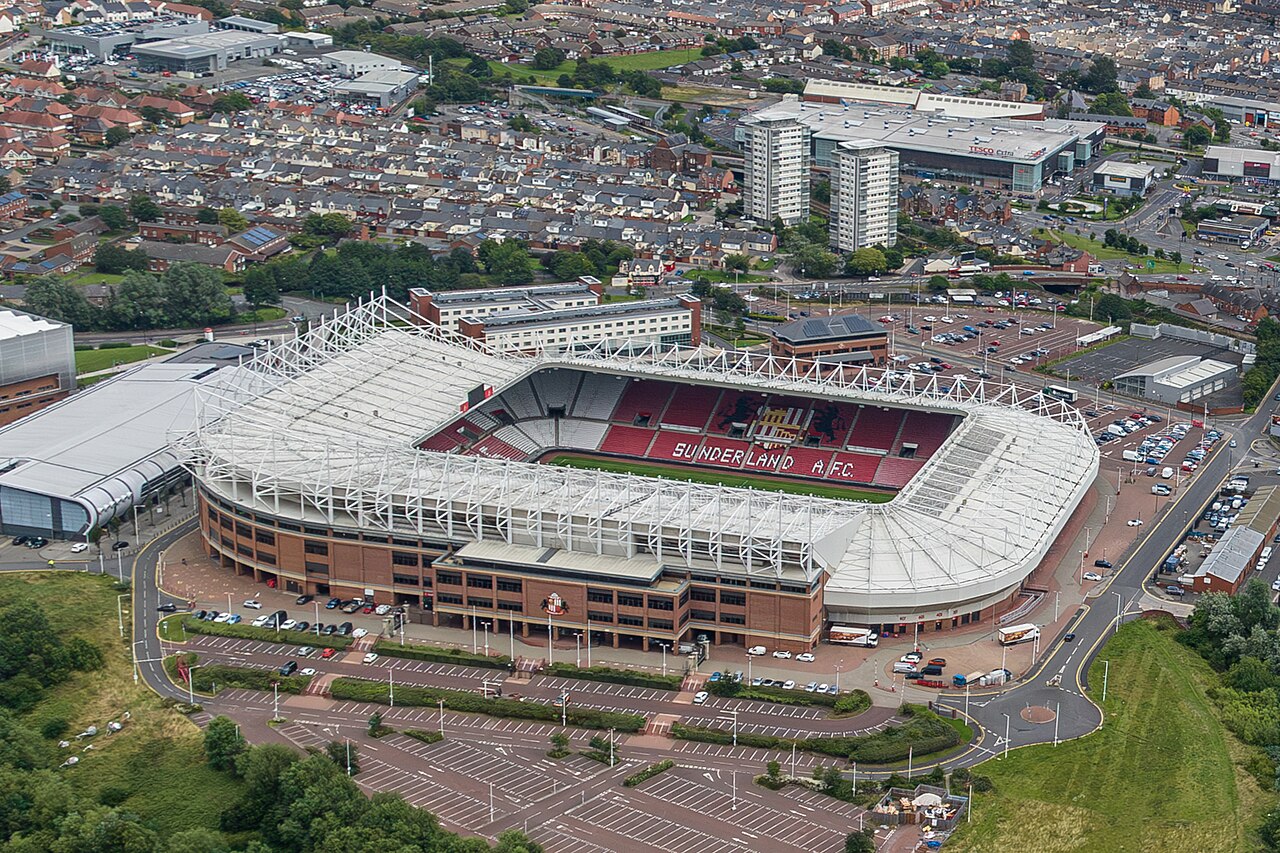
The Stadium of Light opened in 1997 on the site of the old Monkwearmouth Colliery, and the early Premier League years brought back-to-back seventh-place finishes. But the modern era is defined by the fall: relegations in 2017 and 2018 sent the club to the third tier, a saga immortalised in Netflix's 'Sunderland 'Til I Die' — while the fans kept filling the stadium anyway.
The resurrection is the story now: a stoppage-time Wembley winner against Sheffield United sealed the 2025 play-off final and a return to the Premier League after eight years, and Le Bris's young side immediately finished seventh and reached Europe. The identity is pure Wearside — industrial pride, red-and-white stripes, and a fanbase whose loyalty through the dark years became the club's legend.
Founded in 1879, Sunderland were one of Victorian football’s genuine superpowers — the ‘Team of All the Talents’ that won six league titles between 1892 and 1936, with Raich Carter’s genius and Bobby Gurney’s record goalscoring leading the all-conquering sides of the 1930s. But the club’s most romantic moment came long after the titles dried up: the 1973 FA Cup final, when second-tier Sunderland faced Don Revie’s mighty Leeds United — one of the great club sides England has produced — and beat them. Ian Porterfield’s 31st-minute volley won it; Jim Montgomery’s impossible double save, clawing out Trevor Cherry’s header and then somehow blocking Peter Lorimer’s follow-up on the line, sealed it. It remains one of the FA Cup’s greatest-ever upsets. The triumph carried Sunderland into the Cup Winners’ Cup the following season, where they beat Vasas Budapest before falling narrowly to Sporting Lisbon — and nobody on Wearside could have known it would be 53 years before the club played in Europe again.
The modern era, for a long time, was defined by the fall. The early Premier League years under Peter Reid brought back-to-back seventh-place finishes and Kevin Phillips’s 30-goal Golden Boot season in 2000; Niall Quinn’s towering presence carried the turn-of-the-century revival. But relegations in 2017 and 2018 sent the club tumbling into League One, and the saga was immortalised in Netflix’s ‘Sunderland ’Til I Die’ — the documentary that made the club’s suffering famous worldwide, while the fans kept filling the Stadium of Light anyway, 30,000-plus in the third tier, a loyalty that became the club’s legend in itself. Kyril Louis-Dreyfus’s takeover steadied the finances, the data-driven recruitment model started unearthing gems, and the climb began: promotion from League One in 2022, consolidation, and then May 2025 — Wembley, the Championship play-off final against Sheffield United. Tyrese Campbell’s 25th-minute opener had the Blades dreaming; Eliezer Mayenda thundered home with fourteen minutes left; and deep into stoppage time, Tommy Watson — about to leave for Brighton, jeered by some — fizzed home the winner that ended eight years of exile and sent Sunderland back to the Premier League.
What happened next defied every newly-promoted script. Instead of a relegation battle, Régis Le Bris’s young side finished seventh in the Premier League last season — and seventh meant the Europa League, meant Wednesday nights under the lights, meant the end of the 53-year wait. On 16 September 2026, roared on by nearly 45,000 at the Stadium of Light, Sunderland beat AZ Alkmaar 1-0: Enzo Le Fée, brought down at the end of a counter-attack, rolling home the 66th-minute penalty — making amends for his missed spot-kick against Arsenal days earlier — while Robin Roefs made crucial saves, including an early stop to deny Kees Smit, and Kevin Danso, Nordi Mukiele and Dan Ballard threw themselves at everything. “It means everything,” said Trai Hume afterwards. “If you had asked me five years ago would I be here, I would have said no.” The first European victory since 1973 — and, quietly, a €450,000 UEFA win bonus to start the continental account moving, with seven league-phase games still to come through January 2027.
The league campaign has been the harder watch: one win, one draw, three defeats, four points — but it has already produced the individual performance of the Premier League season. On 20 September at the Etihad, Brian Brobbey scored a hat-trick in a 5-3 defeat to Manchester City: the fifth losing-side treble in Premier League history and the first since Roque Santa Cruz in 2007, only the third away hat-trick at City ever — after Michael Owen in 2002-03 and Jamie Vardy in 2020-21 — and the first treble at the Etihad since Vardy in September 2020. The Dutchman, the club’s top scorer since promotion, left Manchester with his head high and his confidence restored. Around him, the spine is pure Le Bris: Granit Xhaka, the club captain and veteran marshal whose experience runs the midfield; Le Fée the creative spark; Ballard, whose dramatic extra-time goal beat Coventry in the play-off semi-final, and Hume the Northern Ireland defensive mainstays; Habib Diarra’s box-to-box energy; Wilson Isidor’s knack for the decisive moment; and Malick Fofana, the £30 million summer arrival from Lyon, the electric winger of the next wave.
The identity is pure Wearside — industrial pride, red-and-white stripes, the Roker Roar reborn in a new home on the old Monkwearmouth Colliery site — and right now it is English football’s best story: from League One to European football inside four seasons, a trajectory that simply does not happen. The challenge now is the Thursday-Sunday balancing act that breaks so many first-time European sides: keeping the league points ticking while chasing the knockout rounds, keeping Brobbey’s new confidence burning, keeping the young squad’s legs under them. But whatever happens from here, this season is already historic — the night the Stadium of Light hosted Europe again, the night a Sunderland striker scored three at the Etihad, the season the Black Cats stopped being a cautionary tale and became the fairytale. “We showed up to win,” Le Bris said after the AZ game. On Wearside, they’re starting to believe that’s just what this team does.
Key Players
Brian Brobbey
No. 9 and the club's top scorer since promotion (10 goals); smashed a Premier League hat-trick away at Manchester City in September 2026.
Granit Xhaka
Club captain and the veteran marshal; his experience runs the midfield.
Enzo Le Fee
The creative spark — scored the penalty that delivered Sunderland's first-ever European win, over AZ Alkmaar.
Wilson Isidor
Haitian forward with a knack for the decisive moment; match-winner against Fulham.
Habib Diarra
Dynamic Senegalese midfielder; box-to-box energy when fit.
Trai Hume
Northern Ireland full-back; a defensive mainstay of the promotion side.
Dan Ballard
Northern Ireland centre-back whose dramatic extra-time goal beat Coventry in the 2025 play-off semi-final.
Malick Fofana
£30m summer signing from Lyon; the electric young winger of the next wave.
Club Legends
Raich Carter
The inside-forward genius of the 1936 title side; one of England's greatest never to win a World Cup.
Bobby Gurney
Club's record goalscorer; the finisher of the all-conquering 1930s teams.
Kevin Phillips
Won the Premier League Golden Boot in 2000 with 30 goals; the last Englishman to do it for decades.
Niall Quinn
Irish striker and later chairman; the towering figure of the turn-of-the-century revival.
Jim Montgomery
Goalkeeper whose impossible double save won the 1973 FA Cup final.