
Few programs in college basketball carry the weight that Cincinnati does. The Bearcats are back-to-back national champions — 1961 and 1962 — and those banners hanging in Fifth Third Arena are not decoration. They are the standard, the expectation, the thing every Cincinnati team is measured against. For more than sixty years, Bearcats basketball has meant the same things: defense, toughness, and an almost pathological refusal to be outworked.
It started with the Big O. Oscar Robertson played at Cincinnati from 1957 to 1960 and remains the most transformative player in program history — a three-time national player of the year who led the nation in scoring in each of his three varsity seasons and averaged 33.8 points per game for his career. Robertson never won a national title himself, but he turned Cincinnati from a regional program into a national power, and the championships that arrived the two seasons after he left were the culmination of everything he built.
The titles came under George Smith, and they came against the same team. In 1961, Cincinnati beat Ohio State 70-65 in overtime in an all-Ohio national final; in 1962, the Bearcats beat the Buckeyes again, 71-59, to go back-to-back. Paul Hogue, Tom Thacker and that relentless Cincinnati defense did something only a handful of programs in history have ever done: win consecutive national championships. The 1963 team nearly made it three straight, falling in the title game. The early 1960s belonged to Cincinnati the way few eras have belonged to anyone.
The decades that followed were strong but title-less, and the banners stayed frozen in the early ’60s while the sport changed around them. Then came Bob Huggins, and with him the modern golden age. From 1989 to 2005, Huggins built the team nobody wanted to play: pressing, physical, nasty, brilliantly coached. The 1992 team reached the Final Four, falling to Michigan’s Fab Five in the national semifinal, and announced Cincinnati’s return to the elite. Huggins went 399-127 in Clifton with 14 consecutive NCAA Tournament appearances, and his rosters read like a roll call of toughness — Nick Van Exel, Corie Blount, Danny Fortson, Ruben Patterson, Steve Logan, and Kenyon Martin, the No. 1 overall pick in the 2000 NBA Draft, whose broken leg in the Conference USA tournament shattered what might have been a title run.
Mick Cronin rebuilt the program from the post-Huggins rubble starting in 2006 and kept the toughness intact, modernizing the defense and ripping off nine straight NCAA Tournament appearances from 2011 to 2019. The 2018 team won the American Athletic Conference regular-season and tournament titles and earned a No. 2 seed. The tournament streaks of the Cronin years kept the program dancing deep into the 2010s, and the identity never wavered: Cincinnati was still the team that would make you bleed for every basket.
The Big 12 move in 2023 was the program’s arrival among the elite. Cincinnati now battles Kansas, Houston, Baylor, Arizona and the rest of the sport’s deepest league on a nightly basis, and the Bearcats’ defensive identity fits the conference’s wars perfectly. The step up in competition has been unforgiving — there are no nights off in this league — but it is also where a program with Cincinnati’s history believes it belongs.
The 2025-26 season was Wes Miller’s fifth in Clifton, and the Bearcats were picked eighth in the Big 12 preseason coaches’ poll. The frontcourt carried them. Baba Miller, the 6-foot-11 Spaniard, earned Second-Team All-Big 12 and a spot on the Big 12 Newcomer Team while leading Cincinnati in points (13.4), rebounds (10.1) and assists (3.6) per game — the first Bearcat to lead the team in all three categories since Oscar Robertson himself in 1959-60. His running mate, 7-foot-2 sophomore Moustapha Thiam, posted 12.6 points and 6.7 rebounds a night with a team-high 1.5 blocks and earned honorable-mention all-conference honors. Around them: Day Day Thomas, Jalen Celestine, Jalen Haynes, Estonian sharpshooter Kerr Kriisa and freshman Shon Abaev. It was a team built the Cincinnati way — long, physical, and mean on the glass.
The 2026-27 season marks a new chapter. After the 2025-26 campaign, the program turned to Jerrod Calhoun, the former Utah State and Youngstown State head coach who arrived in Clifton fresh off a 29-7 Mountain West championship season and an NCAA Tournament win over Villanova. Calhoun brought a dozen transfers with him — including four of his Aggies, MJ Collins, Adlan Elamin, Elijah Perryman and David Iweze — in a portal class that 247Sports ranked fourth in the Big 12 and 23rd nationally. Elamin, the 6-foot-9 forward, immediately stepped into a leadership role, preaching the details of Calhoun’s system to a remade roster. A new era in Cincinnati, built the modern way.
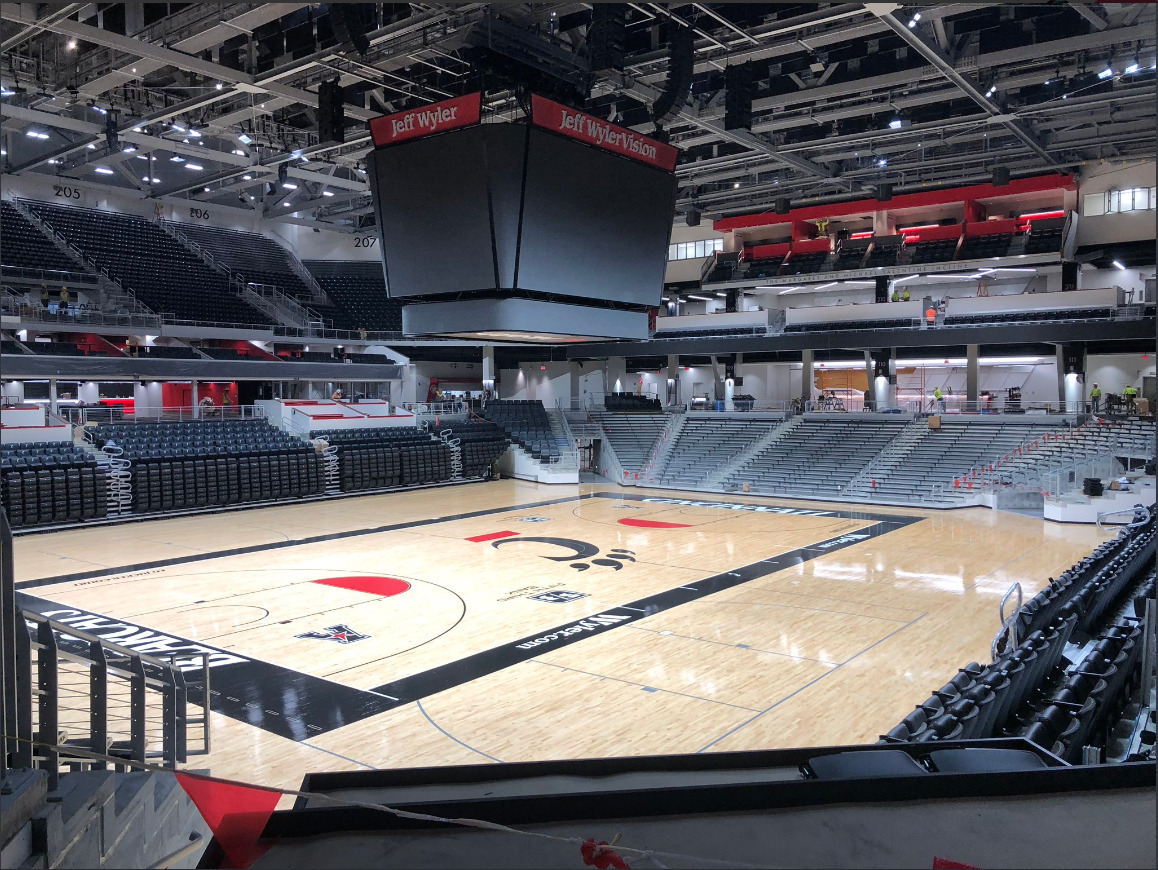
Through every era, the constants have held. Fifth Third Arena — 12,000 seats on campus, renovated into one of the sport’s great venues — is deafening when the Bearcats are rolling, and the student section’s intensity is the stuff of legend. And then there is the Crosstown Shootout: Cincinnati vs. Xavier, played since 1927, one of the fiercest and most personal rivalries in all of college basketball. The city stops for it. The building shakes for it.
What defines Cincinnati is the through-line from 1961 to today: consecutive national titles, Robertson’s brilliance, Huggins’s pressing monsters, Cronin’s relentless tournament teams, and an arena that roars when it matters. The 1961-62 banners watch over it all — the standard, the history, the mission. In Cincinnati, basketball history isn’t nostalgia. It’s the job description. And the next banner is the only one that matters.


