Two seasons ago, Dartmouth men’s basketball did something it hadn’t done in this century: it won. The Big Green’s 2024–25 campaign — 14–14 overall, 8–6 in the Ivy, third place, the program’s first-ever Ivy Madness appearance — was the breakthrough that a decade of patience in Hanover had been building toward. Head coach David McLaughlin and his staff were named the Ivy League Coaching Staff of the Year. Then came the harder part: proving it wasn’t a one-year wonder. The 2025–26 season (11–16, 5–9, fifth) had flashes of the new Dartmouth and reminders of the old one. Now, entering McLaughlin’s tenth season in 2026–27, the Big Green are playing for something bigger than a tournament bid. They’re playing to make winning the identity.
The turnaround started with a mirror. After a 6–21 season and a last-place Ivy finish in 2023–24, McLaughlin and his staff spent the summer doing what he called a deep dive “on both sides of the ball and all aspects of the program.” What emerged was a 180-degree stylistic flip: Dartmouth had ranked in the 200s and 300s nationally in tempo for years; in 2024–25 the Big Green ranked 34th in the country in pace. Faster, more aggressive, more joyful — and it worked immediately. Dartmouth opened Ivy play 6–3 for the first time since the 20th century, blitzed Cornell 88–49 behind a 24–4 opening run, and sat alone in second place in February. The program’s core values — “Be A Pro”: Belief, Excellence, Accountability, Positivity, Relationships, Ownership — finally had a style to match the slogan.
The faces of the breakthrough were Ryan Cornish ’25, a First Team All-Ivy guard, and forward Brandon Mitchell-Day, Second Team All-Ivy — the first Dartmouth duo to earn first- and second-team honors in the same season since 1998–99. Add Jackson Munro’s Academic All-Ivy two-way play, and the Big Green had a legitimate core. That trio carried Dartmouth to its first winning conference record this century and its first Ivy League Tournament berth. For a program whose modern history had been defined by near-misses and 5–23 winters, it was validation — for McLaughlin, for the staff, and for a style change that plenty of people had questioned.
The encore season was bumpier, as encore seasons after breakthroughs usually are. With Cornish graduated, the 2025–26 Big Green started 0–2 with an ugly 75–56 home loss to Marist, then steadied: a 69–68 escape against in-state rival New Hampshire on Kareem Thomas’ runner with 5.5 seconds left, and then a genuinely historic Ivy opening weekend — road wins at Harvard and Cornell to start 2–0 in league play, the first time Dartmouth had opened conference play with two straight road wins since the 1959–60 season. For a weekend in January, the magic was back.
The season’s signature night came in Gainesville. Dartmouth traveled to face Florida — the defending 2025 national champions — and while the final score went the Gators’ way, the Big Green hung 72 points on them, including 45 in the second half: the second-most points any opponent had scored in a half against Florida to that point in the season, and the most by a non-power-conference opponent in years. Mitchell-Day, in his senior season, became the 33rd player in program history to surpass 1,000 career points and earned All-Ivy Honorable Mention. It wasn’t the season anyone drew up — 11–16, fifth place, no Ivy Madness return — but it wasn’t a collapse either. It was a young team learning what the standard costs.
And the youth is the story now. Thomas, who barely played as a freshman and by year’s end was the guy everyone in Leede Arena knew would get the ball on the final possession — coaches included — is the program’s most exciting young guard in years. Sophomore Connor Amundsen fought through an injury-delayed start to become a double-figure scorer (16 points in the season finale against Yale). Jayden Williams earned a captaincy as an underclassman. Munro’s leadership bridges the breakthrough team and whatever comes next. With Cornish and Mitchell-Day graduated, the 2026–27 Big Green will go as far as Thomas, Amundsen and Williams take them — and McLaughlin’s staff has shown it can develop guards.
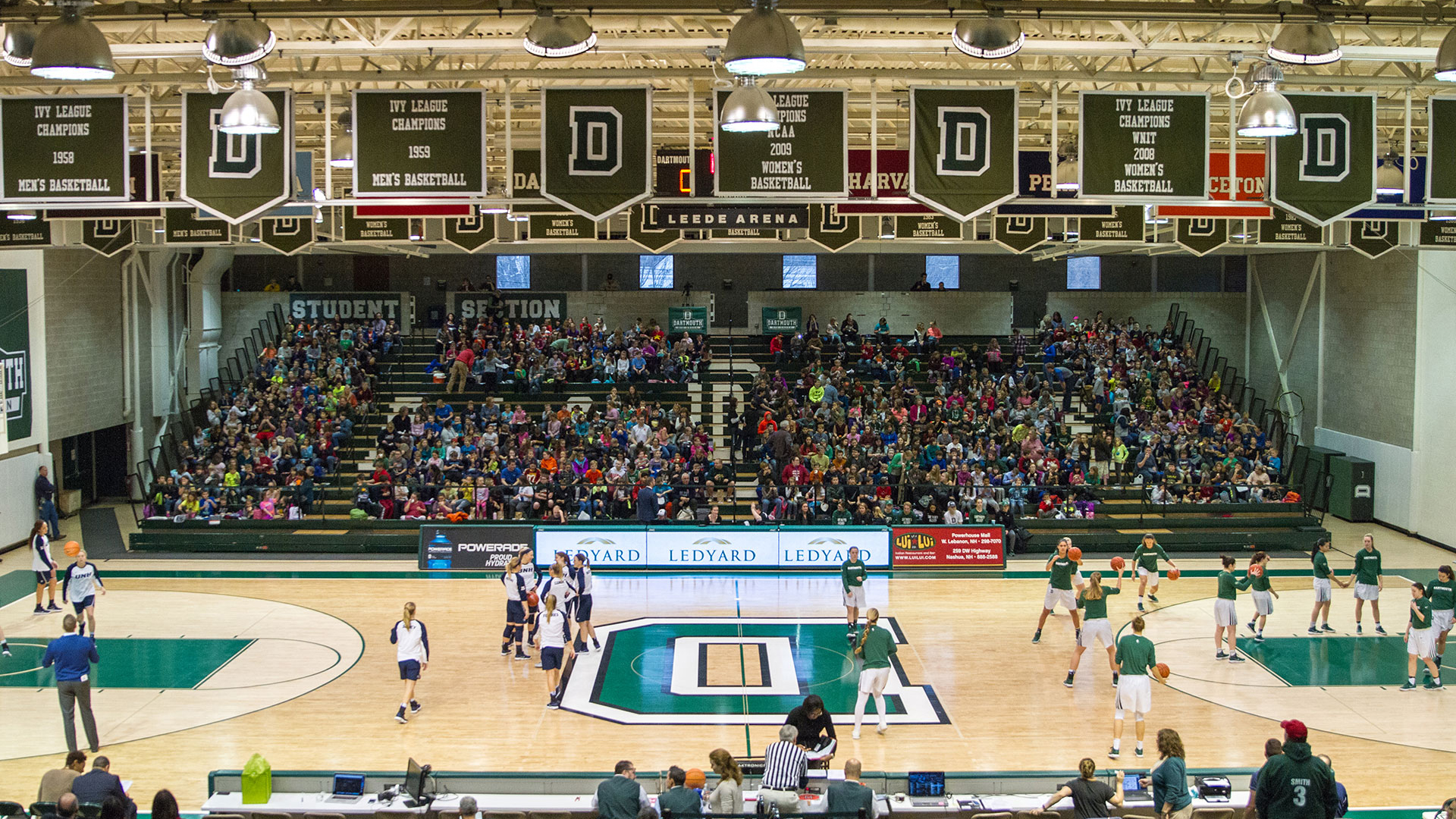
The history hanging over all of it is older than anyone in the building. Dartmouth played in the national championship game twice — 1942 and 1944 — and made five NCAA Tournament appearances between 1941 and 1958, with stars like NBA All-Star Rudy LaRusso. Then the program went quiet for more than half a century while the Ivy’s balance of power shifted to Penn, Princeton and now Yale. McLaughlin’s project has always been about more than one good winter: it’s about making Hanover a place where basketball matters again, where Leede Arena is full in February, where the “Be A Pro” standard produces pros on the court.
Year ten is the referendum. The style is installed, the culture is real, and the 2024–25 breakthrough proved the ceiling is higher than anyone thought. But the Ivy doesn’t wait — Yale, Cornell and Columbia are all building, and fifth place doesn’t get you to March. The Big Green have the coach, the system and the young talent. What they need now is the thing that turned 2024–25 from a nice story into a program: a February where everything clicks, and a second Ivy Madness banner to hang next to the first.