Darian DeVries' first season in Bloomington was an education. The Hoosiers finished 18-14 and 9-11 in the Big Ten — picked tenth, finished tenth — and missed the NCAA Tournament for the third consecutive season, extending a drought that stretches back to Mike Woodson's 2023 team. Six of the top seven scorers ran out of eligibility, the portal class that was supposed to fix everything underwhelmed, and the offseason question was blunt: could DeVries build a winner fast enough in the sport's most impatient program? His answer came in April.
It came with Ryan Carr. The former Indiana Pacers executive left the NBA in February to become the program's executive director of basketball, and his first portal cycle was a clinic: beginning with Jaeden Mustaf's commitment on April 13, Indiana landed six transfers in a furious few days — Mustaf from Georgia Tech, Markus Burton from Notre Dame, Darren Harris from Duke, Samet Yigitoglu from SMU, Aiden Sherrell from Alabama, and Bryce Lindsay from Villanova. The class ranked No. 4 in the country by 247Sports, trailing only Louisville, Texas, and Tennessee.
Markus Burton is the headliner. The redshirt junior point guard was one of the top scorers in the ACC over three seasons at Notre Dame, leading the league with 21.3 points per game as a sophomore in 2024-25, and he arrived in Bloomington ranked the No. 24 overall player and No. 7 point guard in the portal. At the Cream and Crimson scrimmage in early October, Burton was the unquestioned on-ball leader — comfortable using his voice, and, crucially, showing no signs of forcing his offense after being asked to carry so much at Notre Dame.
The shooting is the story around him. Darren Harris, the 6-foot-5 Duke transfer, was regarded as one of the best shooters in the country coming out of high school and looked every bit of it in the scrimmage — the touch is real, the defense is active, and he'll likely start on the wing. Bryce Lindsay spent a season each at Texas A&M, James Madison, and Villanova and brings a career 37.7 percent three-point stroke; nearly two-thirds of his career attempts have come from deep, which is exactly the volume DeVries' spacing-heavy offense needs.
Up front, Indiana finally has size — and choices. Sam Alexis, who was thought to be out of eligibility, secured a fifth year through a recent court decision and immediately pushed SMU transfer Samet Yigitoglu for the starting center spot; the staff believes all three primary bigs — Alexis, Yigitoglu, and Alabama transfer Aiden Sherrell — can play together in two-big lineups. Matchups, the scrimmage made clear, won't be Indiana's problem this winter.
Trent Sisley is the bridge. The sophomore forward averaged 4.2 points and 2.8 rebounds in 13 minutes a game as a freshman and is the program's only confirmed returning scholarship player — the lone thread connecting this team to last year's roster. Around him is a four-man freshman class: 7-foot center Clemens Sokolov, 6-foot-8 forwards Vaughn Karvala and Trevor Manhertz, and guard Prince-Alexander Moody. Manhertz shone at the FISU America Games this summer; Karvala was held out of the scrimmage with a precautionary lower-body injury. Walk-on Ben Winker, a 6-foot-10 St. Louis native from Cal State Fullerton, completes the 16-man roster.
Year two is about proving the portal machine works. DeVries' first class — ranked No. 10 nationally — still missed the tournament, and the lessons were applied immediately: this cycle prioritized proven shot-making, lineup versatility, and roster continuity, with nearly every newcomer carrying multiple years of eligibility. If it clicks, the turnaround could echo Dusty May's Michigan or the reload Brad Underwood engineered at Illinois.
The history hangs over all of it. Indiana is a five-time national champion — 1940, 1953, 1976, 1981, 1987 — and the 1976 team's 32-0 perfection remains the last undefeated championship in men's basketball, half a century unmatched. Bob Knight's three decades (1971-2000) produced the motion offense and the sport's most famous coaching figure; Isiah Thomas carried the 1981 title, and Keith Smart's baseline jumper beat Syracuse in 1987. Branch McCracken's Hurryin' Hoosiers built the foundation; Mike Davis's 2002 team made the program's last title-game appearance.
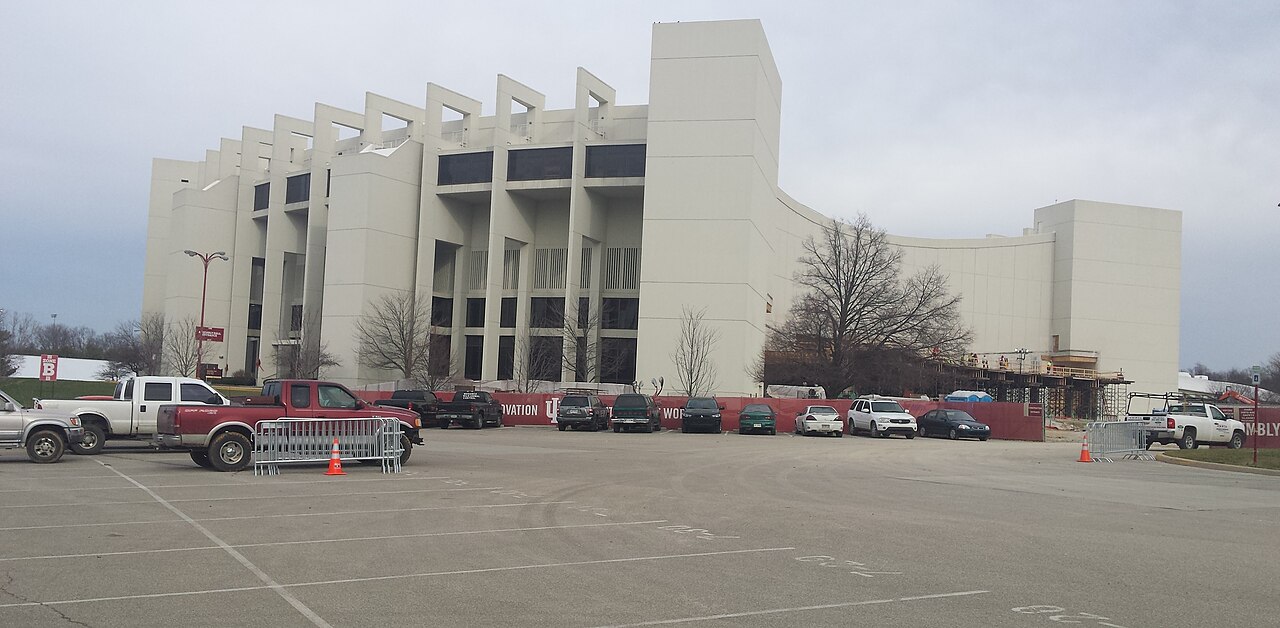
Simon Skjodt Assembly Hall is the cathedral — more than 17,000 strong, where the banners overwhelm visitors and the noise is the sport's standard. The rivalry with Purdue is the Big Ten's fiercest, and the annual wars with Illinois, Michigan State, and Michigan define every winter in Bloomington.
The 2026-27 season is the proving ground: a remade roster, a second-year coach, and a fanbase that has waited three years for March. The pieces are better this time — a true lead guard, real shooting, real size, and a front office built for the portal era. The ceiling is a tournament team that can scare anyone; the floor is another year of waiting.
What defines Indiana right now is urgency: the banners demand more than potential, and DeVries knows the clock is real. The portal class gave him the talent; the scrimmage gave him the first glimpse. The sixth banner is the mission — and this is the season Indiana has to start chasing it for real.
Recruiting the future is already underway alongside the present: nearly every newcomer carries two years of eligibility, and the freshman class was hand-picked for DeVries' system — length, shooting, and defensive switchability. The program's bet is that continuity plus talent finally breaks the drought, and that Bloomington's famously thin patience is rewarded with a March that matters.


