In Lynchburg, Virginia, the Liberty Flames have turned faith, discipline and an unforgiving brand of defense into one of the great mid-major programs in America. Liberty University — the world's largest Christian university — built its basketball identity under head coach Ritchie McKay into something unmistakable: a pack-line defense that suffocates, a precision offense that never rushes, and a roster of high-character players who treat every possession like it matters. After more than a decade of that formula, the Flames are no longer anybody's secret.
March 2019 is the program's immortal moment. As a 12 seed in the NCAA Tournament, Liberty stunned fifth-seeded Mississippi State 80-76 for the first NCAA Tournament win in program history, announcing the Flames to America in the loudest way possible. The nation watched a team nobody had picked turn the bracket's biggest stage into a showcase for everything McKay had built: belief, toughness, and a refusal to blink. Two days later the Flames battled Virginia Tech in the second round, and though the run ended there, Lynchburg had its scripture.
The season that followed may have been even better. The 2019-20 Flames ripped off a program-record 30 victories, finishing 30-2 with the ASUN's best team in a generation — a squad that never got its March moment when the pandemic canceled the postseason. Liberty then completed a three-peat of ASUN tournament championships in 2021, returning to the NCAA Tournament and cementing the most dominant run the conference had ever seen: five straight ASUN regular-season crowns from 2019 through 2023.
Darius McGhee gave the program its modern individual peak. The electrifying guard stacked ASUN Player of the Year honors and authored scoring explosions that made Liberty appointment television, carrying the Flames' late-ASUN-era swagger. His brilliance set the standard every Flame since has chased — and proved a program with Liberty's values could produce a star as loud as anyone's.
The move to Conference USA in July 2023 was the next test: bigger stages, new rivals, a league that demanded the program grow up fast. The Flames didn't blink. Liberty captured the 2025 CUSA tournament championship, punching its ticket to the NCAA Tournament — where it fell to Oregon in Seattle — and then owned the league in 2025-26: 26-8 overall, 17-3 in CUSA, a second consecutive regular-season title won by four games, and a program-record 17 straight victories from December 16 through February 19. The season ended in the NIT, but the message was clear: the league belongs to Lynchburg now.
McKay's staying power is the program's foundation. In the spring of 2026, Liberty extended the winningest coach in program history through the 2031-32 season — a reward for a 2025-26 campaign in which he was named CUSA's Gene Bartow Co-Coach of the Year, his fourth career conference coach of the year honor, and a finalist for the Jim Phelan, Hugh Durham and Ben Jobe national coaching awards. He's won 298 games across 13 seasons in Lynchburg, surrounded by a trusted staff that includes associate head coach Derek Johnston and assistants Stephen Burggraf, Kyle Rode, Zach Farquhar and Chris Rogers.
The numbers behind the era are staggering. Liberty's all-time record stands at 867-780, and over the last eight seasons the Flames have won 203 games — tied for the sixth most in the nation — with a .755 winning percentage that ranks fourth among all Division I teams. Nine of the last ten seasons have produced 20 or more wins, five with at least 25. The program's 11 conference titles over that span are tied for the most in the country. And the Flames have beaten nine Power 4 or high-major opponents in the last eight seasons, most recently toppling Kansas State in the 2024 Paradise Jam semifinals before winning the tournament title over a 30-win McNeese team.
The identity travels. The pack-line principles — gap discipline, contested everything, no easy baskets — make Liberty dangerous in any gym against any opponent. The offense is deliberate and surgical: extra passes, backdoor cuts, a floor spaced for shooters who rarely take a bad one. Opponents know exactly what's coming and still can't stop it, because the Flames play their way with the discipline of a team that has been drilled to the bone.
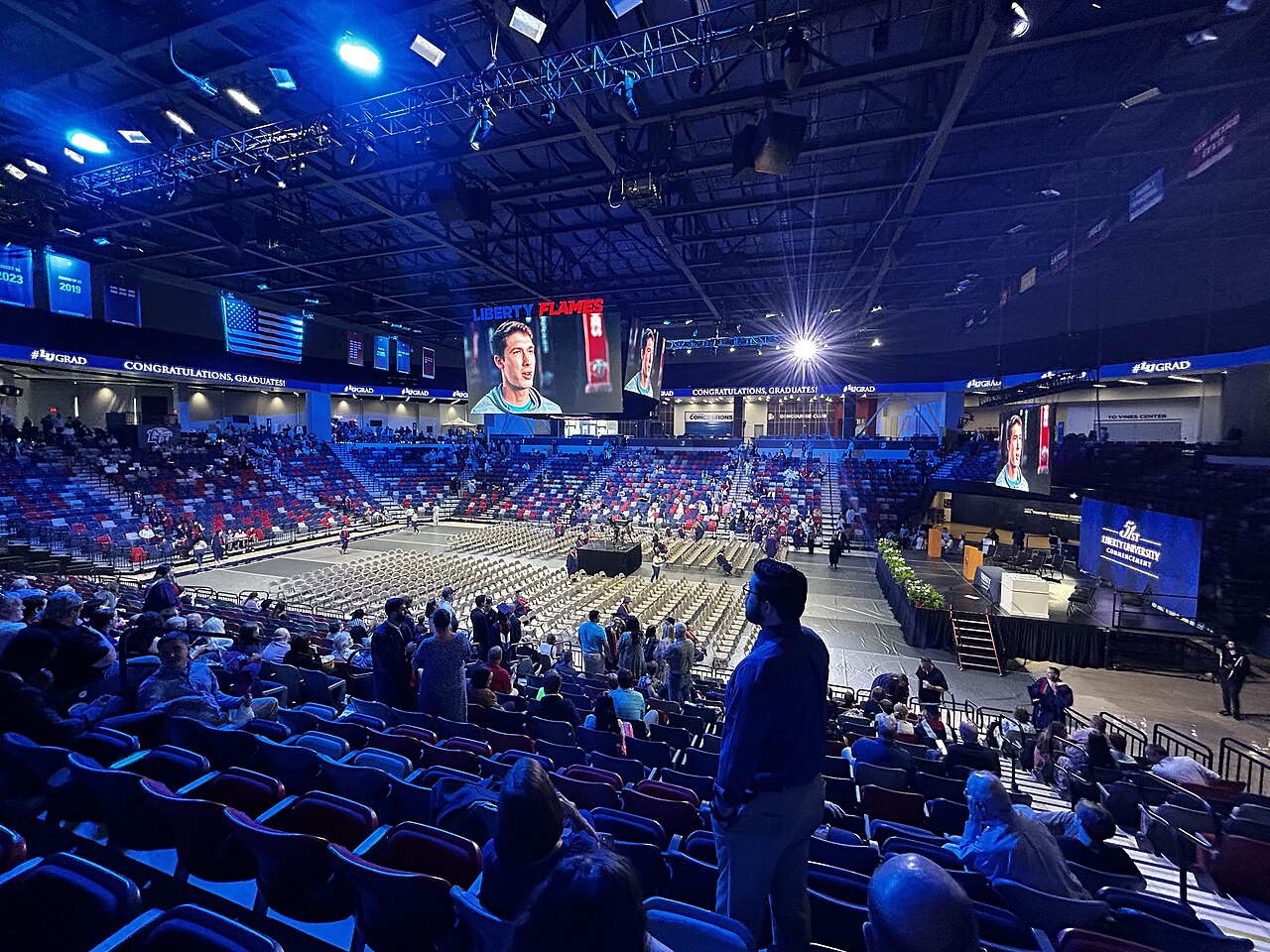
Liberty Arena is the fortress. Four thousand seats of Flame intensity in the Hill City, where the student section — the LUnatics — turns every big night into one of the mid-major world's great atmospheres. The building's intimacy is its weapon: visiting teams feel the walls closing in, and the Flames feed off it.
Before all of this, there was 2013. Liberty's first NCAA Tournament appearance came via the 2013 Big South title, part of a lineage that includes Big South crowns in 1994 and 2004. McKay's rebuild of the program — culture first, winning second, and then more winning than anyone in school history — transformed a regional program into a national mid-major power.
The Conference USA wars define the modern season. League battles, tournament chaos in March, the annual chase against programs with real resources and real ambition — and the Flames standing in the middle of it with a target on their back. The CUSA's parity means nothing is given; the Flames' discipline means they're never out of it.
What defines Liberty is that 2019 magic meeting a decade of proof: the Mississippi State stunner, the LUnatics' roar, the record books rewritten season after season, and a coach who turned a faith-based mission into a basketball machine. The next dance is always the mission. In Lynchburg, it usually arrives.