The LSU Tigers enter the 2026–27 season with the most dramatic storyline in the SEC: Will Wade is back. Four years after LSU fired him amid an NCAA investigation, the school fired Matt McMahon on March 26, 2026 — the same day it re-hired Wade for a second stint, bringing him home from NC State after a single season in Raleigh. Wade himself called the return “deeply personal,” a chance to go home. In Baton Rouge, the prodigal coach narrative is already the season’s defining plot.
The decision was not subtle. McMahon’s four-year tenure ended at 60–70 overall and an abysmal 17–55 in SEC play, bottoming out with a 15–17 campaign in 2025–26 that finished dead last in the conference at 3–15 — the only sub-.500 team in a league that had become the toughest in America. The Tigers lost to Kentucky in the first round of the SEC tournament and closed the year having missed the NCAA Tournament for the fourth consecutive season. LSU owed McMahon an $8.02 million buyout, and paid it to change direction.
Wade, for his part, returns with his reputation intact and his edge undimmed. His first LSU tenure (2017–2022) delivered SEC contention, tournament trips and the 2019 Sweet 16, before the NCAA’s Level I violation findings ended it. His one season at NC State produced a 20–14 record. Now, with Johnny Jones — the former LSU head coach — rejoining the staff as an assistant for his 23rd total season with the program, Wade has surrounded himself with Baton Rouge institutional memory and a mandate to rebuild fast.
And “fast” is the operative word, because Wade’s roster-building approach has been anything but conventional. He told reporters this summer he’s going down an “unconventional” path with a lean, portal-built roster, saying “we’re going to be unapologetic about it.” The pitch is pure Wade confidence: “If I’m wrong, I’m wrong. We ain’t gonna be worse than we’ve been. Hell, what’s the downside?” It’s the kind of gamble that either restores LSU in a hurry or becomes a cautionary tale — there is no middle ground with Will Wade, and Baton Rouge loves it that way.
The last bright spot of the McMahon era was Max Mackinnon. The Brisbane, Australia native transferred from Portland and became Louisiana’s newcomer of the year, averaging a team-high 15.7 points per game with 2.6 rebounds and 2.5 assists, pouring in 20.4 a night over the final five games. His 34-point eruption in a double-overtime win over Ole Miss on February 25 — 11-of-24 shooting, four threes, 8-of-10 from the line — was the season’s signature performance, and his 28 points in the season-ending SEC tournament loss to Kentucky was a fitting farewell. Mackinnon earned an invitation to the Portsmouth Invitational for the nation’s top seniors.
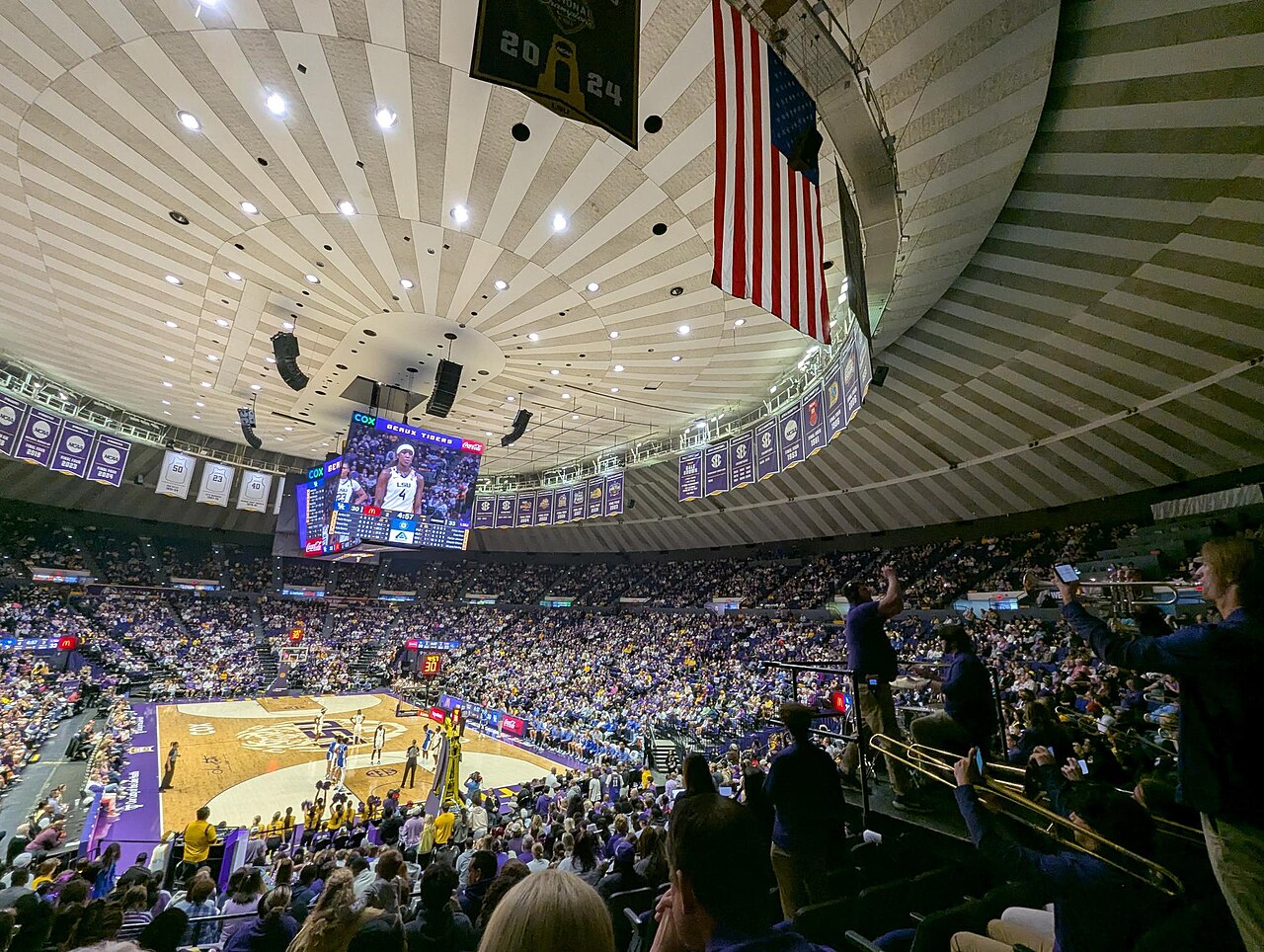
But the present is Wade, and the future is the PMAC. The Pete Maravich Assembly Center — “the Deaf Dome” — remains one of college basketball’s great buildings, named for Pistol Pete, whose 44.2 points per game (without a three-point line) is the most unbreakable record in sports. Maravich’s LSU years (1967–70) are the program’s immortal heritage: the greatest offensive player ever, in purple and gold, with his name on the building. Shaquille O’Neal’s Baton Rouge dominance (1989–92) was the program’s individual peak of the modern era — the Diesel before the legend.
The March lore is real, too. Dale Brown’s 1981 Final Four announced LSU’s arrival; the 1986 run — an 11 seed crashing the Final Four — remains the program’s Cinderella masterpiece and the most beloved March story in Baton Rouge; and the 2006 Final Four, powered by Tyrus Thomas and Glen “Big Baby” Davis, proved the Tigers could do it again. Three Final Fours, spread across three decades, is a heritage most programs would trade for.
The 2026–27 season will be judged against none of that, at least not yet. The bar is lower and the stakes are higher: get LSU back to the NCAA Tournament, restore the PMAC’s menace, and prove that bringing Wade home was genius rather than nostalgia. The SEC gauntlet — Kentucky, Florida, Alabama, Tennessee, and a conference that keeps getting deeper — offers no soft landings. Wade’s teams have always played with swagger and edge; this one will need both, because the league won’t wait.
What defines LSU right now is the audacity of the reset. Firing a coach and re-hiring the coach you fired four years earlier, in the same afternoon, is the kind of move only a program with LSU’s self-image makes. The Tigers believe they belong at the top of the SEC, and they hired the one coach who has taken them there recently to prove it. Wade’s second act begins now — lean roster, loud building, and a fanbase that remembers 2019 and wants it back.
In Baton Rouge, the script is already written: the prodigal son returns, the Deaf Dome roars, and the Tigers claw back into March. The only question is whether the basketball cooperates. With Will Wade, it usually does — and if it doesn’t this year, as he said himself, “we’ll live through one more bad one and we’ll get it going next year.” Buckle up.


