
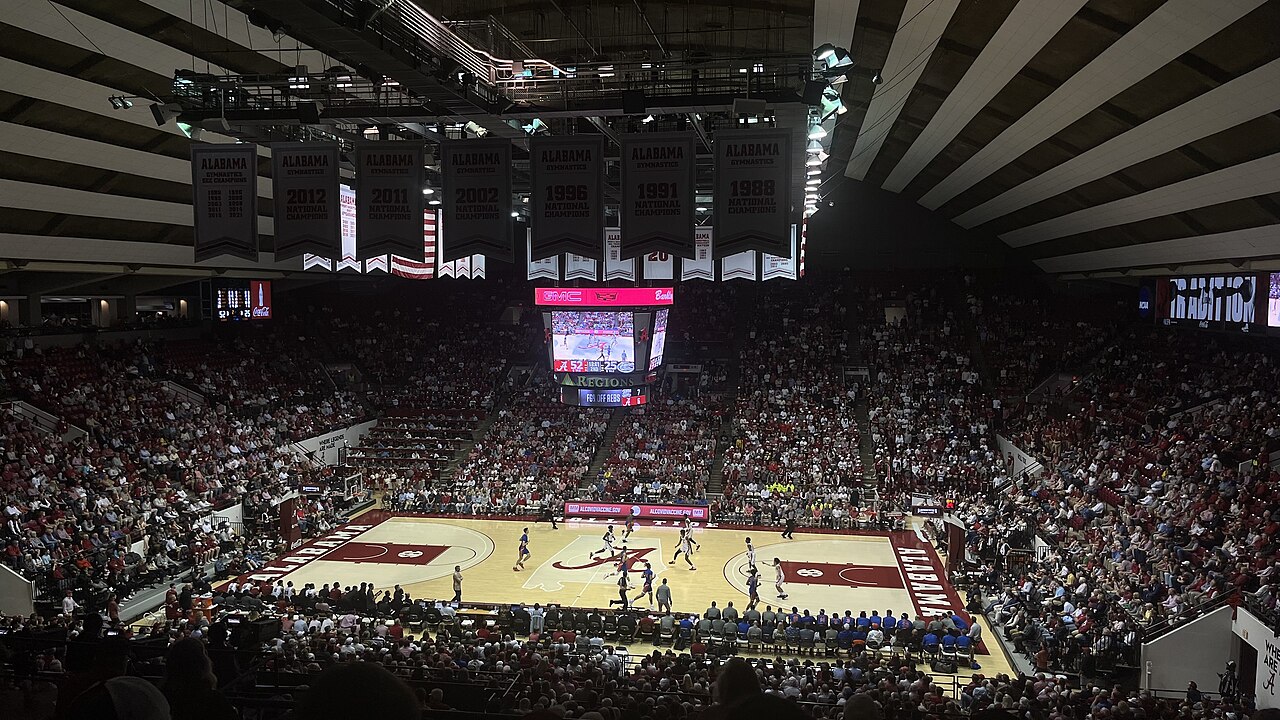
For most of its history, Alabama basketball lived in football's shadow — a proud program that could never quite escape the long silhouette of the gridiron. Nate Oats ended that sentence in 2024 with the school's first Final Four, and the 2025-26 season confirmed the new reality: the Crimson Tide went 25-10, reached a fourth straight Sweet 16, and closed the year with a March loss to Michigan that only sharpened the mission. In his eighth season in Tuscaloosa, Oats isn't chasing relevance anymore. He's chasing a national championship — and he rebuilt the roster to do it.
The 2026-27 Tide look different by design. After the Sweet 16 exit, Oats said Alabama needed to "get bigger," and the portal delivered: the transfer class ranks 19th nationally, the freshman class 12th, the combined haul 10th. "If you look at the games we lost last year, a lot of it was due to our defense and rebounding," Oats said. "I just didn't think we were big enough. We lacked size... We've got some interior size at all the spots."
The new frontcourt is the story of the offseason. Drew Fielder, a 6-11 senior from Boise State who led the Broncos in points and rebounds, brings stretch-four shooting. Brandon Garrison, a 6-10 senior from Kentucky, brings rebounding and rim protection. Jamarion Davis-Fleming, a 6-10 sophomore from Mississippi State who posted a 6.4 percent block rate as a freshman, brings raw athleticism and a family connection — his brother Javian played for Oats. "He's big, he's strong, he's athletic. He plays hard," Oats said. Add 6-7 transfer Cole Cloer, who reclassified, redshirted at NC State, and has already added 25 pounds, and Alabama suddenly has the length it lacked.
The backcourt has experience to match. Senior Aden Holloway returns as the team's second-leading scorer and one of the nation's elite shooters — 43.8 percent from three on six attempts a game. Sophomore Amari Allen, a 3-and-D wing who generated NBA draft buzz before withdrawing in May, and sophomore London Jemison, who carved out a rotation role and started 13 games as a freshman, give Oats proven perimeter pieces. Sophomore Keitenn Bristow and center Collins Onyejiaka return for depth.
The freshman class has star power. Tarris Bouie, a 6-6 wing, averaged nearly 30 points a game at SPIRE Academy and has dropped 40- and 50-point games. Jaxon Richardson — son of NBA veteran Jason Richardson and younger brother of Orlando Magic guard Jase Richardson — drew the quote of the offseason: "The kid Jaxon's probably the most athletic kid I've ever coached," Oats said, calling him a high-level rebounder with an improving shot. Lefty volume scorer Qayden Samuels, reclassified point guard Anderson Diaz — the No. 16 player in the ESPN100 with a 6'6" wingspan and "elite defender" tools, per Oats — and freshman TJ St. Louis round out a class built on positional size and athleticism.
The system won't change: Oats' Alabama plays the fastest, freest basketball in the SEC — relentless pace, a rain of three-pointers, guards attacking in waves. What changes is the physicality behind it. The 2024 Final Four team and the 2025 Elite Eight team (which fell 85-65 to Duke behind consensus first-team All-American Mark Sears' 18.6 points and 5.1 assists per game) proved the ceiling. This roster is built to raise the floor: bigger, more versatile, harder to bully. As Oats put it, Alabama will be "super-skilled" in the frontcourt with "shooting everywhere" — and the defense is finally catching up to the offense.
The history gives this era its weight. Before Oats, the Wimp Sanderson era (1980-92) was the golden age — SEC tournament titles, the plaid jackets, Sweet 16 runs that made Coleman Coliseum rock. The arena has been the Tide's home since 1968, and the Oats era turned it into one of the SEC's toughest road trips. The Iron Bowl of basketball against Auburn has become one of the sport's best rivalries, with both programs nationally relevant at the same time and every meeting carrying March seeding implications.
The Oats era also changed how Alabama recruits: the Tide now chases the same five-star prospects as Kentucky and Duke, wins the battles, and develops them in a pro-style system that has become an NBA pipeline. That's the machine the 2026-27 season plugs into — a program that no longer asks whether basketball can matter at a football school, because it already answered.
What defines Alabama basketball is the arrival: a football school that built a basketball monster through pace, shooting, and an identity so strong it now recruits itself. The Final Four banner hangs. The Sweet 16 streak continues. The next banner is the one nobody in Tuscaloosa will stop talking about until it does.
The stakes for 2026-27 are the highest of the Oats era. The Final Four banner proved Alabama could get there; the back-to-back Sweet 16s proved it wasn't a fluke; now the roster has the size and shooting to finish the job. The SEC will be its usual meat grinder — Auburn, Tennessee, Florida, and Kentucky all reloading — but Alabama's non-conference slate and the Coleman Coliseum advantage give the Tide every chance to chase a No. 1 seed. Oats has been explicit about the standard: the games Alabama lost last year were lost on the glass and on defense, and this roster was built to win exactly those games. In Tuscaloosa, the question is no longer whether basketball belongs. It's whether this is the year the last banner goes up.


