There is exactly one team in American college sports that answers to the name Spiders, and for more than a century it has spun the finest giant-killing webs in March. The Richmond Spiders own the most famous upset in NCAA tournament history — the first 15-over-2, when 15th-seeded Richmond toppled second-seeded Syracuse 73-69 in 1991 — and they remain the only program in the country to win tournament games as a 12, 13, 14 and 15 seed. Nobody treats March like a personal showcase quite like Richmond.
The nickname itself dates to 1894, borrowed from a lanky Richmond baseball pitcher whose long arms reminded reporters of a spider. It stuck — and it fits. Spider basketball is built on webs: the patient, cutting, backdoor-laying Princeton-style offense that entangles bigger, stronger opponents until they walk straight into the trap. In March, the giants keep walking into it.
The mythology started under Dick Tarrant. In 1984, his Spiders knocked off a Charles Barkley-led Auburn team, announcing that Richmond did not read brackets. In 1988, the 13-seeded Spiders beat defending national champion Indiana and then Georgia Tech to reach the Sweet 16 — one of the great March runs of its era. Then came 1991: Syracuse, the mighty 2-seed, fell 73-69 to the Spiders, the first time a 15-seed had ever beaten a 2. The result changed how America thinks about March — and permanently changed how America thought about Richmond.
The torch passed cleanly. In 1998, Richmond beat third-seeded South Carolina. The John Beilein era (1997-2002, 100-53) raised the program's floor before Beilein went on to Michigan's Final Fours. And the modern peaks have been pure Spider theater: the 2011 team, led by fearless guard Kevin Anderson, beat Vanderbilt and Morehead State to reach the Sweet 16 — a 29-8 season and the Atlantic 10 tournament title; and in 2022, the 12th-seeded Spiders stunned fifth-seeded Iowa 67-63 behind Jacob Gilyard's wizardry, the latest chapter in the upset canon.
That 2022 team was built by Chris Mooney, whose tenure has defined the modern program. Mooney took over in 2005 and installed the Princeton offense that became Richmond's identity — backdoor cuts, beautiful basketball, five-man movement that turns underdogs into giant-killers. His 2011 Sweet 16 squad was the deepest run in decades. But the Mooney era has had its scars, too: on February 17, 2023, he stepped away to undergo heart surgery, with Peter Thomas finishing the final six games (2-4). Mooney returned, and the next season produced one of the great program turnarounds — the 2023-24 Spiders stormed to their first Atlantic 10 regular-season title since joining the league in 2001, a program-record 15 conference wins, a 15-1 home record (best in the Robins Center since it opened in 1972), consensus A-10 Coach of the Year honors for Mooney, and a Co-Player of the Year trophy for Jordan King.
The two seasons since have been a rebuild's honest grind. The 2024-25 Spiders featured nine newcomers — the most in Mooney's tenure — and one returning starter, captain DeLonnie Hunt, who fractured his foot on January 8 and missed the next 15 games; Richmond went 3-12 without him and finished 10-22. Last season's 15-17 (5-13 A-10) mark was progress but not where the program expects to be. Still, the foundation was pouring: minutes for a young core, and a return to competitive fight.
Now comes 2026-27 — Mooney's 22nd season at the helm — and the schedule is a statement of intent. The Spiders open Monday, November 2 against UNC Asheville at the Robins Center, then head north to face Temple at The Palestra on November 8 as part of the iconic venue's 100th-anniversary celebration. A November 12 trip to Southern Illinois is a rematch of last year's overtime thriller, and November 16 brings Virginia Tech to the schedule for the first regular-season meeting with the Hokies since 2009. Thanksgiving week means the Greenbrier Tip-Off in White Sulphur Springs, West Virginia, on November 20 and 22 — six home non-conference games, four true road games, three neutral-site tests. As Mooney put it: his players came to Richmond to compete in games like these.
The roster blends proven veterans with high-upside youth. Senior center Mike Walz (6-11, Berwyn, Pennsylvania) and senior forward Jonathan Beagle (6-10, Hudson Falls, New York) give the frontcourt real size and experience. Senior guard AJ Lopez (Queens, New York) and senior forward Apostolos Roumoglou (Xanthi, Greece) bring scoring and versatility. The junior class — forward Jaden Daughtry (Richmond, Virginia), guards Collin Tanner (Creedmoor, North Carolina), David Thomas (McDonough, Georgia) and Mikkel Tyne (Toronto) — is the engine room Mooney is counting on. And the freshman class has a built-in storyline: guard Kirby Mooney is the head coach's son, joined by Will Harper III, Bryson McGlothin, Jaylen Robinson, Donovan Richardson, Aiden Argabright and 6-11 center Dylan Homenick.
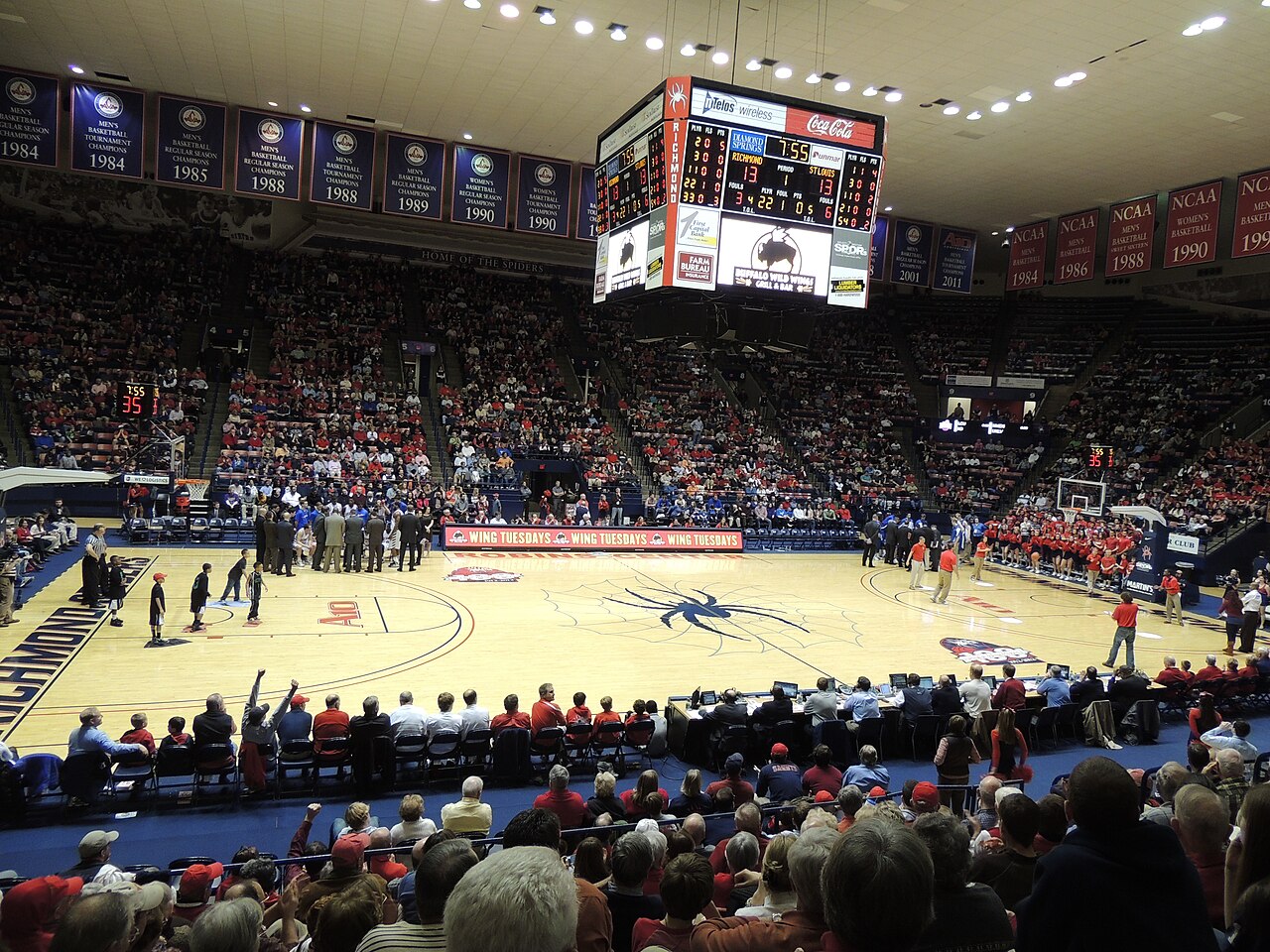
The Robins Center remains one of the Atlantic 10's great home courts — intimate, loud, draped in spider-web pageantry. Opponents know: nothing in the A-10 is easy at Richmond. In a league where VCU, Dayton, Saint Louis and Saint Joseph's have stockpiled recent banners, the Spiders are playing the long game — developing a roster that fits the system, chasing a conference title that has been elusive since 2022, and trusting that the web will do what it has always done.
Richmond's identity is giant-killing as tradition: 1984, 1988, 1991, 1998, 2011, 2022 — six generations of Spiders who ruined brackets and made history. No program of its size has a better March mythology. In Richmond, the web is always set — and the next chapter is one upset away.