One game. That's how close the UConn Huskies came to a third national championship in four years. The 2025–26 Huskies stormed to a 34–6 record, went 17–3 in the Big East, and marched all the way to the national championship game in April — where Michigan edged them 69–63 in a defensive slugfest. The loss stung, but the larger statement was undeniable: Dan Hurley has built the sport's most well-oiled machine, a program that has now reached three national title games in four seasons. The dynasty didn't end in April. It reloaded.
The tournament run was vintage UConn. As the No. 2 seed, the Huskies opened with a double-digit win over Furman, then dismantled No. 7 UCLA 73–57 in the Round of 32 in Philadelphia. The Sweet 16 brought No. 3 Michigan State, and the Final Four delivered the program's signature moment of the season: a comeback win over Duke fueled by Hurley's halftime positivity, the kind of belief-as-tactic speech that has become his trademark. The final against Michigan was a rock fight — 63 points, one cold stretch too many — but getting there, again, was the achievement.
Hurley's numbers are now historic. He entered the 2026–27 season with a 199–75 record in nine years at UConn and 350 career wins, with 30-win seasons three times over. His NCAA Tournament record at UConn ranks among the best in the sport's history — the back-to-back titles of 2023 and 2024, the 2026 runner-up finish, all built on the same formula: elite defense, surgical half-court offense, and a culture of accountability that turns five-stars and transfers alike into two-way players. He was picked to win the Big East again at media day this fall — a coffee-spilling, suit-staining, superstitious-as-ever Dan Hurley, quipping about omens to a horde of reporters.
The 2026–27 roster is a fascinating test of the machine. Only 35.1 percent of last season's minutes return — fourth in the Big East — and just three starters are back. Forward Jaylin Stewart and point guard Silas Demary, who was limited by a lower-body injury down last season's stretch and didn't start the UCLA game, headline the returners. The incoming transfer class ranks 33rd nationally and the freshman class 29th — modest numbers by blue-blood standards, but Hurley's program has never been about recruiting rankings. It's about the system making players better than their stars.
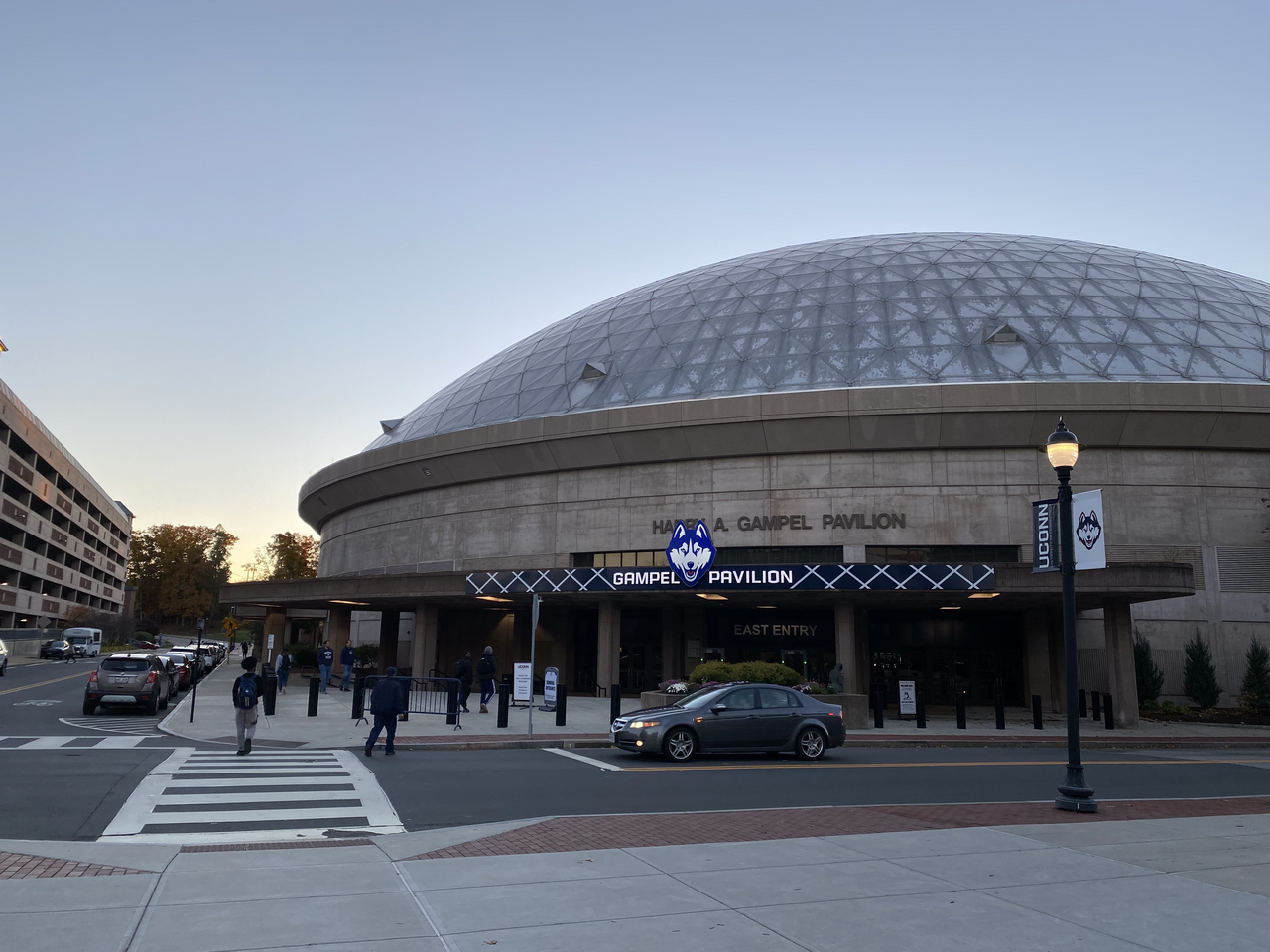
The Big East context favors the Huskies. UConn was picked first in the preseason poll, ahead of a league that remains the nation's best top-to-bottom basketball conference. The home-court split between Harry A. Gampel Pavilion on campus in Storrs and PeoplesBank Arena in Hartford gives the program two distinct fortresses, and the fan base — hardened by six national championships — expects nothing less than a Final Four chase every single year.
That championship pedigree is the program's gravity. UConn's six men's national titles — 1999, 2004, 2011, 2014, 2023, 2024 — span four decades and three distinct eras: Jim Calhoun's building of a power, Kevin Ollie's 2014 lightning strike, and Hurley's modern juggernaut. The return to the Big East in 2020 restored the program's soul; the last four seasons restored its throne. Only the 2024–25 team, which lost to Florida in the second round as the three-peat bid died, interrupted the run — and even that season ended with 24 wins.
The 2026–27 mission is the one Hurley wants most: the response. Championship-game losers either fade or come back furious, and everything about Hurley's program suggests fury. The backcourt contributors are back, the culture is intact, and the coach who has won at every stop believes the next banner is coming. What defines UConn right now is the standard — not the hope of March, but the expectation of April. In Storrs, anything less than the season's final weekend is a disappointment. That's what a dynasty feels like.
Hurley's own arc is the program's foundation story. He won at Wagner, rebuilt Rhode Island into a two-time NCAA team, and arrived in Storrs in 2018 to find a proud program adrift — 16–17 in his first season, the AAC years a slow bleed. The return to the Big East in 2020 changed everything: the rivalries with Villanova, Creighton and Marquette restored the program's edge, the recruiting caught fire, and by 2023 the Huskies were cutting nets in Houston. Nine years, 199 wins, three title games. The rebuild is complete; this is the empire phase.
The home-court advantage is real and split in two. Gampel Pavilion on the Storrs campus — 10,167 seats of deafening student noise — is one of the great on-campus environments in the sport, and PeoplesBank Arena in Hartford gives the program a big-stage second home. Opponents don't just play UConn; they play the building, the banners, and the weight of a program that has owned March for most of the last decade. The 2026–27 Huskies open the season knowing exactly who they are. Everyone else is chasing them.