The Vermont Catamounts gave March one of its great early-century classics. In 2005, 13th-seeded Vermont stunned fourth-seeded Syracuse 60-57 in overtime — T.J. Sorrentine's legendary 30-footer with the shot clock winding down — for the program's first NCAA Tournament win. It's still the signature moment in school history, the shot that put Burlington on the college basketball map and announced that the little program from the Green Mountains belonged.
That upset wasn't a fluke; it was a foundation. The Catamounts built one of the great mid-major dynasties of the modern era, and the architect is John Becker. Now in his 16th season, Becker passed Tom Brennan in 2023 to become the winningest coach in program history, and his numbers are staggering: 351 wins at Vermont, nine America East regular-season titles, six conference tournament championships, and at least 20 wins in 13 of his seasons. From 2017 through 2024, the Catamounts earned five March Madness bids. Patrick Gym — loud, cramped, and gloriously hostile — became the hardest road trip in the America East.
Becker's own road was anything but easy. His first head coaching job, at Gallaudet, produced a 6-44 record over two brutal seasons. He arrived in Burlington as an assistant in 2006, absorbed the program's culture, and took over in 2011 — then spent the next decade and a half turning Vermont into the league's standard-bearer. His lone NCAA Tournament win came in 2012, a First Four triumph over Lamar, but his teams' consistency — year after year of 25-win seasons, suffocating defense, and veteran guard play — made Vermont the mid-major program every power conference quietly hoped to avoid.
The last two seasons, though, have tested that standard. Vermont finished second in the league in both 2024-25 and 2025-26, and the 2026 America East championship game was a heartbreaker: regular-season champion UMBC defended its home floor with a 74-59 win, sending the Catamounts home without an NCAA berth for the second straight March. In the transfer-portal era, Becker has faced the same churn as everyone else — ten first-time Catamounts dot the 2026-27 roster after another offseason of graduations and portal exits.
Becker's response has been introspective and pointed. "I spent a lot more time with the players educating them on Vermont," he said over the summer, putting the onus on himself to reestablish the program's culture and expectations. "I thought at times last year I didn't do a good enough job of making sure it felt like a Vermont team." The returning core — Gus Yalden, the skilled big man who moves beautifully in the paint; Noah Barnett; and Momo Nkugwa — gives him a veteran spine to build around, and Becker says the newcomers fit what the program is about.
The nonconference schedule offers both a measuring stick and a showcase: an early-December road trip to Florida — the preseason No. 1 team in the country — headlines a slate that also features the MAAC-AE challenge at Fairfield, Quinnipiac at Patrick Gym, and a holiday MTE at Hofstra in the New York metro area. For a program trying to rebuild its identity, there is no better test than the nation's best on their floor.
Off the court, Vermont made national news in April 2026 with a hire believed to be a first in NCAA Division I history: former Holy Cross coach Maureen Magarity — John Becker's wife — was named the Catamounts' women's basketball head coach, replacing Alisa Kresge (who left for Richmond). The married couple now leads the school's men's and women's programs, a milestone that says everything about how deeply the Beckers are woven into Burlington.
The standard at Vermont is clear, and it was set long before this season: win the league, win in March, and make the big boys sweat. Sorrentine's shot, Coppenrath's dominance, Anthony Lamb's brilliance — the Catamounts' history is a highlight reel of mid-major excellence. Two straight empty Marches don't erase a dynasty; they just make the next one hungrier.
The Brennan-to-Becker bridge runs through Taylor Coppenrath, the 6-9 forward whose 2,442 career points made him the face of the 2005 breakthrough. The Catamounts' modern resume also includes Anthony Lamb's brilliance in the late 2010s and a string of America East coronations that turned Burlington into the league's capital. The emerging foil is UMBC -- the Retrievers have twice now denied Vermont at the final hurdle, and the 2026 championship-game loss on their floor gives the 2026-27 rematches genuine bite. In a one-bid league, the regular season is prelude; everything is decided in March, and Vermont has made a dynasty of winning those three games in three days.
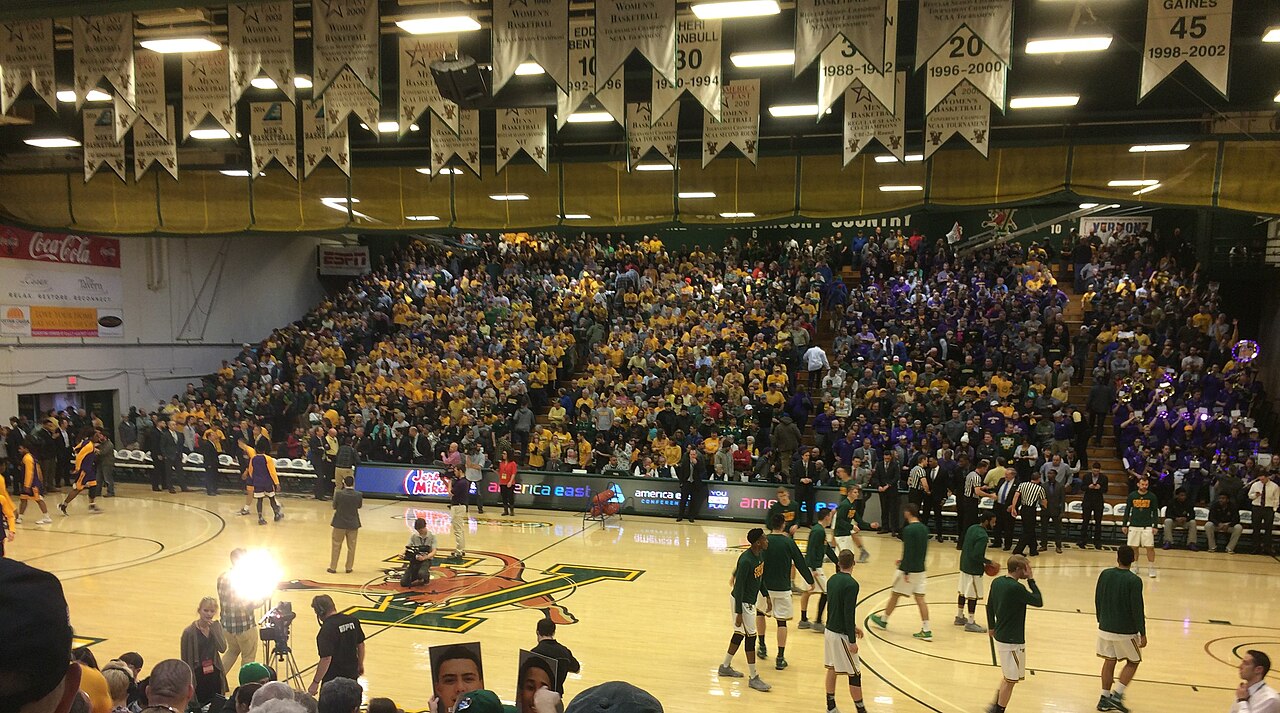
And then there is Patrick Gym itself -- 3,200 seats of pure New England noise, where the student section arrives early and stays late, and where visiting America East teams have learned that a February night in Burlington is the closest thing the league has to a guarantee of misery. It is the smallest stage for one of the biggest dynasties, and the Catamounts would not have it any other way.