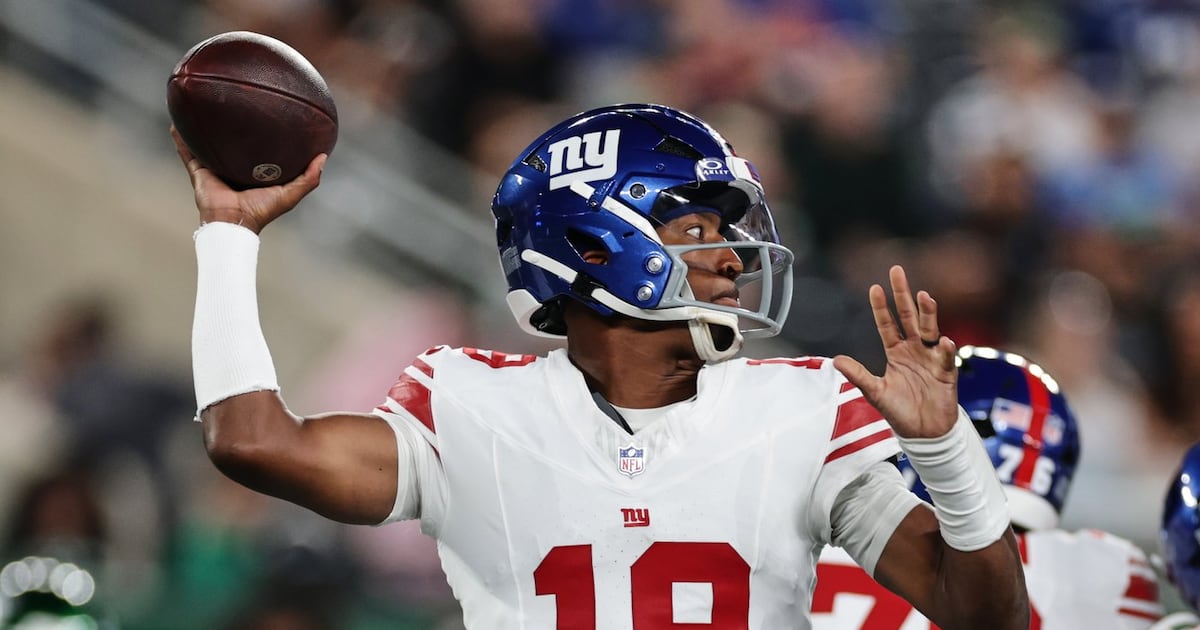
The New York Giants are 2-1, and they have scored 18 points in their last two games combined. Read that again. Eighteen points — and they're above .500, because the defense is playing championship-level football and the whole operation has the unmistakable fingerprints of John Harbaugh, the Super Bowl-winning coach who took over this franchise and immediately changed its posture. Sunday brings the 1-2 Cardinals to MetLife Stadium. The quarterback will be 32-year-old Jameis Winston, the famous gunslinger turned caretaker, starting his third straight game. And waiting in the wings, learning the offense on the scout team, is the most fascinating reclamation project in football: J.J. McCarthy, acquired from Minnesota this week for a 2027 fifth-round pick.
The McCarthy trade is the kind of low-risk, high-upside swing smart teams make. The cost was a Day 3 pick two drafts from now. The player was the No. 10 overall pick in 2024, a 23-year-old national champion at Michigan who started ten games for the Vikings last season (6-4, 1,632 yards, 11 touchdowns against 12 interceptions) and lost the starting job to Kyler Murray this summer. The Giants didn't plan on needing him — but they lost Jaxson Dart, their rookie starter, to season-ending knee surgery (a full meniscus tear plus MCL damage) less than three weeks into the season, and suddenly the quarterback room was Winston and prayers. McCarthy called the trade "a shock" and says he's already in love with the building: "Absolutely love the Harbaugh family. They're made of the right stuff. Faith, family, football." (It doesn't hurt that John's brother Jim coached McCarthy to that national title at Michigan.) For now, he's learning Matt Nagy's system on the scout team — Harbaugh admits getting him up to speed midseason "will be a challenge" — but the runway is there. If Winston falters, the former top-ten pick gets his second chance in the country's biggest market.
Winston, to his credit, has done exactly what was asked: don't lose the game. After Dart went down, the veteran — signed to a two-year, $13 million deal this offseason — has completed 25 of 49 passes for 221 yards with no touchdowns and one interception. The numbers are grim (a 55.6 passer rating), but the record since he took over is 1-1, and last week's 12-7 win over Tennessee was a masterclass in complementary football: the defense suffocated the Titans, and kicker Dominic Zvada drilled all four of his field goals for every point New York scored. It's not pretty. It's not supposed to be. The Giants are winning the way Harbaugh's best Baltimore teams won — defense, special teams, field position, and a quarterback who understands the assignment.
The concern is sustainability. Eighteen points across two games doesn't beat good teams, and the schedule will stiffen. The offensive line has to give Winston cleaner pockets — he's been sacked repeatedly and the passing game has no vertical element without Dart's mobility and improvisation. The run game needs to carry more. And at some point, the question everyone in New York is already asking will demand an answer: is McCarthy's development fast enough to matter this season, or is this a 2027 investment wearing a 2026 uniform? Harbaugh has been adamant that Winston is the starter, and there's no quarterback controversy while the team keeps winning. But the Giants didn't trade for a 23-year-old former top-ten pick to hold a clipboard forever.
What makes this moment so compelling is the franchise underneath it. The Giants are one of the NFL's charter royalty — founded in 1925 by Tim Mara for $500, family-owned ever since, eight championships in the trophy case. The early titles (1927, 1934, 1938, 1956), the glory years of the 1980s under Bill Parcells with Lawrence Taylor redefining defense, the "wide right" heartbreak of Super Bowl XXV's aftermath giving way to the franchise's modern miracles: Super Bowl XLII, when Eli Manning escaped the grasp of the Patriots' pass rush and David Tyree pinned the ball to his helmet, ending New England's perfect season in the greatest upset in Super Bowl history; and Super Bowl XLVI, the rematch, Manningham's sideline catch, Eli doing it to Brady again. Four Super Bowls, all of them earned the hard way. This franchise doesn't do easy.
The last decade-plus, though, has been mostly wilderness. One playoff appearance since Super Bowl XLVI. The Daniel Jones era's false dawns. Coaching carousels, front-office turmoil, the slow fade from relevance in the league's biggest market. Harbaugh's arrival was the loudest possible statement that the Mara family was done drifting — you don't hire a coach with his résumé to rebuild quietly. And the early returns, however ugly on the offensive side of the ball, suggest the culture transplant is taking: this team plays hard, plays smart, and doesn't beat itself. That's not nothing. In the modern NFL, that's the foundation everything else gets built on.
Sunday against Arizona is exactly the kind of game that defines seasons like this one. The Cardinals are 1-2 and dangerous; the Giants are 2-1 and held together by defense and kicking. Win, and it's 3-1 with the quarterback situation stabilizing and McCarthy gaining ground every week in the meeting rooms. Lose, and the questions get louder — about Winston, about the offense, about whether a team scoring nine points a game can really hang around in the NFC East race. The Giants have been here before: counted out, unpretty, and somehow still standing in January. The helmets say New York. The head coach has a ring. And somewhere on the scout team, a 23-year-old with everything to prove is learning the playbook as fast as he can. In the NFL, that's called hope.