
The Phoenix Mercury are one of the WNBA's eight original franchises, born in 1997 — and for their first decade, they were the league's beautiful frustration. The early Mercury had real stars — Jennifer Gillom, Bridget Pettis — but never quite the right mix around them, a playoff team that couldn't break through. Then Diana Taurasi arrived in 2004, and everything changed. The UConn legend — the "White Mamba" herself — became the greatest scorer in league history and the gravitational center of the franchise for two decades. With Taurasi, the Mercury won championships in 2007 and 2009 under coach Corey Gaines, playing Paul Westhead's run-and-gun system at a pace the league had never seen. It was the "seven seconds or less" of women's basketball, and it worked: Cappie Pondexter took home the 2007 Finals MVP as Phoenix outran everyone in its path.
What defines the Mercury is the long arc of the Taurasi era. The 2014 team — Taurasi, Brittney Griner, Candice Dupree, coached by Sandy Brondello — went 29–5 and swept the Chicago Sky for the franchise's third title, one of the most dominant seasons in league history. The 2021 team, with an aging Taurasi willing her squad through the playoffs on one good leg, reached the Finals and fell to those same Sky. Through it all, Taurasi piled up scoring records that may never be broken and became the undisputed face of the franchise — until her retirement in February 2025 closed a two-decade chapter and forced Phoenix to imagine a future without its sun.
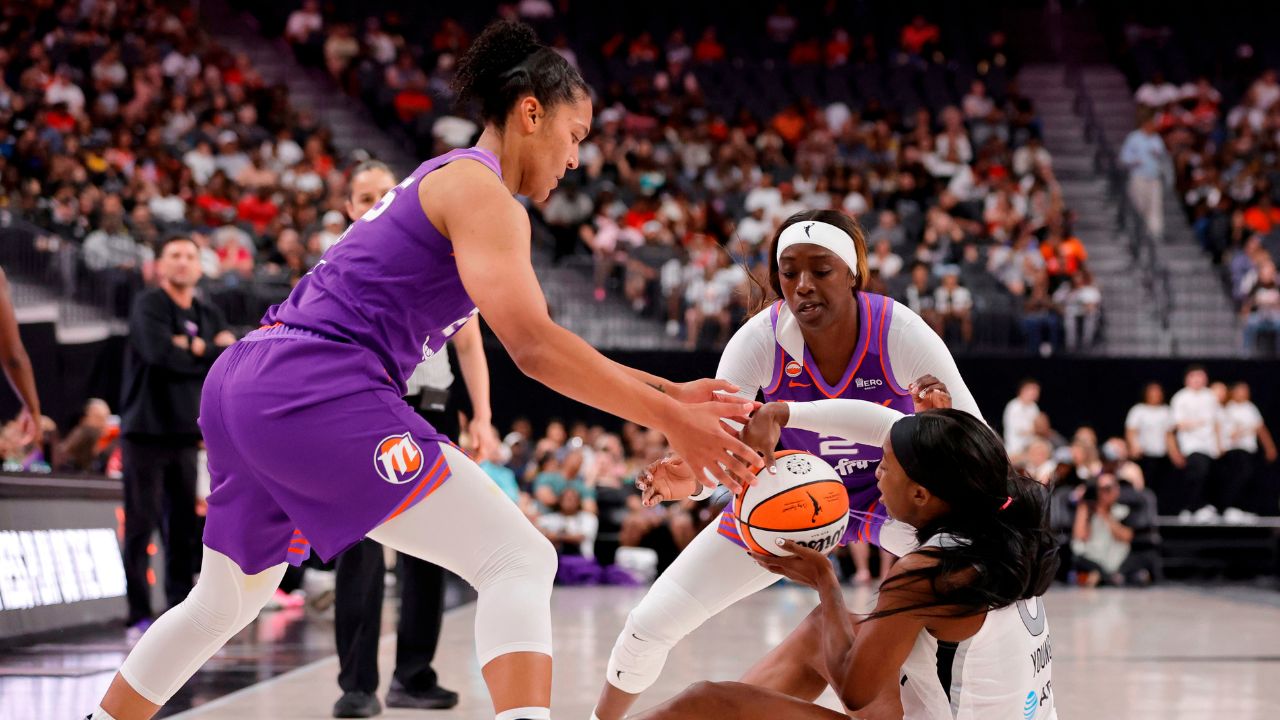
The post-Taurasi pivot came fast. In 2025, Phoenix went big-game hunting, trading for Satou Sabally and pairing her with Alyssa Thomas and Kahleah Copper for a run that carried the Mercury all the way back to the WNBA Finals, where they fell to the eventual champion Las Vegas Aces. It was supposed to be the start of a new era. Instead, 2026 became a masterclass in how quickly things unravel. Sabally walked in free agency. Kathryn Westbeld suffered a season-ending ACL injury before training camp even began. The Mercury stumbled to a 2–8 start, never found a winning rhythm, and watched the season slip away one paper cut at a time — exactly the phrase general manager Nick U'Ren used on exit day: "There were times where it felt like death by a thousand paper cuts."
The details were brutal. Sami Whitcomb, one of the league's best reserves during the Finals run, played less than half the season. International addition Jovana Nogic left the team after 16 games, with the Mercury sitting at 4–12. The midseason trade for Kelsey Plum — the splash move meant to supply a third elite scorer alongside Thomas and Copper — yielded just five games before a lower left-leg injury shut Plum down. DeWanna Bonner was moved into the starting lineup and then bought out in August so she could chase a playoff spot with Atlanta. Phoenix finished 16–28 with the league's fifth-worst offense and fifth-worst defense, surrendering seven more points per game than the year before. "This year hasn't been up to our standard," coach Nate Tibbetts said after a season-ending 100–82 loss to the Aces. "We want to be in the playoffs, that's what this organization is about."
And yet the rubble contained real treasure. Alyssa Thomas set a new WNBA single-season assists record with 358, breaking her own mark of 357 from 2025 — doing it on a team that gave her almost no margin for error. Kahleah Copper averaged a career-high 21.5 points per game in her eleventh season, including a game-winner over Dallas with 2.4 seconds left on September 21 that reminded everyone what the ceiling looks like. Both are under contract for 2027, along with Whitcomb and Natasha Mack, and Phoenix enters the offseason with over $3.26 million in cap room — flexibility most of the league would kill for. The franchise's own second- and third-round picks are in hand. The biggest question is Plum: an unrestricted free agent who will command well over $1 million, and who U'Ren said plainly the team intends to keep: "We brought her here for a reason."
The Mercury's identity has always been desert basketball: fast, skilled, and just a little bit defiant. The "X-Factor" fans remain among the league's most passionate, packing the downtown Phoenix arena — now the Mortgage Matchup Center — through every era. The rivalries are Western Conference classics: the Los Angeles Sparks, the two-decade foil; the Seattle Storm, the dynasty measuring stick; the Minnesota Lynx, the Finals-adjacent battles. Three banners hang from 2007, 2009, and 2014. The 2026 season was the franchise's worst stumble in a decade — only its second playoff miss since 2013 — but the organization has been here before and climbed out. With Thomas still playing at an elite level at 34, Copper at the peak of her powers, and a war chest of cap space, the mandate for 2027 is simple: get back to the playoffs, or the leash gets short for everyone.