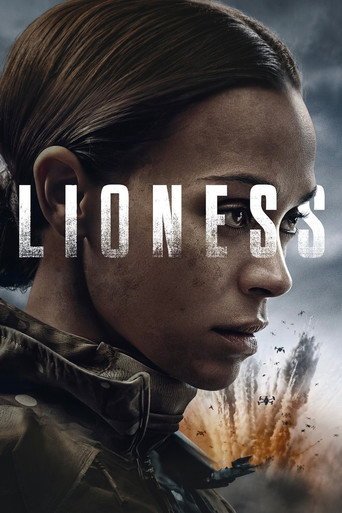
Lioness
Cruz Manuelos, a rough-around-the-edges but passionate young Marine, is recruited to join the CIA's Lioness Engagement Team to help bring down a terrorist organization from within. Joe, the station chief of the Lioness program, is tasked with training, managing and leading her female undercover operatives.
Vivian's Take
The Hook
The pitch is pure competence porn: Cruz Manuelos — a rough-edged young Marine — is recruited into the CIA's Lioness Engagement Team to infiltrate a terrorist network from within, while Joe, the program's station chief, trains, manages, and runs her female operatives. It's a spy thriller about women doing the most dangerous work in the shadows, and it's exactly as intense as that sounds.
The premise has real-world roots, but the show isn't interested in being a documentary. It's interested in the cost: what it takes to build a human weapon, what it takes to aim one, and what happens to the people holding the leash. Cruz's recruitment isn't a career move. It's a transformation with no exit.
The Deep Cut
What works is the operational authenticity, or at least the convincing performance of it. The show runs on procedure — the tradecraft, the chain of command, the unglamorous machinery of dangerous work — and applies that machinery to the undercover world with gripping results. The training sequences crackle, the missions have genuine stakes, and the female-led ensemble gives the genre something it rarely gets: a spy story where the emotional core isn't a tortured man with a gun but women navigating impossible loyalties.
What doesn't: the pacing lurches between breakneck operations and long, speechy interludes where characters explain the themes at each other. The politics are a particular brand of muscular American mythmaking that you'll either ride with or roll your eyes at. And the 8.3 rating, while strong, reflects a show that's easier to admire in pieces than to love whole. The missions thrill; the connective tissue sometimes sags.
Who it's for: spy-thriller devotees who've exhausted the usual suspects, viewers who want their procedurals with real weight, and anyone who believes the best action scenes are the ones where you understand exactly what's at stake.
Cultural Context
Lioness sits at the center of television's most dominant drama empire — a one-man studio system churning out modern westerns, crime sagas, and now spy thrillers. The creator understood something the industry forgot: there's a massive audience for earnest, high-stakes, unapologetically American storytelling. Lioness extends that empire into the intelligence world, and the audience followed.
The show also matters as a corrective. The female-led spy thriller has a thin canon — a few standouts surrounded by decades of Bond girls and fridged wives. A series built around women running and executing the most dangerous operations, treated with the same gravity as any male-led prestige drama, shouldn't feel novel. That it does is both the show's achievement and the genre's indictment.
The Players
The cast is stacked like a Sheridan production demands. Zoe Saldaña plays Joe, the station chief running the Lioness program — a woman conducting lethal operations abroad while trying to keep a marriage and two kids intact at home, and Saldaña plays both halves with the same exhausted ferocity. Laysla De Oliveira is Cruz Manuelos, the rough-edged young Marine the program recruits, breaks down, and rebuilds into a weapon; it’s a star-making turn, all coiled intensity. Nicole Kidman is Kaitlyn Meade, the senior CIA supervisor who greenlights the morally radioactive decisions from a safe distance, all silk and steel. Michael Kelly is Deputy Director Byron Westfield, Dave Annable is Joe’s husband Neil — the show’s civilian conscience, watching his wife disappear into work he can’t ask about — and season two adds Morgan Freeman as Secretary of State Edwin Mullins, Genesis Rodriguez as Captain Josephina Carrillo, and Max Martini to the ensemble. It’s a cast with more combined star power than most film franchises, deployed in service of eight-episode seasons that move like thrillers and land like dramas.
The Missions
Season one premiered July 23, 2023, under the full title Special Ops: Lioness: Cruz is inserted into the orbit of a terrorist financier by befriending his daughter, a long-game infiltration where the asset becomes the friend and the friend becomes the liability. Season two — premiered October 27, 2024, now billed simply as Lioness — raises the stakes and the body count, with the team hunting a new network while Joe’s home life cracks under the weight of everything she can’t say out loud. The throughline is the cost of the work: every operation the show stages is also an argument about what it takes out of the people running it. The tradecraft is the spectacle — recruitment, training, cover-building, exfiltration — and Sheridan’s scripts treat procedure as character development, which is why the training sequences hit harder than most shows’ finales.
The Real Roots
The premise isn’t invented. It’s drawn from the real CIA program and the Female Engagement Teams — “Team Lioness” — deployed in Iraq and Afghanistan, where female service members could search and engage local women in ways male troops culturally couldn’t, putting them in extraordinary danger with extraordinary little recognition. The show fictionalizes aggressively — this is entertainment, not testimony — but the core idea, that some of the most dangerous intelligence work of the last twenty years was done by women the history books barely mention, is real. That grounding is what separates Lioness from the generic spy show: the missions feel researched, the stakes feel borrowed from reality, and the 8.3 TMDB rating reflects an audience that showed up for the thrills and stayed for the weight. In the Sheridan empire — Yellowstone, 1883, 1923, Tulsa King, Mayor of Kingstown — this is the covert-ops wing, and it’s built to the same spec: earnest, muscular, unapologetic, and engineered to be talked about.