Ted Lasso
Ted Lasso, an American football coach, moves to England when he's hired to manage a soccer team—despite having no experience. With cynical players and a doubtful town, will he get them to see the Ted Lasso Way?
The complete guide to Ted Lasso
The kindness comedy that became a cultural phenomenon — the NBC promo origins, the Richmond ensemble, all four seasons, the Emmys, and the legacy.

The premise
Ted Lasso, an American college football coach from Kansas, is hired to manage AFC Richmond — a struggling English Premier League soccer club — despite knowing almost nothing about the sport. The twist, revealed early, is that Richmond's owner, Rebecca Welton, hired him as an act of sabotage against her ex-husband: she wants the folksy American to fail spectacularly. What she doesn't count on is that Ted's relentless, almost pathological optimism isn't a strategy or a performance — it's a discipline. Slowly, player by player, cynic by cynic, he wins the room. The show's real question is never whether Richmond wins the league. It's whether believing in people is a strategy or a delusion — and the show has the nerve to argue, season after season, that it's a strategy.
The series began life as a one-joke character: Jason Sudeikis played Ted Lasso in a pair of 2013 NBC Sports promos for Premier League coverage, a cheerful American bumbling through English football. Stretching that sketch into prestige television sounded like a dare. That it became the defining comfort watch of the decade is one of streaming's great improbabilities — proof that sincerity, executed with enough craft, could be the bravest move in the room.
The cast
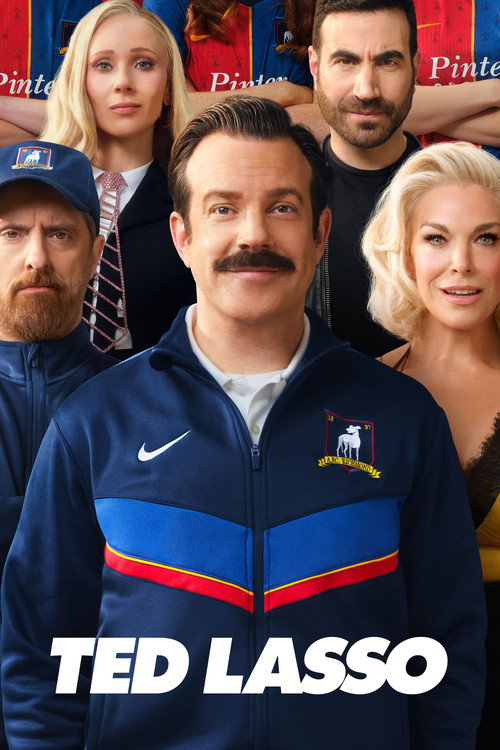
Jason Sudeikis is Ted — mustache, visor, biscuit tin for the boss, and a performance that won back-to-back Emmys for Outstanding Lead Actor in a Comedy Series. Around him, the ensemble became one of television's great companies. Hannah Waddingham plays Rebecca Welton, the ice-queen owner whose thaw is the show's stealth emotional spine. Brett Goldstein is Roy Kent — magnificent profanity, buried vulnerability — and also one of the show's writers. Juno Temple is Keeley Jones, who grows from comic relief into the show's moral and professional center. Brendan Hunt, Sudeikis's co-creator, is Coach Beard, Ted's near-silent best friend; their friendship is the single greatest slow-burn relationship in modern TV comedy.
The Richmond locker room runs deep: Nick Mohammed as Nate Shelley, the kit man turned coach whose arc — betrayal, villainy, and a redemption the show asked the audience to grant faster than it had earned — became the series' most argued-over storyline. Jeremy Swift as the long-suffering Leslie Higgins, Phil Dunster as the slowly humanized Jamie Tartt, Cristo Fernández as the irrepressible Dani Rojas, Kola Bokinni as Isaac McAdoo — and Sarah Niles as the quietly devastating sports psychologist Dr. Sharon Fieldstone, Anthony Head as the reptilian Rupert Mannion. Season four, which finds Ted coaching a second-division women's team, brought back the core — Waddingham, Temple, Goldstein, Hunt, Swift — alongside new faces including Tanya Reynolds, Jude Mack, Faye Marsey, Rex Hayes, Aisling Sharkey, Abbie Hern, and Grant Feely as a recast Henry Lasso.
The seasons
Season one (August 2020, 10 episodes) is a near-perfect comedy season — the sabotage plot, the slow thaw, the relegation gut-punch that somehow feels like a win. Season two (July 2021, 12 episodes) deepened everything: Ted's panic attacks, Dr. Sharon, the "Beard After Hours" odyssey, and Nate's turn, which split the fandom down the middle. Season three (March–May 2023, 12 episodes) was the divisive victory lap — bloated in the middle, with too many characters and subplots, but emotionally devastating at the finish, as Ted said goodbye and Richmond learned to believe without him.
Then came the resurrection nobody quite believed would happen. Apple renewed the show in March 2025, and season four premiered in August 2026 with Ted returning to Richmond to take on his biggest challenge yet: coaching a second-division women's football team. "Throughout the course of the season, Ted and the team learn to leap before they look," the official synopsis reads — Sudeikis's thesis for a world conditioned to do the opposite. The season landed at an 89% Tomatometer, notably warmer than its predecessor, with critics praising the return to the show's ensemble-first strengths. A fifth season remains unconfirmed, but the writers' room has been regrouping — the Lasso Way, it turns out, doesn't end on schedule.
Critical reception
The trophy case tells the story: 13 Primetime Emmy wins, including Outstanding Comedy Series back-to-back in 2021 and 2022, acting wins for Sudeikis (twice), Waddingham, and Goldstein (twice). The first two seasons were near-universally adored; the third drew the show's first real critical split, with the bloat debate — too many subplots, the Nate redemption's pacing — becoming the discourse of the season. Season four's warmer reception (89% Tomatometer) suggests the show found its footing again by doing what it always did best: trusting the ensemble and letting kindness be a choice made inside conflict, repeatedly, at cost.
The writing understands something most comedies don't: that optimism isn't the absence of darkness. Ted's panic attacks, Rebecca's loneliness, Nate's cruelty, Roy's fear of irrelevance — the show's thesis only works because it keeps testing it against the worst version of events. Kindness as discipline, not mood. That's the whole show.
Cultural impact
Ted Lasso arrived in the summer of 2020, when the world was locked inside and allergic to sincerity, and became a Rorschach test for the culture. "Believe" signs appeared in real windows. The discourse spent years arguing about whether the show was saccharine — and its defenders kept pointing out that the criticism was the point. The show's thesis, that kindness is a discipline, quietly became one of the decade's most argued-over ideas, cited in management seminars, therapy offices, and locker rooms alike.
Its legacy is complicated in the best way. It proved sincerity could be prestige television, opened the door for the warm-comedy wave that followed, and then — like all phenomena — got picked apart for the crime of being popular. AFC Richmond, a club that doesn't exist, developed a real fanbase with real merchandise and real emotional stakes. The discourse moved on. The show didn't need it to. "Believe" outlasted the argument — which, in the end, was the argument.
Vivian's Take
The Hook
Ted Lasso shouldn't have worked. A one-joke promo character — an American football coach bumbling through English soccer — stretched into a prestige streaming series? In 2020, of all years, when the world was locked inside and allergic to sincerity? And yet it became the defining comfort watch of the decade, the rare show your therapist, your dad, and your group chat all agreed on.
The premise is a Trojan horse. Yes, it's about an American coaching a Premier League club he doesn't understand. But it's really about what happens when relentless, almost pathological optimism collides with people who have been disappointed too many times to trust it. Ted Lasso isn't a sports show. It's a show about whether believing in people is a strategy or a delusion — and it has the nerve to argue it's a strategy.
The Deep Cut
What works is the ensemble. Ted is the sun, but the show's real engine is Richmond: Roy Kent's magnificent profanity-laced vulnerability, Rebecca's ice-queen thaw, Jamie Tartt's slow humanization, and the single greatest friendship arc in modern TV between Ted and Coach Beard. The writing understands that kindness isn't the absence of conflict — it's a choice made inside conflict, repeatedly, at cost.
What doesn't: the third season. Let's be honest — it bloated. Too many characters, too many subplots, and a Nate redemption that asked the audience to forgive faster than the show had earned. The show that once moved like a counterattack started passing sideways. It stuck the landing emotionally, but the middle of that final run is the one stretch where the Lasso Way felt like a brand instead of a belief.
Who it's for: anyone who has ever been the new person in the room, anyone managing people, anyone who suspects cynicism is just disappointed optimism with better PR. Watch it with someone you like. You'll both cry at least once and lie about it.
Cultural Context
Ted Lasso arrived at the exact moment culture needed it — the summer of 2020, when believe signs started appearing in real windows and the discourse was deciding whether optimism was naive. It became a Rorschach test: critics of the show called it saccharine; its defenders called that criticism the point. The show's thesis — that kindness is a discipline, not a mood — quietly became one of the decade's most argued-over ideas.
Its legacy is complicated in the best way. It proved sincerity could be prestige, opened the door for the warm-comedy wave that followed, and then, like all phenomena, got picked apart for the crime of being popular. The discourse moved on. The show didn't need it to.