Sparks of Tomorrow
TV SERIES
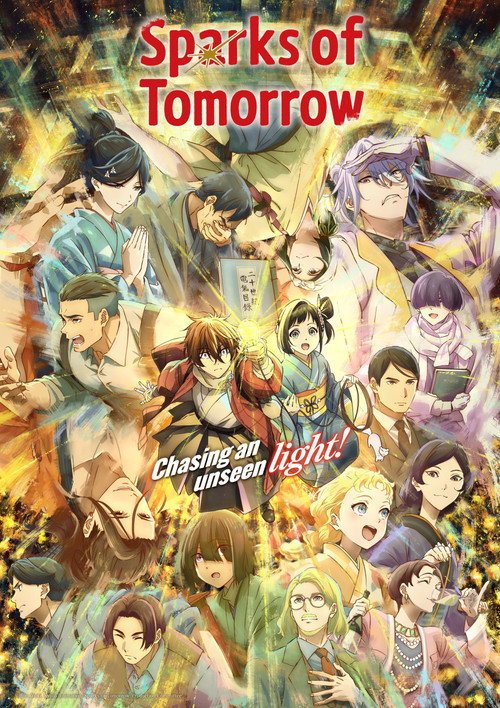
In an alternate past, an unlikely duo team up to look for a missing catalog that could bring electricity to the smoke-filled streets of Kyoto.
Sparks of Tomorrow (2026)
In an alternate past, an unlikely duo team up to look for a missing catalog that could bring electricity to the smoke-filled streets of Kyoto.
Genres: Animation, Drama, Sci-Fi
Rating: TMDB rating 7.7/10
Vivian’s Take
The hook
An alternate past. An unlikely duo. A missing catalog that could bring electricity to the smoke-filled streets of Kyoto. That's not a premise — that's a dare. Sparks of Tomorrow — in Japanese, 20 Seiki Denki Mokuroku, the 20th Century Electrical Catalog — is Kyoto Animation's long-awaited adaptation of Hiro Yuki's novel, and it arrives carrying eight years of expectation: KyoAni announced the project back in 2018, when the novel won an honorable mention at the Kyoto Animation Awards and was published under the studio's own KA Esuma Bunko label. Then came the years the studio spent rebuilding — creatively and literally — and the project waited. It finally premiered July 5, 2026, thirteen episodes running through September 27, streaming worldwide on Netflix in both Japanese and English.
The "smoke-filled streets of Kyoto" detail is doing the real world-building work. This isn't a shiny retro-future; it's a city choking on its own industry, an alternate early 20th century where technological progress took a different fork and a steam monopoly froze the world in place. Series director Minoru Ota — making his directorial debut here — has been explicit about the visual strategy: "We designed the everyday scenes to feel dark and convey the stagnation of this society that has long been stuck with no technological progress beyond steam engines. We wanted the gloomy atmosphere of the setting to provide extra weight to the characters' cathartic moments." The darkness isn't mood for mood's sake. It's the argument of the show: this is what a world looks like when the lights never come on, so that when electricity finally appears, it reads as liberation.
The deep cut
What works: the setting is rich territory, visually and narratively — alternate Kyoto gives the animators a city that's both familiar and strange, and the duo structure provides a classic buddy engine. Kihachi Sakamoto (Yuma Uchida) is a boy hardened by his brother's death, grown distrustful after their shared dream of an "Age of Electricity" was cut short. Inako Momokawa (Sora Amamiya) is a deeply devout girl hiding her dreams — and her grief for her deceased mother — deep in her heart. When the two cross paths, they set out to explore the secrets of the mythical 20th Century Electrical Catalog, a glimpse of the future they long for. The performances carry the concept: Uchida gives Kihachi a wounded, prickly intelligence, and Amamiya — one of the defining voice actresses of her generation — makes Inako's quiet faith feel like a load-bearing wall. Around them: Koki Uchiyama as Yosuke Mizoe, Daisuke Ono as Seiroku Sakamoto, Shunsuke Takeuchi, Minako Kotobuki, and a deep bench of veteran voices.
Behind the camera, the craft is unmistakably KyoAni: series composition by Tatsuhiko Urahata, character designs by Kohei Okamura, music by Hitomi Koto, and art direction by Mao Takayama — her first series in the role, after coming up as a background artist on Violet Evergarden: The Movie. Her painted, overcast Kyoto is the show's second protagonist. The music is a story in itself: the ending theme, "Soarin'," was written, composed, and arranged by Ginger Root's Cameron Lew — recorded, by his own account, alone in a bedroom — his first anime theme song, a lo-fi American indie-pop artifact landing in the middle of a Kyoto Animation production. The opening, "Eureka Evrika," comes from Luna Goami. The collision of sensibilities shouldn't work, and it does.
What doesn't: alt-history is a lore trap. The more intricate the divergence, the more the story risks getting lost explaining itself — and "missing catalog" plots live or die on whether the MacGuffin justifies the journey. A thirteen-episode season is also a tight frame for the novel's scope; some threads feel compressed, some emotional turns arrive a scene earlier than they should. The show's answer is to keep the camera on the duo: whenever the mythology threatens to sprawl, it cuts back to Kihachi and Inako, two kids confronting their pasts and carving a path toward a future they once believed in. It's the right instinct, even when the pacing strains.
Who it's for: anime fans who like their science fiction historical — the viewers who want world-building with their wonder, and who'll happily trade some plot momentum for atmosphere.
Cultural context
Anime's alt-history lane is one of its most fertile traditions — the reimagined past as a way of interrogating the present. Sparks of Tomorrow sits in that lineage, but with a distinctive angle: it's not about war or empire, it's about infrastructure. The steam monopoly is a parable about who controls progress and who gets left in the dark, and the catalog — a book of electrical knowledge — is a parable about information as liberation. In a medium that often treats technology as either salvation or apocalypse, the show's quieter claim stands out: that the future is something people build together, one wire at a time.
There's a quieter cultural note too: the "unlikely duo" is anime's most reliable emotional technology. The genre has been pairing opposites for decades because it works — two worldviews in collision generate both comedy and catharsis. Kihachi's distrust and Inako's faith grind against each other productively; each has what the other lost. And for Kyoto Animation, the series is a milestone: an adaptation eight years in the making, a directorial debut, a first-time art director, a first-time anime theme songwriter — a studio betting on new voices to tell an old-fashioned story about hope. The smoke clears. The lights come on. That's the whole show, and it's enough.
The verdict
Sparks of Tomorrow is built on one of alt-history anime's most fertile questions: what if the lights came on differently? The smoke-filled Kyoto setting gives the show atmosphere to spare, the missing-catalog quest gives it momentum, and the Kihachi-Inako duo gives it a heart. It doesn't always escape the lore trap, but when it trusts its characters over its mythology, it's genuinely moving — a reminder that Kyoto Animation's greatest special effect was never the animation. It was sincerity.
Vivian's grade: B — A bright, strange premise with real atmosphere — worth the trip even when the plot flickers.