Tulsa King
TV SERIES
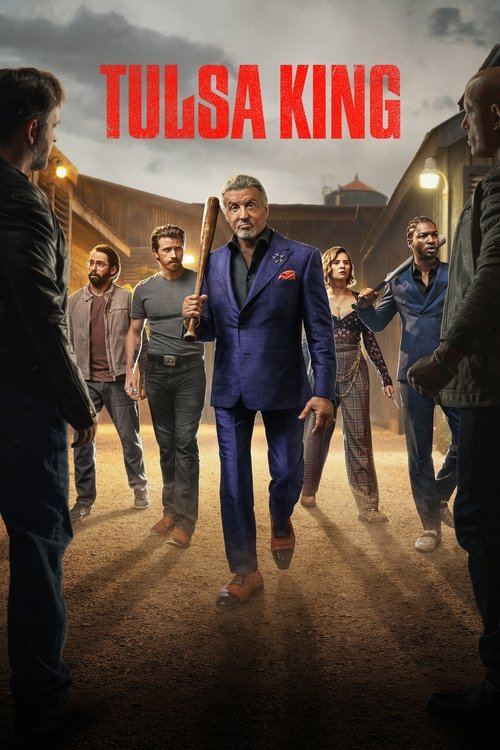
New York mafia capo Dwight "The General" Manfredi is released from prison after 25 years and exiled by his boss to set up shop in Tulsa, Oklahoma. Realizing that his mob family may not have his best interests in mind, Dwight slowly builds a crew.
Tulsa King (2022)
New York mafia capo Dwight "The General" Manfredi is released from prison after 25 years and exiled by his boss to set up shop in Tulsa, Oklahoma. Realizing that his mob family may not have his best interests in mind, Dwight slowly builds a crew.
Genres: Comedy, Crime, Drama
Rating: TMDB rating 8.3/10
Vivian’s Take
The hook
Sylvester Stallone had never led a television series before Tulsa King. Seventy-six years old, five decades a movie star, and he'd never carried a season of TV. Then Taylor Sheridan — the Yellowstone architect, the busiest hitmaker in the business — wrote him a part that plays like it was carved out of Stallone's own mythology: Dwight "The General" Manfredi, a New York capo who did twenty-five years in federal prison without flipping, who kept his mouth shut and his honor intact, and whose reward is exile. The Invernizzi family doesn't welcome him home. They send him to Tulsa, Oklahoma — a punchline with an airport — to set up shop and stay out of the way. Dwight's response is the whole show: fine. I'll build my own thing.
What follows is the great American crime story told as a startup comedy. Dwight lands in Tulsa with a driver's license, a bag of cash, and a quarter-century of mob instincts, and starts assembling an empire from spare parts: Bodhi (Martin Starr), a twitchy dispensary owner who becomes the organization's reluctant tech brain; Tyson (Jay Will), a cab driver turned driver in the other sense, whose exasperated loyalty is the show's warmest relationship; Mitch Keller (Garrett Hedlund), a former bull rider turned bar owner with his own code; and a rotating crew of lawyers, muscle, and fixers. The businesses are aggressively Oklahoman — legal marijuana, a casino, liquor distribution — and the comedy comes from watching old-school New York mob ritual collide with the modern West: Dwight conducting sit-downs in dispensaries, dispensing street justice with a grandfather's warmth and a made man's menace.
The deep cut
What works: Stallone, full stop. The performance is the reason the show exists and the reason it works — a movie star's charisma weaponized for the small screen, playing a man who is simultaneously terrifying and tender. Dwight dotes on his crew, mentors Tyson like a son, romances with old-world gallantry, and then — when the situation requires — reminds everyone exactly what twenty-five years of prison silence bought him. Critics have called it some of the best work of Stallone's career, and they're not wrong: the role lets him be funny, which he'd rarely been allowed to be, and it lets him be vulnerable, which he'd almost never been allowed to be. The fish-out-of-water engine never quite runs dry, because Dwight isn't really out of water — he's just in a smaller pond, and he's the biggest fish in it.
The show's other strength is Sheridan's machine humming underneath. Created by Sheridan and run at various points by Terence Winter (The Sopranos, Boardwalk Empire) — Winter created the show's voice in season one, stepped back, and returns as head writer and executive producer for season four after Dave Erickson's third-season run — Tulsa King has the Sheridan trademarks: muscular dialogue, a romantic view of outlaws, and a deep bench of character actors. Frank Grillo arrived in season two as Kansas City mobster Bill Bevilaqua and stole every scene he touched. Neal McDonough brought granite menace as Cal Thresher. Dana Delany, Annabella Sciorra, Vincent Piazza, Kevin Pollak, James Russo — the guest roster reads like a character-actor hall of fame.
What doesn't: the show's relationship with logic is casual. Rival mobs behave like video-game factions, law enforcement is decorative, and Dwight's empire expands with a frictionlessness that would make a Silicon Valley founder blush. The New York family — the Invernizzis, led by the perpetually furious Chickie — oscillates between genuine threat and comic relief depending on the episode's needs. And the tonal whiplash is real: this is a show that will stage a brutal beating and a weed-dispensary sight gag in the same act. But the whiplash is also the point. Tulsa King isn't prestige TV straining for importance; it's a star vehicle with a wink, and it knows exactly what it is.
Who it's for: anyone who likes their crime stories with a laugh track underneath — the Yellowstone audience looking for something lighter, the Stallone faithful, and viewers who want a mob show where the don is the funniest guy in the room.
Cultural context
Tulsa King premiered in November 2022 and became one of Paramount+'s signature hits — the rare streaming series that crossed over into the culture, the rare Taylor Sheridan show that isn't about cowboys. Its success proved two things: that Stallone, at an age when most action stars are doing direct-to-video, could open a television series; and that the Sheridan formula — take a mythic American archetype, drop him somewhere unexpected, let him build — works outside the ranch. Season two (fall 2024) expanded the canvas; season three (premiered September 21, 2025) introduced Samuel L. Jackson as Russell Lee Washington Jr., a hitman with a shared prison history with Dwight — a backdoor pilot for the franchise's first spinoff.
That spinoff has become a saga of its own: developed as NOLA King, ordered to series, then re-conceived as Frisco King, with Jackson starring as Washington building his own criminal enterprise in Frisco, Texas. All eight first-season episodes were written solely by Sheridan; filming began in March 2026 around Fort Worth; the premiere date is still to be announced. It's the Yellowstone playbook applied to the mob universe — and a sign of how fully Tulsa King has become a franchise rather than just a show.
Season four, premiering October 16, 2026, finds Dwight fighting to legitimize his empire — corrupt politicians, dangerous new enemies, and a crushing personal loss hitting from every direction, per Paramount+. Gretchen Mol joins as a series regular playing Amanda Clark, a ruthless Tulsa politician who wants the mob out of Oklahoma. The logline for the season could be the logline for the series: every hard-won gain comes with harder truths about loyalty, leadership, and the cost of ambition. Dwight keeps trying to go legit. Tulsa keeps pulling him back. We keep watching.
The verdict
A star vehicle in the best sense: Stallone has never been funnier, warmer, or more at ease, and Sheridan's machine gives him a world worth conquering. The plotting is loose and the logic is looser, but the charm is airtight. This is comfort-food crime TV made with A-list ingredients — and there's nothing else on television quite like watching Rocky run a weed empire in Oklahoma.
Vivian's grade: A- — Stallone's late-career triumph: a mob comedy with real heart and the best fish-out-of-water engine on TV.