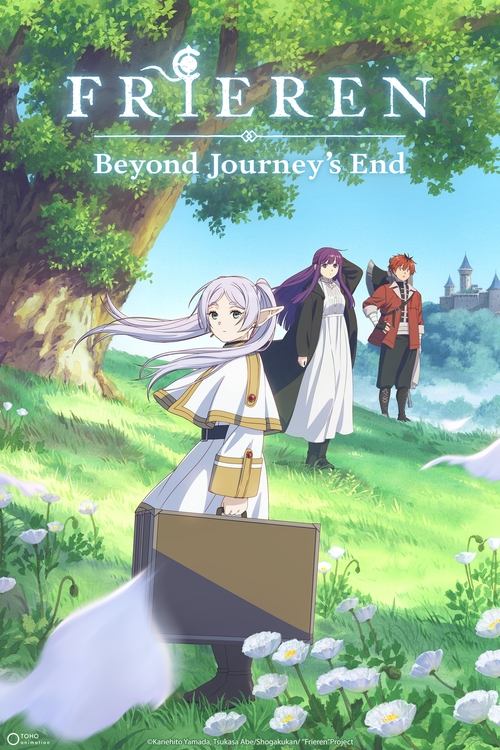
After the party of heroes defeated the Demon King, they restored peace to the land and returned to lives of solitude. Generations pass, and the elven mage Frieren comes face to face with humanity's mortality. She takes on a new apprentice and promises to fulfill old friends' dying wishes. Can an elven mind make peace with the nature of life and death? Frieren embarks on her quest to find out.
Year — 2023
Genres — Action, Animation, Drama, Sci-fi
TMDB rating — TMDB 8.8/10
Vivian's grade — A+
Vivian's Review
Is it worth your time?
Read Vivian's full review▾
The Hook
The Demon King is defeated. The heroes go home. And then — decades pass, the humans grow old and die, and the elven mage Frieren, who barely noticed the years passing, is left to understand what the journey actually meant. Frieren: Beyond Journey's End starts where every fantasy epic ends, and it's the most quietly devastating premise in modern anime.
The 8.8 TMDB rating makes it the highest-rated title on this entire list, and it's not close. That's not hype — that's consensus. In a medium crowded with power fantasies, Frieren is a grief fantasy, a time fantasy, a fantasy about what it costs to outlive everyone you've ever loved.
The Deep Cut
What works is everything the genre usually rushes past. The show's radical act is treating time as the real subject: an elf's centuries against a human's decades, the way small moments compound into a life, the belated understanding that the adventure was never the point — the people were. Frieren taking on a new apprentice and honoring old friends' dying wishes gives the abstraction a beating heart.
What doesn't: if you need your fantasy loud, look elsewhere. Frieren's pace is meditative to the point of defiance — long silences, small gestures, episodes where the biggest event is a conversation remembered too late. Some viewers will bounce off the stillness. They're wrong, but they'll bounce.
Who it's for: anyone who's ever lost someone and understood them better afterward — which is to say, everyone, eventually. And anime skeptics: if one show converts you, it's this one.
Cultural Context
Frieren is the crown jewel of anime's prestige era — the proof that the medium can do what the best literature does, and do it with images no novel could dream of. It belongs on the shelf with the art form's landmarks, the shows people will still be discovering decades from now.
Culturally, its timing is perfect. A generation raised on endless fantasy franchises — where victory is the end of the story — was ready for a story about what victory leaves behind. Frieren looked at the hero's journey and asked the question nobody asks: what does the elf do on Monday, after the parade? The answer turned out to be one of the great television achievements of the decade.
A+
Vivian's verdict: A masterpiece about time itself — the rare fantasy that understands the real magic was the moments we wasted along the way.
Previously Deep Dive
Frieren: Beyond Journey's End: the show that starts where every fantasy ends
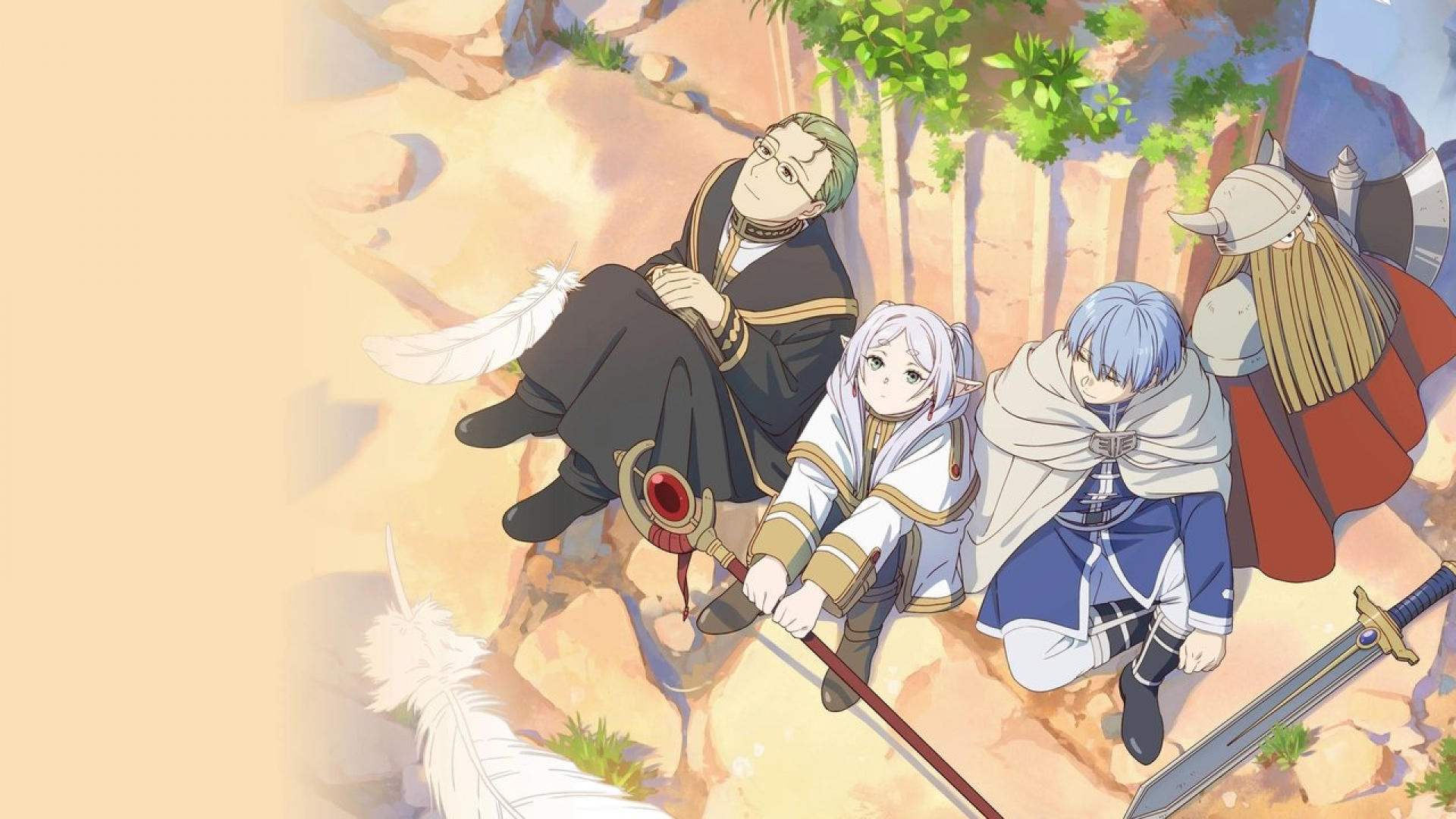
Frieren, Fern and Stark — the new party on the old hero's road. Key art via Madhouse.
The premise
The Demon King is dead. The heroes go home. And then the camera stays exactly where every other fantasy would have cut away: decades pass, the humans grow old, and the elven mage who barely noticed the years passing is left to understand what the journey actually meant. Frieren: Beyond Journey's End, adapted from the manga by Kanehito Yamada and Tsukasa Abe, begins fifty years after the ten-year quest that saved the world — with Frieren returning to visit her old party and watching Himmel, the hero, die of old age before her unchanging eyes.
Her regret becomes the entire engine of the series: she never really got to know them. So Frieren takes on a new apprentice, the young mage Fern, and sets out north on a journey to the resting place of souls — part pilgrimage, part atonement — retracing the steps of the old quest while fulfilling the dying wishes of her former companions. The show's radical act is treating time itself as the subject. An elf's centuries against a human's decades; the way small moments compound into a life; the belated understanding that the adventure was never the point — the people were. It is a grief fantasy, a time fantasy, a fantasy about what it costs to outlive everyone you have ever loved.
Cast and characters
The heart of the show is Frieren herself, voiced in Japanese by Atsumi Tanezaki, who plays the thousand-year-old elf with a beautiful, maddening emotional flatness — not because she feels nothing, but because her feelings arrive at human scale in geological time. Every small crack in that stillness, every belated smile at a memory, lands like a thunderclap precisely because of how long the show makes you wait for it.
Opposite her is Fern, voiced by Kana Ichinose, the orphan Frieren inherited from her old priest companion Heiter — disciplined, prickly, and the show's true emotional translator, constantly converting Frieren's centuries of experience into something human-sized. And there is Stark, voiced by Chiaki Kobayashi, the red-haired warrior brought on for muscle who is secretly terrified of everything he fights — a coward who shows up anyway, which is the show's favorite kind of courage. Around them orbits the old party in flashback: Nobuhiko Okamoto's Himmel, the vain, kind hero whose statue-pose narcissism curdled into genuine legend; the drunken priest Heiter; the taciturn dwarf Eisen, who outlives them all.
Seasons
The first season aired from September 2023 to March 2024 — a rare 28-episode run for a prestige fantasy — produced by the legendary studio Madhouse under director Keiichiro Saito, with series composition by Tomohiro Suzuki and a score by Evan Call that does as much emotional heavy lifting as any script. The season adapted the manga through the first-class mage examination arc, balancing its meditative pacing with spectacular action sequences like Frieren's duel with her clone and the battles against the demons, which confirmed that the show's stillness was a choice, not a limitation.
The second season premiered on January 16, 2026 — ten episodes running weekly through March on Nippon TV's Friday Anime Night, simulcast worldwide on Crunchyroll — with Madhouse returning and Tomoya Kitagawa taking over directorial duties from Saito, supported by the original staff and the returning principal cast. It picks up with Frieren, Fern and Stark pressing deeper into the Northern Plateau, and into the manga's Golden Land arc — the story's most philosophically loaded territory, where Frieren's empathy for the inhuman collides with the party's resolve. Season one remains streaming on Crunchyroll and Netflix in the US, Canada and Latin America, and the franchise keeps growing outward — including the "Echoes of Adventure" story-driven attraction at Universal Studios Japan, a twenty-minute walk through Frieren's gentle everyday scenes and fierce spellcasting moments.
Critical reception
It is difficult to overstate how thoroughly this show was canonized. Season one shot straight to the top of MyAnimeList's all-time rankings with a 9.28 — dethroning Fullmetal Alchemist: Brotherhood, the ranking's untouchable king for over a decade — and season two went higher, climbing to a 9.31, beating the show's own record. It is not hype; it is consensus, from a fan base not known for agreeing on anything. The show took the biggest prizes at the Crunchyroll Anime Awards, including Anime of the Year, and the conversation around it has never really stopped: every few months another critic, essayist or newcomer rediscovers it and writes the same stunned appreciation.
The praise has consistently landed on the same two pillars. First, the animation: Madhouse delivered sequences that are among the finest the studio has ever produced — patient, painterly, and suddenly, breathtakingly kinetic. Second, the writing: Yamada's manga was already one of the most decorated of its generation, and the adaptation preserves its devastating economy. The show trusts silence. It lets a look hold. It understands that the distance between "I should have asked" and "I never asked" is a whole life.
Cultural impact
Frieren is the crown jewel of anime's prestige era — the proof that the medium can do what the best literature does, and do it with images no novel could dream of. It belongs on the shelf with the art form's landmarks, the shows people will still be discovering decades from now. A generation raised on endless fantasy franchises — where victory is the end of the story — was ready for a story about what victory leaves behind. The series looked at the hero's journey and asked the question nobody asks: what does the elf do on Monday, after the parade? The answer turned out to be one of the great television achievements of the decade — a show about time that will outlast its own.