Follow the misadventures of four irreverent grade-schoolers in the quiet, dysfunctional town of South Park, Colorado.
Vivian's Take
By Vivian · Previously's film & TV critic
The Hook
South Park has been on television since 1997. Let that sink in. Four foul-mouthed grade-schoolers from a fictional Colorado town have outlasted presidencies, outlived entire networks' identities, and survived every attempt to cancel, tame, or explain them. There is no other show with this kind of longevity that still matters this much — and the reason is brutally simple: it never stopped being angry at the right things.
The premise never changed — the misadventures of four irreverent kids in a dysfunctional town — because it never needed to. South Park isn't really about Cartman, Stan, Kyle, and Kenny. It's about America, with the kids as the only characters honest enough to say what the adults are all thinking. The town is the country. The kids are the id. Everything else is just this week's news cycle wearing a parka.
The Deep Cut
What works is the speed. No animated show in history has turned around episodes this fast, and that production model is the entire artistic point: South Park can respond to the culture while the culture is still happening. Other satires are essays; South Park is a group chat with animation. When it hits — and it still hits multiple times a season — nothing else on television is funnier or more surgically precise.
What doesn't: the serialization experiments. The seasons that tried to be one long story often sagged in the middle, because South Park's genius is the standalone missile, not the novel. And yes, some episodes have aged badly — the show's both-sides instincts occasionally land it in false-equivalence territory. But a show this prolific was always going to have misses. The hit rate is the miracle.
Who it's for: anyone who thinks satire should punch in every direction, anyone exhausted by comedy that asks permission first, and anyone who wants to understand America — because future historians will learn more from South Park than from most prestige dramas.
Cultural Context
South Park invented the modern animated satire economy. Without it, there's no Rick and Morty, no BoJack Horseman, no Big Mouth — the entire idea that animation could be the sharpest voice in the cultural conversation starts here. Its massive streaming deal wasn't just a payday; it was the industry admitting that two guys with construction-paper aesthetics had built the most durable comedy institution of the century.
The show's real legacy is its refusal to be captured. Every faction has tried to claim it or kill it, and it has offended all of them with perfect equanimity. In an era when every piece of art arrives with a team and a statement, there's something almost punk about a show that still just wants to make the powerful look ridiculous.
A
Vivian's verdict: Nearly three decades of not missing. The most important American satire ever made.
South Park: twenty-nine years on, still television's sharpest satire
The gang's all here: Stan, Kyle, Cartman and Kenny, twenty-nine years and counting. Image via Comedy Central press.
The premise
Four foul-mouthed grade-schoolers in a fictional Colorado mountain town watch the adult world lose its mind, one absurd week at a time. That has been the whole engine of South Park since August 13, 1997: Stan Marsh, Kyle Broflovski, Eric Cartman and Kenny McCormick — plus their classmates, their parents, and the spectacularly incompetent adults of South Park, Colorado — serve as the show's delivery system for satire so fast it is usually finished within six days of the event it is mocking.
The production cycle is the famous part, and it is real: each episode is written, animated and delivered within about a week of airtime, usually the week before it airs. That speed is what lets the show mine comedy out of current events faster than any other animated program, and faster than every live-action comedy except Saturday Night Live. It is also why premiere dates are treated as advisory rather than binding — when the show is chasing a breaking story, episodes have been delayed by days while Parker and Stone re-cut the ending. The crude construction-paper animation is the original joke and the lasting advantage: the show can be redrawn and rewritten at a pace no polished series can touch.
Cast and characters
Trey Parker and Matt Stone voice nearly everyone who matters: Parker is Stan and Cartman (and Randy Marsh, Mr. Garrison, Timmy, and a rotating cast of dozens); Stone is Kyle and Kenny (and Butters, Gerald Broflovski, and just as many others). The women's voices were for years supplied by April Stewart and Mona Marshall, who between them cover nearly every female character in the town. Behind the camera, Adrien Beard directs, and the writing room has included, over the decades, names like Pam Brady, Nancy M. Pimental, David A. Goodman, Bill Hader and others — though Parker and Stone's authorial voice has never really been shared.
The character dynamics are the show's real longevity trick. Stan and Kyle are the conscience and the argument; Cartman is the id with a body count; Kenny is the punchline who became a soul. Around them: Butters, the sweet chaos goblin; Randy Marsh, who evolved from straight-man dad into the show's most reliable engine of midlife-crisis comedy (and the proprietor of Tegridy Farms); Mr. Garrison, the show's longest-running vehicle for political satire; and PC Principal, Vice Principal Strong Woman, and a town full of adults who are always, reliably, the problem.
Seasons
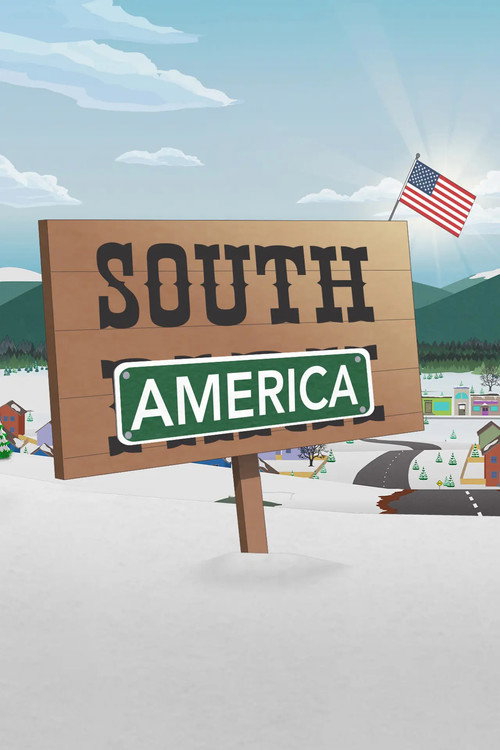
Season 29 premiered on September 16, 2026, on Comedy Central at 10 p.m. ET, streaming the next day on Paramount+ in the US, Canada and Australia — and it arrived with a joke built into its marketing: after twenty-nine years, the show "rebranded" itself as South America, roasting President Trump's renaming spree (Gulf of America, Lake America) with the kind of joke only South Park can pull off. The six-episode season — one more than seasons 27 and 28 — airs biweekly on Wednesdays: September 16 (premiere, "South American Biker Gangs," in which e-bikes take over the town), September 30, October 14, October 28, November 11, and November 25.
The show is not going anywhere. In July 2025, Parker and Stone signed a five-year, $1.5 billion deal with Paramount Global for fifty new episodes across five seasons, running through 2030 — a contract that keeps South Park as the centerpiece of Paramount's adult animation strategy and, at the time it was signed, was one of the largest talent deals in television history. All previous 28 seasons are available on Paramount+, and new episodes continue to air first on Comedy Central, the network that has been the show's home since 1997.
Critical reception
The trophy case is absurd for a show about construction-paper children swearing: six Primetime Emmys for Outstanding Animated Program, including the 2026 win; twenty-one total Emmy nominations; a Peabody Award; and in 2026, South Park became the first animated show ever included in the Television Academy Honors, and the first animated series nominated by the Producers Guild in the Best Episodic Comedy category — with American Film Institute and Critics Choice recognition alongside. The show was the number one show on cable in 2025 among adults 18–49, with the season 27 return delivering the show's best average share in the demo in 27 years and its most-watched season in six.
Critics have long since stopped debating whether the show is "good" and settled into arguing about what it is: the last mass-market satire with teeth, the most influential comedy voice of its generation, or both. Season 27's run drew particular attention for its sustained, brutal mockery of the Trump administration — the season premiered with the president literally in bed with Satan — and season 29 has picked up the thread without blinking. The Trump parody, a sensitive bully who threatens to tariff or sue anyone who crosses him, has become the show's defining long-form satire target of the late 2020s.
Cultural impact
South Park's fingerprints are everywhere. It pioneered the idea that animation could be a real-time response to the news — a model that every fast-turnaround satire since has imitated and none has matched. It entered the language: "Member berries," "They took our jobs," "Oh my God, they killed Kenny," and a generation's understanding of what political correctness debates actually sound like. It survived censorship fights that would have killed lesser shows — the Muhammad episodes, pulled episodes, streaming-library disputes — and came out the other side with its reputation as comedy's most independent voice intact. Twenty-nine years in, the show that was supposed to be a crude fad is television's sharpest satire — because the one thing Parker and Stone have never lost is the willingness to be six days ahead of everybody else.