Futurama
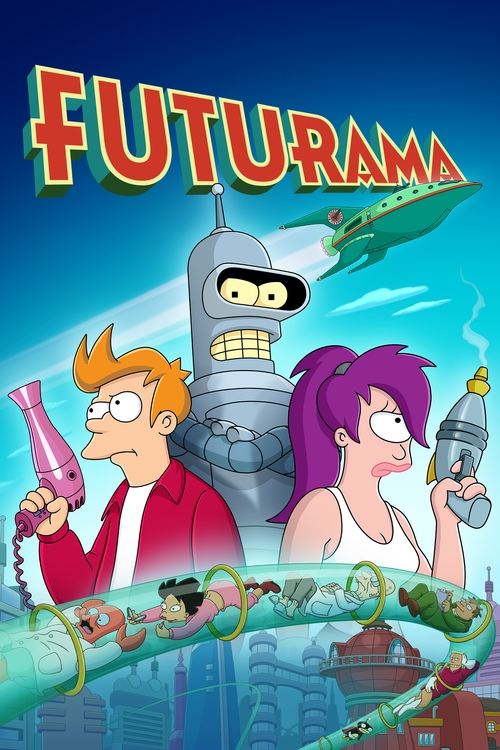
The adventures of a late-20th-century New York City pizza delivery boy, Philip J. Fry, who, after being unwittingly cryogenically frozen for one thousand years, finds employment at Planet Express, an interplanetary delivery company in the retro-futuristic 31st century.
Vivian's Take
The Hook
Philip J. Fry was a pizza delivery boy who fell into a cryogenic tube on New Year's Eve 1999 and woke up a thousand years later. That was 1999. Since then, Futurama has been cancelled, revived, cancelled again, and revived again — a show that refuses to stay dead with the same stubbornness as its own characters. The adventures of the Planet Express crew in the 31st century remain the gold standard for what animated sci-fi comedy can be.
The premise is the ultimate reset button: a 20th-century slacker loose in a retro-futuristic tomorrow, delivering packages across the galaxy with a cyclops captain, a kleptomaniac robot, and a brilliant one-eyed engineer. It's a workplace comedy where the workplace is the universe — and the universe, it turns out, is mostly paperwork, bureaucracy, and bad decisions.
The Deep Cut
What works is the density. Futurama packs more jokes per minute than almost anything in television history, and they're jokes that reward intelligence — the writing room famously included doctorate-level mathematicians, and it shows in gags that operate on three levels at once. But the real miracle is the heart: this is the funniest show ever made about the saddest things — a dog waiting forever, a brother's dream deferred, love across a thousand years. That's not comedy. That's power.
What doesn't: the revivals, while welcome, have a patchier hit rate than the original run. Some new episodes feel like the show doing an impression of itself — the voices right, the soul slightly off. But the floor is so high that even a mid-tier Futurama episode outclasses most comedies' best efforts. The 8.4 rating spans all eras, and that's the audience telling you the revivals earned their place.
Who it's for: anyone who likes their comedy with a bibliography, anyone who thinks cartoons can't make you cry (prepare to be corrected), and anyone who has ever felt like a 20th-century person lost in the 21st.
Cultural Context
Futurama is the great what-if of animation history — what if the smartest comedy ever made had gotten luckier with its timeslot? Instead it became the patron saint of the cancelled-too-soon, the proof that quality eventually finds its audience through reruns, DVDs, and streaming. Every revival-era success story owes it a debt: it proved fandom could resurrect the dead.
Its deeper legacy is tonal. Futurama proved you could be the silliest and the saddest show on television simultaneously — that a joke about a robot's shiny metal posterior and a meditation on mortality could live in the same 22 minutes. Modern animated comedy's emotional ambition starts here. The future, it turns out, was the show all along.
The Cast
The Planet Express crew is one of the great voice ensembles in animation, and it survived every cancellation intact. Billy West carries the show as Philip J. Fry — and as Professor Farnsworth, Dr. Zoidberg, and Zapp Brannigan. Katey Sagal gives Turanga Leela her dry, wounded authority. John DiMaggio is Bender Bending Rodriguez, the booze-guzzling, cigar-chomping robot whose 2022 contract standoff — the pay dispute fans nicknamed "Bendergate" — briefly threatened the Hulu revival before both sides came back to the table. Tress MacNeille, Maurice LaMarche, Lauren Tom (Amy Wong), Phil LaMarr (Hermes Conrad), and David Herman (Scruffy the janitor) round out a bench so deep that background characters routinely steal episodes. Creators Matt Groening and David X. Cohen built the show as the cynical, science-literate sibling to The Simpsons — and staffed it with writers holding actual advanced degrees.
The Cancellations and Resurrections
No show in television history has died and come back this many times. Futurama premiered on Fox in March 1999 and ran four seasons before the network — which never knew what to do with it, burying it in preempted time slots — cancelled it in 2003. Reruns on Cartoon Network's Adult Swim proved the audience had been there all along, and four direct-to-DVD films (2007–2009) were recut into a fifth season for Comedy Central, which then ordered two more seasons (2010–2013) before cancelling it again — the 2013 finale "Meanwhile" was designed as a series-ender. Then Hulu called: a 20-episode revival order in February 2022, new episodes premiering July 2023, with the satire finding fresh targets in cryptocurrency, streaming culture, AI, and cancel culture. Hulu renewed it again, and the revival era stretched through season 14, which ended in September 2026 with another finale engineered to double as a series finale — just in case. No fifteenth season has been ordered, but Groening told Variety: "They can put us in a coffin. They can nail the lid shut, but they can't bury us. We will rise again." And at San Diego Comic-Con 2026, the team announced three "XXXL-Sized" specials — movie-length episodes — beginning with a Christmas installment in 2027.

Reception and Legacy
The numbers validate the resurrections: Nielsen measured 11.75 billion minutes of Futurama viewing in 2024, making it the sixth most-streamed original series of the year — for a show that technically ended three times. Critics have long treated it as the great what-if of network animation, a show whose science jokes were written by people who actually understood the science. The trophy case holds multiple Primetime Emmys including Outstanding Animated Program. But the legacy is emotional as much as intellectual: "Jurassic Bark" — Fry's fossilized dog waiting a lifetime outside a pizzeria — and "The Luck of the Fryrish" remain the genre's gold standard for the half-hour gut-punch. Futurama proved that a cartoon about the year 3000 could be the most human show on television, and that the future it mocked in 1999 would keep arriving right on schedule.