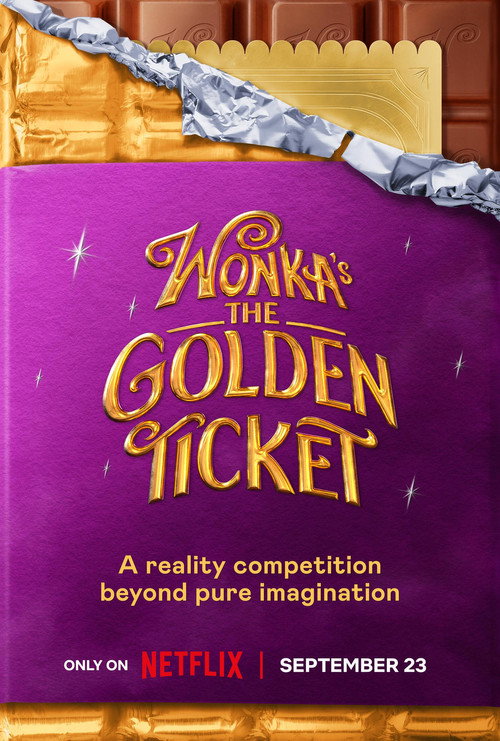
Wonka's The Golden Ticket (2026)
In this one-of-a-kind reality competition, lucky players step inside Wonka's Chocolate Factory to face unpredictable games, tests and temptations.
Year — 2026
Genres — Reality
TMDB rating — TMDB 6.0/10
Vivian's grade — C+
Vivian's Review
Is it worth your time?
Read Vivian's full review▾
The Premise
The golden ticket has gone from a childhood fantasy to a casting call. Wonka's The Golden Ticket takes the immortal premise — the Chocolate Factory, the wonder, the impossible — and feeds it through the reality-competition machine. Twelve Golden Ticket winners step inside a full-scale recreation of Wonka's factory, each bringing a partner of their choice, and compete in pairs through unpredictable games, tests, and temptations that push them physically, mentally, and morally. The prize: $3 million, presented as a "lifetime supply of money" — paid out, in the fine print the show is honest about, as a six-figure annuity over thirty years.
It is a bet that makes complete sense on paper. Intellectual property is the only currency Hollywood trusts anymore, and Wonka is as evergreen as it gets: a brand that has survived generations of reinvention and come out the other side smelling like cocoa. Turning the factory into an arena is the IP-to-reality pipeline doing exactly what it was built to do. The twist that makes this one different from every other IP competition: there is no conventional host. Willy Wonka himself presides — voiced by an AI recreation of Gene Wilder, who played the character in the 1971 film and died in 2016. The estate approved it. His widow, Karen Wilder, gave the production permission and provided old recordings and audiobooks to train the voice, built with the AI voice company ElevenLabs. The factory's god is a ghost made of machine learning.
The Cast (of Thousands, Plus Holograms)
Reality competitions don't have casts so much as contestants, and the twelve pairs are the show's human engine: Marcy and Joanne, Shawn and Garrison, Ray and Jackson, Bill and Kayla, Tatum and Kellye, and seven more duos — each pair entering with someone they already know, which means every temptation on offer doesn't just test greed, it tests the relationship. One partner plays it safe while the other wants the dramatic move; one shares information while the other hoards it. The format is smarter than it looks: elimination stops being about speed or luck and starts being about behavior inside the factory.
The celebrity layer is where the show gets genuinely fun. Howie Mandel, Nick Cannon, and Wayne Brady appear via hologram to host the games inside Wonkavision 2.0 — a rebuilt version of the television studio from the 1971 film, where Mike Teavee once got himself transmitted. The games have names like "Wheel of Misfortune," "Bubble Jeopardy," and "Steal or No Steal," and the three hosts aren't cameos; they're embedded in the format, beaming in to run their segments. And then there are the legacy touches that will melt anyone who grew up on the original: Rusty Goffe, who played an Oompa-Loompa in the 1971 film, returns as an Oompa-Loompa, and Peter Ostrum — the original Charlie Bucket himself — makes a cameo. The show knows exactly which heartstrings it is pulling.
The Season
Nine episodes, released in two batches: seven on September 23, 2026, and the two-part finale on September 30. The split-week schedule is doing deliberate work — the premiere establishes the players and the rules, the finale decides who survives Wonka's tests, and the seven-day gap in between is a spoiler boundary the show wants the internet to argue across. Eureka Productions made the series in Australia, and the scale is the real star: an 88,000-square-foot set built across three studios on the Gold Coast, complete with a 27,000-gallon "chocolate" river and two miles of lickable wallpaper. Rich Kim directs. The production rebuilt the factory's familiar spaces with practical illusion work so the building itself feels like an active rule-maker rather than decoration — the factory creates problems, not just backdrops.
The Reception
The audience showed up before the critics finished their sentences. By September 24 — one day after premiere — the show hit No. 2 on Netflix's U.S. Top 10 TV list, per FlixPatrol, blowing past The Gentlemen and several established titles. The critics, meanwhile, have been cooler: a 20 percent score on Rotten Tomatoes across the first five reviews, with the consensus landing on "mixed." The 6.0 audience rating tells the fuller story: viewers are charmed and slightly unconvinced, often in the same episode.
The divide is really about the Wilder voice. For some viewers, the estate-approved AI recreation is a lovely tribute — the 1971 film's soul presiding over the fantasy. For others, it's the whole uncanny-valley debate in miniature: an estate-approved imitation is still an imitation, and every scene it narrates carries the pressure of the comparison. The show's defenders have a fair counter: the voice settles in once the challenges develop their own personality. The skeptics have a fair counter to that: it shouldn't have to. Both things can be true, and on this show, they are.
Cultural Context
This is the nostalgia economy at full churn. The last few years turned every beloved childhood property into a competition — survival games, baking battles, treasure hunts — and Wonka was always going to get its turn. But The Golden Ticket arrives at the exact moment audiences are both hungry for comfort IP and quietly exhausted by how it's deployed, which makes it a useful stress test: can wonder itself be gamified? Can you manufacture the feeling of finding a golden ticket, or does the manufacturing kill the feeling?
The AI Wilder question is the bigger cultural story, and the show knows it. This is one of the highest-profile uses yet of a recreated performer voice with estate approval — not a deepfake scandal but a licensed resurrection, with the widow's blessing and the audiobooks as training data. How audiences receive it will shape the next dozen decisions like it. If the hologram hosts are the show's past (beloved TV personalities, beamed in) and the contestants are its present (real people, real relationships, real greed), the Wilder voice is its future tense — a preview of an entertainment industry increasingly comfortable with the dead as talent.
The smarter read on the whole enterprise: the factory was always a test of character disguised as a tour, and a reality competition is a test of character disguised as entertainment. The fit is better than the cynics admit. Whether the show earns it — whether the games have personality, whether the temptations reveal anything true about the players — is the difference between a sugar rush and a meal. This one lands somewhere in the middle, which in 2026 counts as a respectable outcome for IP this heavily strip-mined.
Vivian's verdict: A golden ticket to a candy-coated competition that entertains in the moment and evaporates like sugar on the tongue — but the factory is magnificent, and the ghost of Gene Wilder is doing his best.