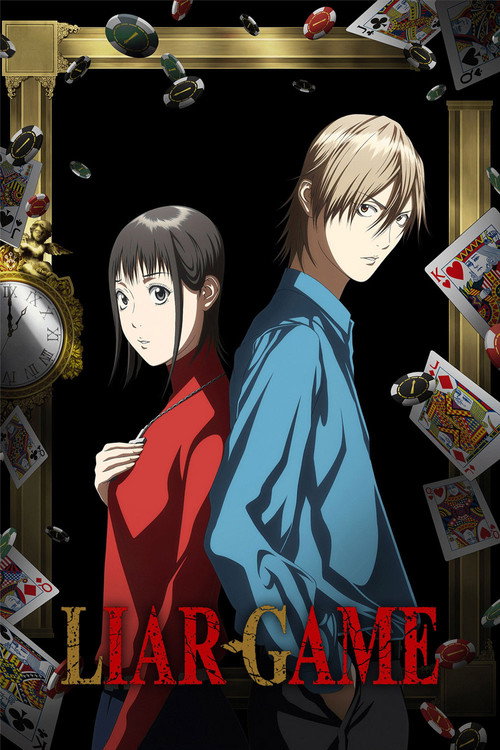
LIAR GAME (2026)
Madhouse's anime adaptation of Shinobu Kaitani's legendary psychological manga finally arrives: naive college student Nao Kanzaki receives a suitcase containing 100 million yen and an invitation to the LIAR GAME, a tournament of deception where she must outwit rivals or drown in debt. Premiered April 7, 2026, on TV Tokyo; streaming globally on Crunchyroll. A second season is already announced.
Year — 2026
Studio — Madhouse
Network — TV Tokyo / BS TV Tokyo
Episodes — 26 (Season 2 announced)
Streaming — Crunchyroll (global, excl. Japan/China)
Starring — Saya Hitomi, Takeo Otsuka, Kazuhiro Nakaya
Vivian's grade — B+
Vivian's Review
Is it worth your time?
Read Vivian's full review▾
The Hook
A strange letter, a suitcase with 100 million yen, and an invitation you can't refuse: welcome to the LIAR GAME, a tournament run by the shadowy LGT Office in which players steal each other's money through rounds of elaborately rigged psychological games — and losers sink into debts they can never repay. Nao Kanzaki, an impossibly honest college student, is the worst possible player for this game, which is exactly why the story works: she recruits Shinichi Akiyama, a genius ex-con artist fresh out of prison for bankrupting a pyramid scheme, to be her brain while she remains its conscience.
This is the anime adaptation fans waited nearly two decades for. Shinobu Kaitani's Liar Game manga ran in Weekly Young Jump from 2005 to 2015 — 19 volumes of game-theory-as-drama that became a defining text of the psychological battle genre. Japan already adapted it twice as a live-action drama (2007, with a second season in 2009–10) plus two films (2010’s The Final Stage and 2012’s Reborn), and Korea remade it in 2014. But the manga’s most devoted readers always said the material wanted the one thing live action couldn’t give it: the full, unhurried, 26-episode treatment. Madhouse finally delivered it, premiering April 7, 2026, on TV Tokyo and BS TV Tokyo, streaming worldwide on Crunchyroll.
The Players
Saya Hitomi voices Nao Kanzaki, and she threads the needle the role demands — Nao’s incorruptible honesty has to read as a moral superpower rather than stupidity, and Hitomi keeps her warm, stubborn, and strategically underestimated. Takeo Otsuka (fresh off a string of leading-man turns) is Shinichi Akiyama, the cool, calculating ex-fraudster whose contempt for the game’s organizers slowly curdles into something like faith in Nao’s way of playing. Their dynamic — idealism and cynicism in a trench coat, each forcing the other to evolve — is the masterstroke of the whole franchise, and the anime gives it room to breathe.
Kazuhiro Nakaya voices Leronira, the masked, unsettling dealer who explains the rules with the cheerful menace of a casino pit boss from hell, joined by Nobuo Tobita, Yoji Ueda, and a deep bench of veteran supporting voices. The casting philosophy is clear: surround the two leads with character actors who can sell a monologue about probability theory like it’s a death threat.
The Studio
This is Madhouse operating in its sweet spot. Chief director Yuzo Sato (a veteran of the studio’s psychological-thriller heyday) and director Asami Kawano run a tight, claustrophobic ship; series composer Tatsuhiko Urahata structures each game round like a heist film in reverse; character designer Kei Tsuchiya keeps Kaitani’s sharp, angular faces intact; and composer Yugo Kanno’s score does the thing great game-anime music must do — make a conversation about voting mechanics feel like a bomb countdown.
What makes this adaptation sing is fidelity with judgment. The anime doesn’t just animate the manga’s famous game rounds (the Minority Rule game, the Contraband game, the intricate team battles of the later arcs); it understands that Kaitani’s real subject was never the puzzles. It was the question underneath them: in a system engineered to reward deceit, is honesty a strategy or a suicide note? The show stages that question as a 26-episode argument between its two leads, and it never lets either side win cheaply.

The Deep Cut
What works is the gamesmanship. Psychological battle anime lives or dies on the intricacy of its cons, and LIAR GAME delivers schemes within schemes — every round is a logic puzzle where the real game is reading people. The anime format turns out to be the ideal delivery system: internal monologues, probability graphics, and the delicious slow zoom on a player realizing they’ve been played three moves ago.
What doesn't: the moralizing can get heavy-handed. Nao’s incorruptible honesty is the thematic point, but it’s also dramatically inconvenient, and the show occasionally bends its own cleverness to keep her pure — Akiyama will execute a plan of breathtaking cynicism only for Nao to veto the final cruelty, and the show expects us to cheer the veto rather than notice the contrivance. Newcomers should also know this is a talky, twisty watch — the action is all psychological, and a single game round can sprawl across four episodes of escalating mind games.
Who it's for: Death Note veterans, poker-face enthusiasts, and anyone who likes their anime as a chess match where every piece is lying about what it is. Manga readers get the faithful adaptation they’ve demanded since 2015; newcomers get the definitive entry point the franchise never had.
Cultural Context
The psychological game genre is anime’s gift to television — a tradition of turning intellect into spectacle that Western TV has never quite cracked, from Kaiji to Death Note to Tomodachi Game. LIAR GAME sits at the genre’s foundation: Kaitani’s manga essentially wrote the rulebook for the “debt tournament” story, and every imitator since has been working in its shadow. The 2026 anime is both a homecoming and a coronation.
Its arrival lands in a culture obsessed with truth and lies as never before — misinformation, deepfakes, the daily question of who to believe. A show about the strategic value of honesty in a system designed to reward deceit isn’t just entertainment right now; it’s practically a survival guide. That resonance, plus strong streaming numbers on Crunchyroll, is why a second season was announced before the first had even finished airing — the game, it turns out, is only getting started.
Vivian's verdict: The definitive LIAR GAME adaptation — a high-stakes chess match where every move is a lie, and the smartest, most stressful game in town. Manga readers waited 20 years; it was worth it.