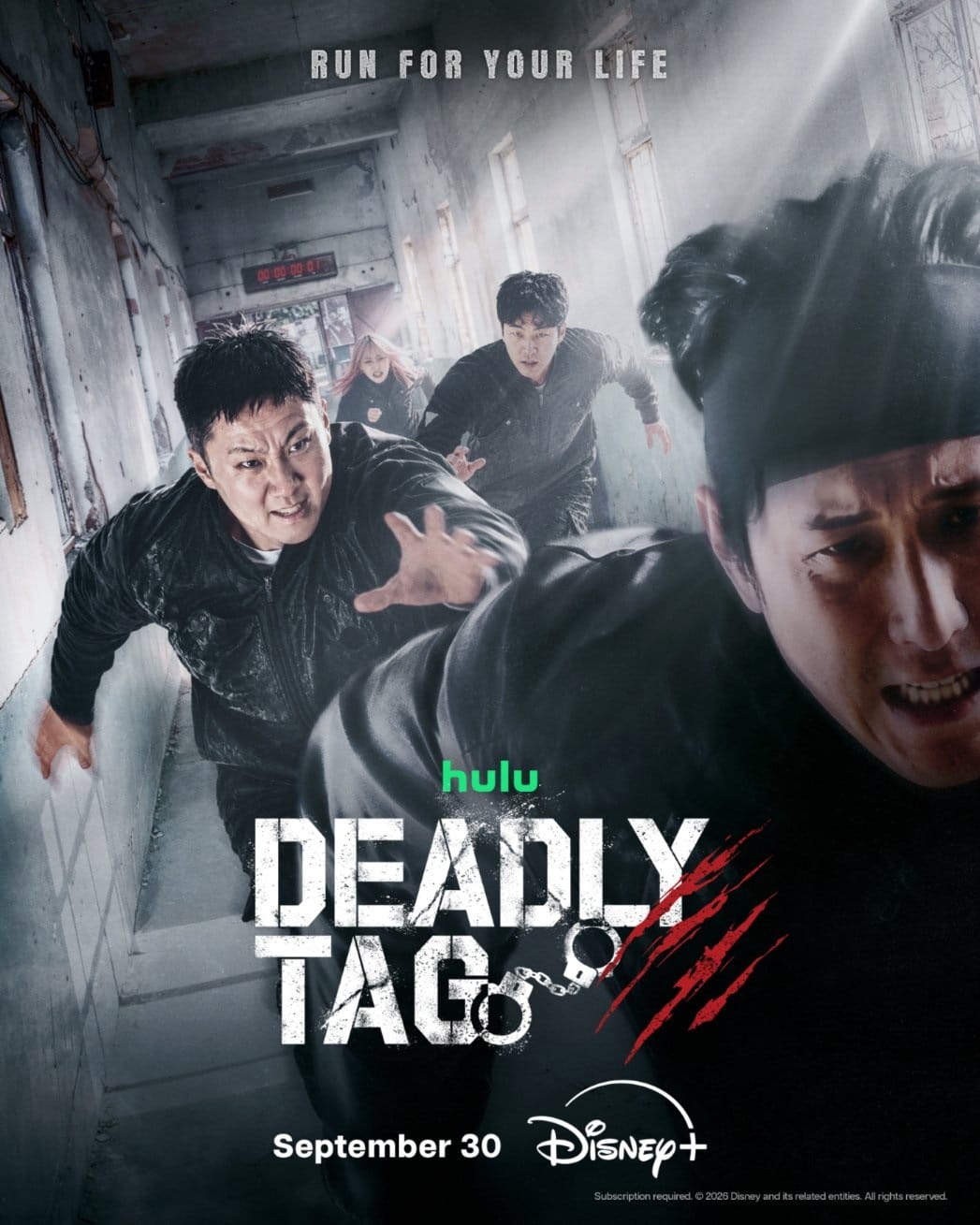
Deadly Tag (2026)
Disney+'s Korean pursuit-survival competition: contestants face physical and mental trials across a vast battlefield while a hidden Seeker pulls the strings. Ten episodes, one winner, nobody to trust.
Year — 2026
Network — Disney+ (Hulu in the U.S.)
Episodes — 10
Created by — Hyun Jung-wan
TMDB rating — Not yet rated
Vivian's grade — C+
Vivian's Review
Is it worth your time?
Read Vivian's full review▾
The Hook
A brutal chase for survival across a vast battlefield where no one can be trusted and only the last one standing wins. Deadly Tag is the survival-reality formula stripped to its studs: no gimmicks in the logline, no twist in the title — just the ancient promise that watching people compete to be the last one breathing never gets old.
And it doesn't, quite. The battle-royale reality show is the genre's cockroach — it survives every trend cycle because the underlying psychology is bulletproof. Put humans in a contest with elimination stakes and alliances become currency, paranoia becomes strategy, and the audience becomes complicit.
The Setup
Deadly Tag is a Korean reality competition series that premiered worldwide on Disney+ on September 30, 2026 (streaming in the U.S. on Disney+ and Hulu). It was created by Hyun Jung-wan, a producer who previously worked on the survival show Game of Blood, and it represents Disney+'s latest bet on the Korean unscripted boom — the same pipeline that turned the country's variety producers into some of the most sought-after format creators on the planet.
The premise takes the childhood game of tag and runs it through survival mode. A mixed cast of contestants — an ex-Navy SEAL, professional athletes, YouTubers, actors, and reality stars — is dropped into a series of physical and mental challenges across a vast play area, all while avoiding being caught by their pursuers. The kicker, and the show's real engine, is the Seeker: a hidden puppet master planted among the contestants, secretly calling the shots. Nobody knows who it is. Everybody has a theory. The result is tag on steroids — part endurance gauntlet, part social deduction game.
Season one runs ten episodes, each around 75 minutes, with the premiere episode titled "Cops and Robbers" — a signal of exactly the register the show wants to live in: schoolyard games, adult consequences.
The Cast
The ensemble is engineered for collision. The lineup includes Jae-gyun Hwang, Pani Bottle, Kyung Soo-jin, Malwang, Jang Eun-sil, Park Ji-min, Kim Ddolddol, Yang Da-il, Yuk Jun-seo, Ji Ji-won, Shin Ji-eun, Yoon Sang-hyun, and Lee Jun-su — a deliberately scrambled mix of physical specimens and media personalities. That's the format's whole bet: the ex-soldier reads the terrain, the YouTuber reads the room, the actor reads the people, and nobody can read the Seeker.
This is the Korean survival-show casting doctrine refined to a science. Shows in this lane learned long ago that pure athleticism makes for boring television — what you need is a room full of people with completely different definitions of winning, then give them a reason to suspect each other. Deadly Tag understands that the Seeker mechanic only works if the cast is paranoid enough to turn on each other before the Seeker ever has to lift a finger.
The Format
Each episode layers physical trials — chases, captures, endurance tests — over the slow-burn psychological game of identifying the Seeker. It's a hybrid that borrows from two proven bloodlines: the Japanese chase format Run for the Money, which Netflix adapted a few years back, and the social-deduction boom that turned every group of friends into amateur detectives. The physical game is the spectacle; the suspicion game is the story.
What works is the purity of that design. No convoluted rulebook, no producer-manufactured twist every episode — just a vast battlefield, untrustworthy competitors, a hidden Seeker, and the clarity of last-one-standing. In a reality landscape bloated with overproduced concepts, there's something almost refreshing about a show that trusts the game. The chases are genuinely propulsive, and the Seeker layer means even a quiet episode has an undercurrent of dread: every alliance might be a trap, every friendly face might be the puppet master.
What doesn't: familiarity is the tax. The survival-reality lane is the most crowded on television, and "brutal chase across a battlefield" describes half a dozen shows you can already stream. The Seeker twist helps, but the show is competing on execution alone — and execution in this genre lives or dies on casting chemistry, which takes a few episodes to ignite.
Reception
It's early days — the series only just premiered, and it hasn't accumulated a TMDB audience score yet. Early tracking (a 67/100 on Reelgood from the first handful of ratings, split between love and dislike) suggests the classic survival-show polarization: viewers who came for the chases are getting them, and viewers who wanted something new are still waiting. That's about the expected reception curve for a format show in week one; the verdict that matters will be the one rendered around episode six, when the Seeker game has had time to curdle every relationship on screen.
Who it's for: the viewers who never got tired of the format — alliance theorists, betrayal connoisseurs, and anyone who watches competition shows the way other people watch sports. If you've ever yelled "it's obviously him" at a social-deduction game, this is your show.
Cultural Context
Deadly Tag arrives at the absolute peak of the Korean survival wave. What started as physical endurance programming became a full-blown cultural export: the formats, the production grammar, even the casting philosophy now travel the world, and Disney+ has been one of the most aggressive buyers. The show is also downstream of the biggest idea in modern reality TV — that the audience doesn't just want to watch people suffer, it wants to watch people think under pressure. The Seeker mechanic is the genre's answer to that appetite: suspicion as a second screen.
Culturally, these shows are the last appointment television of the streaming age — the rare format that still generates water-cooler debate about who played it right. Deadly Tag doesn't need to reinvent the wheel. It just needs to spin it well enough that you're yelling at your screen by episode three — and pointing at the Seeker by episode four.
Vivian's verdict: The survival-reality wheel keeps spinning — slick, ruthless, and entirely familiar. The Seeker twist is the only thing standing between this and the pile.