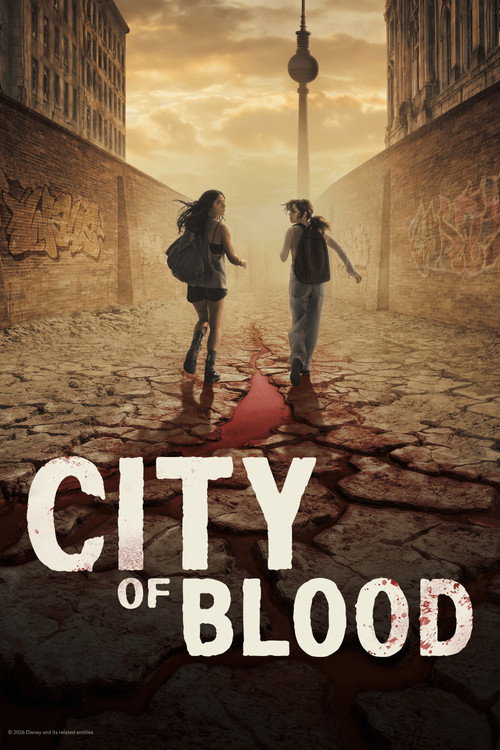
City of Blood (2026)
In a climate-ravaged Berlin, the elite live beneath a climate-controlled dome while vampires turn blood into currency and move on political power. Two estranged sisters are caught in the middle.
Year — 2026
Network — Disney+ (Hulu in the U.S.)
Episodes — 8
Created by — Philipp Kadelbach & Elena Lyubarskaya
Based on — Berlinoir by Reinhard Kleist & Tobias O. Meißner
TMDB rating — ★ 6.4/10
Vivian's grade — B-
Vivian's Review
Is it worth your time?
Read Vivian's full review▾
The Hook
Berlin, divided by climate and class: a privileged few live under a climate-controlled dome while everyone else sweats it out in the heat, the corruption, and the crime. Into this pressure cooker walk two reunited sisters, Bea and Phoebe, and a secret with fangs — vampires are moving on political power, and blood has become the city's currency.
If that sounds like three shows fighting in a trench coat, that's because it is — and that's exactly why it's interesting. City of Blood is the kind of maximalist swing that streaming-era genre TV was built for: take the climate anxiety, take the wealth gap, take the vampire myth, and let them all bleed into each other.
The Setup
City of Blood is an eight-episode German horror thriller that premiered September 16, 2026 on Disney+ (streaming in the U.S. on Hulu). It was created by Philipp Kadelbach — one of Germany's most decorated television directors — and Elena Lyubarskaya, directed by Kadelbach, and produced by Amusement Park Film. And it's an adaptation with real pedigree: the source is Berlinoir, the graphic novel by Reinhard Kleist and Tobias O. Meißner, which imagined an alternate Berlin shaped by a powerful vampire society.
The world: after extreme climate damage has fractured daily life, Berlin is a city-state on the brink. The wealthy elite live beneath the Klima Dome, a fully climate-controlled enclosure where comfort is a birthright. Outside it, the rest of the city sinks into heat, corruption, and violence — resources unstable, institutions hollowed out. Into this divided city come the sisters. Bea and Phoebe were separated as children by a twist of fate. Bea, chronically ill, grew up sheltered and protected with her adoptive mother inside the system's embrace. Phoebe grew up on the streets, learning to survive outside it. When their worlds collide again on the eve of pivotal elections, they uncover the terrifying truth at the center of the season: vampires control organized crime in Berlin, and they're done operating from the shadows — they want political power. Blood has become the city's true currency, traded, smuggled, and hoarded like any other resource. Caught between rival forces, the sisters have to confront the season's ultimate question: who poses the greater threat — humans or vampires?
The Cast
The sisters are played by Lea Drinda as Bea Hoffmann and Soma Pysall as Phoebe Kaya — two young performers carrying the season's emotional weight, and the contrast between them is the show's best idea. Bea's sheltered fragility and Phoebe's street-forged hardness aren't just character notes; they're the two halves of the city's argument about itself.
The ensemble around them is stacked with German screen veterans. Lars Eidinger — arthouse royalty and one of the most magnetic presences in European television — plays Zeno Gennardi, at the heart of the vampire power structure. Franz Hartwig plays Johan, David Schütter plays Oliver Lawal, Mouataz Alshaltouh plays Yassin, and Jördis Triebel plays Laura Hoffmann. Jenny Schily, Dagmar Manzel (as Hilda Klein), Melika Foroutan (as Farah Lawal), and Jan Georg Schütte (as Pit Zocha) round out a cast that gives the sprawling story genuine gravity. When a show is juggling this many plotlines, casting this deep is not a luxury — it's load-bearing.
The Source
Berlinoir, the graphic novel the series adapts, has been a cult object in German comics since its publication — Kleist's noir-soaked artwork and Meißner's alternate-history worldbuilding made it a natural, if ambitious, candidate for adaptation. The series expands well beyond the comic's events across its eight episodes, using the source as a foundation rather than a script: the vampire society, the divided city, the blood economy are all there, but the sisters' story and the election-timed political thriller are the show's own architecture. It's the right call — faithful to the mythos, free to be television.
Reception
The 6.4 on TMDB tells the story of a show people admire more than they love. The critical conversation has centered on the ambition-to-execution ratio. The most pointed assessment called it a case of too many stories fighting for the same screen: the sister relationship, the vampire mythology, and the political thriller each contain enough potential to sustain a series, and the season gives each enough time to make its case before moving on to the next witness. The worldbuilding draws the same split verdict — the Klima Dome and the blood-smuggling economy are the kind of details that change how characters behave, which is when dystopia works best; but the surrounding civilization survives social collapse with its smartphones, streaming news, and grooming standards suspiciously intact, which is when it doesn't.
What works is the central metaphor, which is doing genuine heavy lifting. Blood as currency in a city split between the domed rich and the exposed poor is the rare genre conceit that actually illuminates something — every transaction in this Berlin has a cost measured in bodies. The sister relationship gives the sprawl an emotional anchor. What doesn't work is the sprawl itself. Mystery, political thriller, climate fiction, vampire horror — the show wants to be all of them at once, and the pacing lurches between slow-burn intrigue and plot avalanches.
Who it's for: genre omnivores who'd rather watch a show swing big and miss than play it safe, and anyone who likes their vampires as a metaphor first and monsters second.
Cultural Context
The vampire has always been a creature of its economic moment — aristocrats in the 19th century, seductive outsiders in the 20th, and now, apparently, political operators in a climate apartheid. City of Blood understands the assignment: in 2026, the scariest thing a vampire can be is a landlord. The blood economy is the show's sharpest satirical instrument — a literalization of what it means to live in a city where survival itself has been financialized.
It also belongs to Berlin's ongoing reign as television's favorite haunted city. From Weimar decadence to Cold War paranoia to this domed dystopia, Berlin on screen is where Europe goes to process its anxieties. City of Blood just processes them with fangs. And it belongs to the larger German genre moment: a generation of filmmakers raised on the country's arthouse prestige is now making big-swing popular entertainment without apologizing for the ambition — Kadelbach directing a vampire election thriller for Disney+ would have been unthinkable a decade ago. Now it's the fall schedule.
Vivian's verdict: Ambitious, messy, and never boring — the blood-as-currency metaphor works harder than the plot, and the cast is strong enough to carry the sprawl.