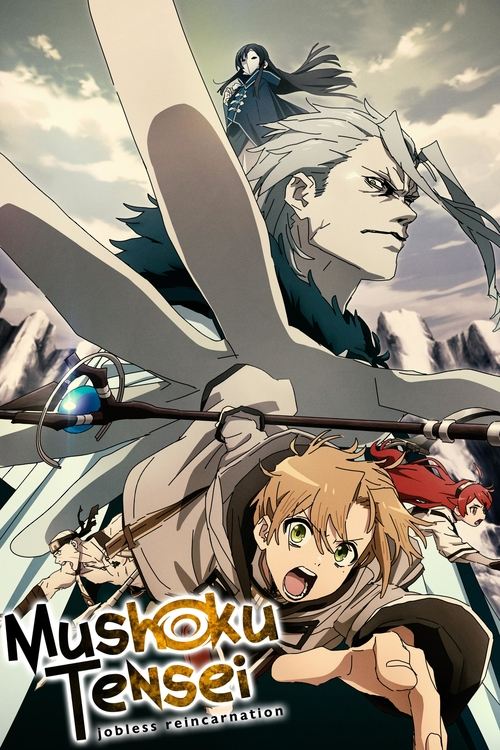
Mushoku Tensei: Jobless Reincarnation
When a 34-year-old underachiever gets run over by a truck, his story doesn't end there. Reincarnated in a new world as an infant, Rudy will seize every opportunity to live the life he's always wanted. Armed with new friends, some freshly acquired magical abilities, and the courage to do the things he's always dreamed of, he's embarking on an epic adventure—with all of his past experience intact!
Vivian's Take
The hook
A 34-year-old unemployed shut-in dies saving strangers from a truck, wakes up as a baby in a world of swords and sorcery — and gets a second chance at the life he wasted. That's the pitch, and it's one of the most influential sentences in modern anime. Mushoku Tensei: Jobless Reincarnation is the most beautiful isekai ever made and the hardest to defend: a masterpiece of craft wrapped around a protagonist whose behavior has fueled years of fierce debate. To write about it honestly is to hold both truths at once. It's that good. It's that complicated.
Strip away the controversy and what remains is a fantasy epic of unusual seriousness — a cradle-to-grave character study about whether a ruined man can actually become someone better. Few anime have ever attempted that arc with this much patience. None have looked this good doing it.

The premise
The unnamed protagonist dies a pathetic death: a 34-year-old NEET, kicked out of his parents' house after their funeral, run over saving teenagers from a speeding truck. He wakes as Rudeus Greyrat, infant son of two former adventurers, in a richly built fantasy world — with every memory of his wasted first life intact. Unlike most isekai heroes, those memories grant him no cheat skills. They grant him something rarer: the knowledge of exactly how he failed. His premature awareness lets him learn magic as a toddler, but the real story is the slow, painful project of becoming a person — learning courage, earning love, failing, and trying again across decades of in-world time.
The series follows Rudeus from infancy through childhood tutelage under the demon mage Roxy Migurdia, through the catastrophe of the Teleport Incident that scatters his family across continents, through his brutal coming-of-age journey across the Demon Continent with the cursed warrior Ruijerd and the volatile noblewoman Eris, and into adulthood — magic university, marriage, fatherhood, and war. It is, structurally, a life: the rare fantasy that lets its hero actually grow up.
Cast & characters
Yumi Uchiyama voices Rudeus across his entire life — child, teen, and adult — a remarkable sustained performance that tracks his growth from creep to husband to father without ever sanding off his flaws. The women around him are the show's true ensemble: Konomi Kohara as Roxy, the tiny demon mage who becomes his teacher, idol, and eventually his second wife; Ai Kayano as Sylphiette, the childhood friend whose devotion survives everything; Ai Kakuma as Eris Boreas Greyrat, the feral swordswoman whose departure shatters Rudeus and whose return completes him. Daisuke Namikawa brings weary honor to Ruijerd Superdia, Toshiyuki Morikawa and Hisako Kanemoto play Rudeus's complicated parents Paul and Zenith, and Megumi Toyoguchi is unforgettable as Ghislaine, the beastfolk sword king. It's an ensemble the show treats with novelistic seriousness — every one of them gets an arc.
Season by season
Season one (2021, twenty-three episodes across two cours) adapts Rudeus's childhood and the Teleport Incident saga — widely hailed as one of the best-directed anime seasons of the decade. Season two (2023–24, twenty-four episodes) follows his university years, his depression and recovery after Eris's departure, his marriage to Sylphie, and the labyrinth arc that costs him his father and gains him a second wife. The long-awaited season three (premiered July 4, 2026, with two episodes at once) adapts the acclaimed later arcs with a visible animation upgrade. The adaptation is produced by Studio Bind — a studio literally founded for this single purpose, a joint venture built to give Rifujin na Magonote's story the production it deserved — with Manabu Okamoto directing season one and Hiroki Hirano taking the reins from season two onward.
Critical reception
The craft consensus is overwhelming: critics consistently rank Mushoku Tensei among the best-produced television anime ever made — the background art, the magic choreography, the patient direction, the willingness to spend whole episodes on quiet character work. Season three sits around 8.5 on MyAnimeList, and Polygon's review called it one of the reviewer's top three fantasy anime of all time. But the reception has always been two conversations at once. Rudeus's sexual behavior — particularly toward younger characters, played at times for comedy — has drawn sustained criticism since season one, and season three's more divided episode ratings show the debate never closed. The show's defenders argue the story is precisely about a bad man becoming better and that it never excuses him; its critics argue some things shouldn't be the vehicle for that arc. Both conversations are real, and any honest account of the series has to include them.
Cultural impact
Whatever the debate, the influence is undeniable. The original web novel — published by Rifujin na Magonote on Shōsetsuka ni Narō from 2012 to 2015 — is widely credited as the work that launched the modern isekai boom; the light novel (twenty-six volumes, over 14.8 million copies in circulation) codified the genre's grammar. Nearly every isekai that followed is in dialogue with it, whether imitating its reincarnation structure or reacting against its darkness. Its author has been blunt about his stance — "No matter what people say, I'll write what I want to write" — and the industry has followed the audience: three seasons, films, games, and manga spinoffs. Mushoku Tensei is the genre's founding text and its permanent argument: proof that isekai could be literature, and a standing question about what literature is allowed to do.