Stranger Things
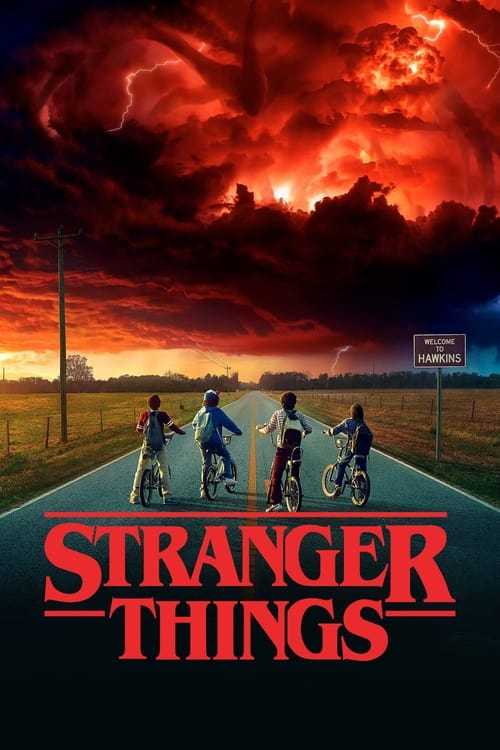
TV SERIES
When a young boy vanishes, a small town uncovers a mystery involving secret experiments, terrifying supernatural forces, and one strange little girl.
Stranger Things (2016)
When a young boy vanishes, a small town uncovers a mystery involving secret experiments, terrifying supernatural forces, and one strange little girl.
Genres: Action, Mystery, Sci-Fi
Rating: TMDB rating 8.5/10
Vivian’s Take
The hook
A boy vanishes. A small town uncovers secret experiments, supernatural forces, and one strange little girl. From that fairy-tale-simple setup came the defining blockbuster of the streaming era — the show that proved a platform could mint monoculture, that nostalgia could be an engine rather than a garnish, and that a group of kids on bikes could carry the weight of a mythology.
It matters because of what it proved about the new television economy. Before Stranger Things, the streaming blockbuster was a theory. After it, every platform was hunting for its own Upside Down. The show didn’t just succeed — it created the template: the synth score, the slow-burn mystery box, the season-as-event, the young cast growing up in public.
The deep cut
What works: the ensemble. The kids — and the strange girl at the center of it all — are the show’s real special effect; the series understood early that the audience would follow these characters into any amount of mythology as long as the friendships felt true. Hawkins feels mythic because it’s specific: the show does small-town America with the texture of a place its creators actually remember.
What doesn’t: the sprawl. Later seasons ballooned in runtime and cast, and the ever-longer gaps between seasons stretched the spell thin — momentum is a kind of magic, and hiatuses break it. The mythology, stretched across that much real time, occasionally feels like it’s being managed rather than told.
Who it’s for: everyone. This is the last true four-quadrant streaming phenomenon — kids, parents, horror fans, nostalgia tourists. If you’ve never seen it, you’re not behind; you’re the person the final season is waiting for.
Cultural context
Stranger Things made the 1980s the default setting of the popular imagination for a decade — tabletop games, synth scores, practical-effects horror, the whole aesthetic vocabulary. But its deeper cultural move was proving that earnestness scales: in an era of ironic detachment, the show’s sincerest emotion was its superpower.
It also changed what a TV star is. Its young cast grew up on screen and became generational celebrities in the process — the show was a star factory operating at a scale television had never attempted. Every streaming platform’s casting strategy since has been, consciously or not, an attempt to repeat the trick.
The Story, Season by Season
November 1983, Hawkins, Indiana: twelve-year-old Will Byers vanishes on his bike ride home, and his mother Joyce refuses to believe he's gone. The search unearths two impossible things — a girl with a shaved head, psychokinetic powers, and "011" tattooed on her arm, escaped from the secretive Hawkins National Laboratory, and a parallel dimension of rot and spores the kids name the Upside Down. Season one (2016) is the disappearance and the rescue. Season two (2017) brings the Mind Flayer, a shadow-colossus reaching through the breach, and Will's possession. Season three (2019) goes full summer-blockbuster at the new Starcourt Mall, with Russian agents drilling under Hawkins and Billy's sacrifice. Season four (2022) splits the party across Hawkins, California, and a Soviet prison in Kamchatka as Vecna — the lab's first child, Henry Creel — flays teenagers with their own trauma, while Kate Bush's "Running Up That Hill" becomes a global number-one 37 years after release and Eddie Munson's "Master of Puppets" shred becomes the show's signature set piece. The fifth and final season (2025) jumps to fall 1987: rifts have torn Hawkins open, the military has quarantined the town and is hunting Eleven, and the group reunites for one last battle. Eight episodes released in three drops — four on November 26, three on Christmas Day, and the two-hour-plus finale "The Rightside Up" on New Year's Eve — closed the saga. Forty-two episodes, one complete story.
The Cast
The show's real special effect was always the ensemble. Winona Ryder gave Joyce Byers her frantic, Christmas-light brilliance; David Harbour turned Jim Hopper from washed-up chief into the show's battered heart. Millie Bobby Brown became a generational star as Eleven, opposite Finn Wolfhard's Mike, Gaten Matarazzo's Dustin, Caleb McLaughlin's Lucas, and Noah Schnapp's Will — kids who grew up on camera across a decade. Sadie Sink's Max gave season four its soul; Natalia Dyer, Charlie Heaton, and Joe Keery anchored the older teens; Maya Hawke's Robin stole season three outright. Jamie Campbell Bower's Vecna was the rare late-addition villain who elevated everything, and the final season added Linda Hamilton to the roster — Sarah Connor herself, in Hawkins. Creators Matt and Ross Duffer ran the show with producer-director Shawn Levy, and even Frank Darabont came aboard to direct a final-season episode.

Reception and Legacy
No series defined the streaming era more completely. Season four became Netflix's most-watched English-language season at the time of release; the fifth drew glowing notices for its scale and emotional payoff and earned seven nominations at the 78th Primetime Emmy Awards, winning for visual effects. But the cultural footprint dwarfs the trophies. Stranger Things single-handedly made the 1980s the default aesthetic of popular culture for a decade — synth scores, Dungeons & Dragons, practical-effects horror, Eggo waffles, Christmas lights on the wall. It revived Kate Bush and Metallica for new generations, minted a new model of the TV star factory, and proved that earnestness could scale to monoculture size in an age of ironic detachment. It was the last show everybody watched at once — and it earned that ubiquity the hard way, one perfectly calibrated season at a time.
The verdict
A boy vanishes, a strange girl appears, and television changed forever. Stranger Things didn’t just succeed — it created the template: the synth score, the slow-burn mystery box, the season as event, the young cast growing up in public. The later seasons bloated and the hiatuses stretched the spell thin, and the show deserves those criticisms. But the heart never left. This is the last true four-quadrant streaming phenomenon, and the rare ubiquity that was actually earned.
Vivian’s grade: A — The streaming era’s defining epic — imperfect in its sprawl, unbeatable in its heart.