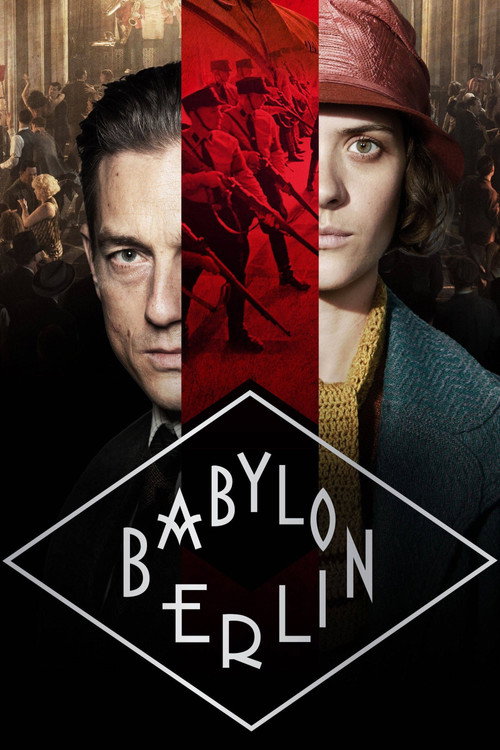
Babylon Berlin (2017)
Beneath the decadence of 1929 Berlin, lies an underworld city of sin. Police investigator Gereon Rath has been transferred from Cologne to the epicenter of political and social changes in the Golden Twenties.
Year — 2017
Genres — Crime, Drama, Mystery
TMDB rating — TMDB 7.7/10
Vivian's grade — A
Vivian's Review
Is it worth your time?
Read Vivian's full review▾
The Hook
Berlin, 1929. The Golden Twenties are roaring, the republic is rotting, and police investigator Gereon Rath has just been transferred from Cologne into the epicenter of it all. Babylon Berlin is the rare period drama that makes history feel like a thriller — because for the people living it, it was. This is prestige television with the volume turned all the way up: decadence and dread in every frame, a city dancing on the edge of an abyss it can't quite see yet.

The Premise
The series opens in the spring of 1929. Gereon Rath, a homicide detective from Cologne, is quietly seconded to the Berlin vice squad to investigate a blackmail case with a politically explosive pornographic film at its center. But the case is a door, not a destination. On the other side: a hijacked freight train rolling out of Soviet Russia loaded with stolen gold, a Trotskyist cell plotting revolution in the city's shadows, and the sprawling, corrupt machinery of the Berlin police itself. The show is based on the bestselling Gereon Rath novels by German author Volker Kutscher, beginning with Der nasse Fisch (The Wet Fish), and it treats Weimar Berlin not as wallpaper but as the engine of the plot. Every personal betrayal rhymes with a political one; every crime scene sits on top of a fault line.
What makes the premise sing is its refusal to be one thing. It's a detective story, a political thriller, a gangster saga, and a social panorama at once — cabaret singers and communist agitators, industrialist conspirators and Armenian gangsters, all colliding in a city that contains multitudes. The Weimar Republic was, briefly, the most modern society on earth: sexual liberation, avant-garde art, mass media, democratic experiment — built on an economy of quicksand. Babylon Berlin understands that the party and the panic were the same event.
Cast & Characters
Volker Bruch plays Gereon Rath as a man held together by morphine, duty, and denial — a Great War veteran with PTSD who medicates his tremors and his guilt, a capable detective who keeps discovering that competence is no defense against history. Opposite him, Liv Lisa Fries gives one of the great star-making performances of modern European television as Charlotte Ritter: a police stenographer from the slums who does sex work at night to support her family and is determined to become the Berlin force's first female homicide detective. Charlotte is the show's moral spine and its beating heart — tough, funny, ambitious, and constantly underestimated.
The ensemble around them is enormous and uniformly superb. Peter Kurth is Bruno Wolter, Rath's partner, a veteran cop whose easy charm curdles into something much darker — one of the show's most chilling studies of how ordinary men radicalize. Matthias Brandt plays August Benda, the Jewish head of the political police and the rare character who sees exactly what's coming. Lars Eidinger is the industrialist Alfred Nyssen, suave and sinister. Severija Janušauskaitė is unforgettable as the Russian countess Svetlana Sorokina — and as her drag-king alter ego Nikoros, the star of the Moka Efti nightclub, whose performance of "Zu Asche, Zu Staub" became a genuine viral hit. Mišel Matičević brings menace and magnetism to Edgar Kasabian, "the Armenian," the gangland boss who runs the Moka Efti. Leonie Benesch, Hannah Herzsprung, Christian Friedel, Karl Markovics, Fritzi Haberlandt, and Jördis Triebel round out a cast with no weak links.
Season by Season
The first two seasons (eight episodes each, both 2017, filmed as one continuous 16-episode block) adapt The Wet Fish. Rath's blackmail investigation tangles with the Armenian's underworld, the Sorokin gold train, and a Trotskyist plot — while Charlotte fights her way into detective work and Greta Overbeck, a young housemaid played by Leonie Benesch, is drawn into a communist cell with devastating consequences. The third season (twelve episodes, 2020), drawn from The Silent Death, moves to the film studios: an actress is murdered during a shoot, the 1929 stock market crash detonates the economy, and Rath's investigation collides with the rising Nazi street movement. The fourth season (twelve episodes, 2022), based on Goldstein, brings an American gangster to Berlin and pushes the calendar to 1931–32, with the SA's violence now impossible to ignore and Charlotte hunting a serial killer inside the police's own orbit.
The fifth and final season (eight episodes, 2026) closes the saga on the brink of 1933. Announced as the show's conclusion, it reunites the surviving players — Bruch and Fries joined by returning faces including Hannah Herzsprung, Karl Markovics, Fritzi Haberlandt, Christian Friedel, and Lars Eidinger — for a final movement set as the republic's last lights go out. Across five seasons and 48 episodes, the series ran from October 2017 to September 2026, a nine-year run that tracked, in fiction, the exact lifespan of the world it depicted.
Critical Reception
The critical consensus has been close to rapturous. The series holds a rare 100% critics' score on Rotten Tomatoes across its run, with a 90% audience score — the kind of split that says critics admired it and viewers devoured it. Reviewers singled out the totality of the world-building: the show's Berlin is the most completely realized historical environment television has ever produced, down to the period-correct advertising, the streetcars, the nightclub choreography. The leads drew special praise — Bruch's haunted restraint, Fries's incandescent ambition — and the show's willingness to let history do the scaring, no monsters required.
It was also, bluntly, a production landmark. With a budget of roughly €40 million for its first sixteen episodes, Babylon Berlin was the most expensive German television production ever mounted at the time — a co-production of ARD Degeto, Sky Deutschland, X Filme Creative Pool, and Beta Film, shot by three directors who share every credit: Tom Tykwer (Run Lola Run, Cloud Atlas), Achim von Borries, and Henk Handloegten, who write and direct as a unit. The money is on the screen in every crowd scene, every cabaret number, every rain-slicked street.
Cultural Impact
Babylon Berlin arrived as part of television's great international awakening — the moment global audiences realized the best TV wasn't all in English. Alongside a handful of peers, it proved that European prestige television could match anything Hollywood made, on its own terms, in its own language. It became Germany's flagship cultural export of the streaming era, airing in the U.S. first on Netflix and later on MHz Choice, and it reset expectations for what German television could attempt.
Its deeper function is as a warning dressed as entertainment. Watching 1929 Berlin — the art, the freedom, the fragility — with full knowledge of what comes next gives every champagne toast a shadow. The show never lectures; it simply shows a democracy's immune system failing in real time, through the eyes of people too busy surviving to notice. In an era of democratic anxiety worldwide, that shadow feels less like history and more like a mirror. Few series have ever made the past feel this urgently present — or made a detective story feel this much like a reckoning.
Vivian's verdict: Television's most intoxicating history lesson — decadence, dread, and a detective drowning in both.