House of the Dragon
TV SERIES
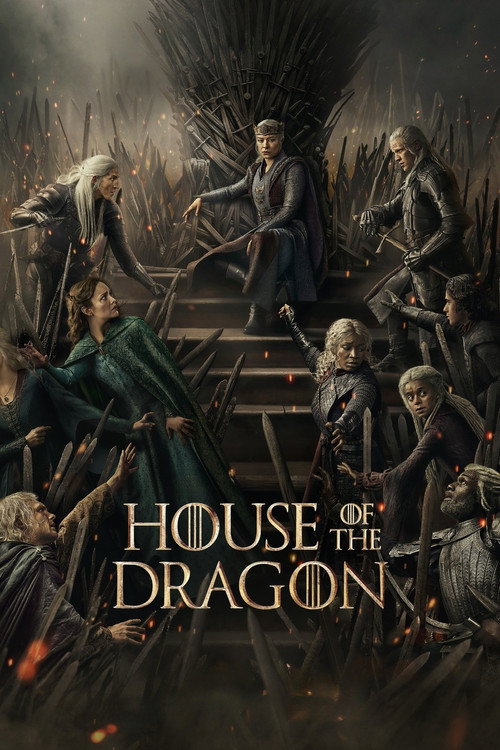
The Targaryen dynasty is at the absolute apex of its power, with more than 15 dragons under their yoke. Most empires crumble from such heights. In the case of the Targaryens, their slow fall begins when King Viserys breaks with a century of tradition by naming his daughter Rhaenyra heir to the Iron Throne. But when Viserys later fathers a son, the court is shocked when Rhaenyra retains her status as his heir, and seeds of division sow friction across the realm.
House of the Dragon (2022)
The Targaryen dynasty is at the absolute apex of its power, with more than 15 dragons under their yoke. Most empires crumble from such heights. In the case of the Targaryens, their slow fall begins when King Viserys breaks with a century of tradition by naming his daughter Rhaenyra heir to the Iron Throne. But when Viserys later fathers a son, the court is shocked when Rhaenyra retains her status as his heir, and seeds of division sow friction across the realm.
Genres: Action, Drama, Sci-Fi
Rating: TMDB rating 8.4/10
Vivian’s Take
The hook
No show in television history arrived with a heavier burden. House of the Dragon had to do the impossible: make the world care about Westeros again after the most debated finale in TV history, and do it as a prequel — the format where everyone already knows how the story ends. That it works at all is a minor miracle. That it works this well is a statement about what the franchise actually is when you strip away the shock value.
The setup is Shakespearean in its simplicity. The Targaryens are at the absolute apex — more than fifteen dragons, total dominion — and King Viserys breaks a century of tradition by naming his daughter Rhaenyra heir to the Iron Throne. Then he fathers a son, keeps Rhaenyra as heir anyway, and the realm splits along a fault line no one can un-draw. This is a succession drama wearing dragon armor, and succession drama is the oldest story there is.
The deep cut
What works: the show understands that dragons are most interesting as weapons of mass destruction that everyone is afraid to use — the threat of them shapes every negotiation, every marriage, every slight. The court intrigue is genuinely intricate without becoming homework, and the time jumps, risky as they were, gave the tragedy its proper scale: this is a fall measured in decades, not episodes.
What doesn’t: the pacing stumbles. The middle stretches of the seasons can feel like the show is arranging pieces on a board it already showed you, and the sprawl occasionally keeps the audience at arm’s length — you admire the tragedy more than you feel it. An 8.4 on TMDB reflects exactly that: near-universal respect, slightly less than universal love.
Who it’s for: epic-fantasy loyalists who stayed, prestige-TV viewers who never left, and anyone who believes the best fantasy is really about power — who holds it, who inherits it, and what it costs the people standing too close.
Cultural context
House of the Dragon arrived at the exact moment ‘prestige fantasy’ became a crowded bet, with every streamer swinging for its own Game of Thrones. Its success validated something important: the prequel model works when it’s treated with total seriousness — not as fan service, but as history. The show’s real subject isn’t dragons; it’s how empires talk themselves into civil war, one reasonable decision at a time.
It also rehabilitated the idea of the television monoculture. For a few weeks each season, this was the show everyone was watching at the same time, arguing about on the same timeline. In the fractured streaming era, that shared text feels almost archaeological — and precious.
The verdict
No show ever arrived with a heavier burden, and House of the Dragon carried it. The succession engine — Viserys naming Rhaenyra heir, then fathering a son, then refusing to un-name her — is Shakespearean in structure and devastating in execution. The dragons work best as the threat everyone’s afraid to use. The pacing stumbles in the middle stretches, and the sprawl occasionally keeps you at arm’s length, which is why this is an A-minus and not an A. But as a prequel, as a rehabilitation, as pure prestige television: it earned the throne.
Vivian’s grade: A- — The rare prequel that earns its throne: operatic, brutal, and built on a genuinely tragic succession story.