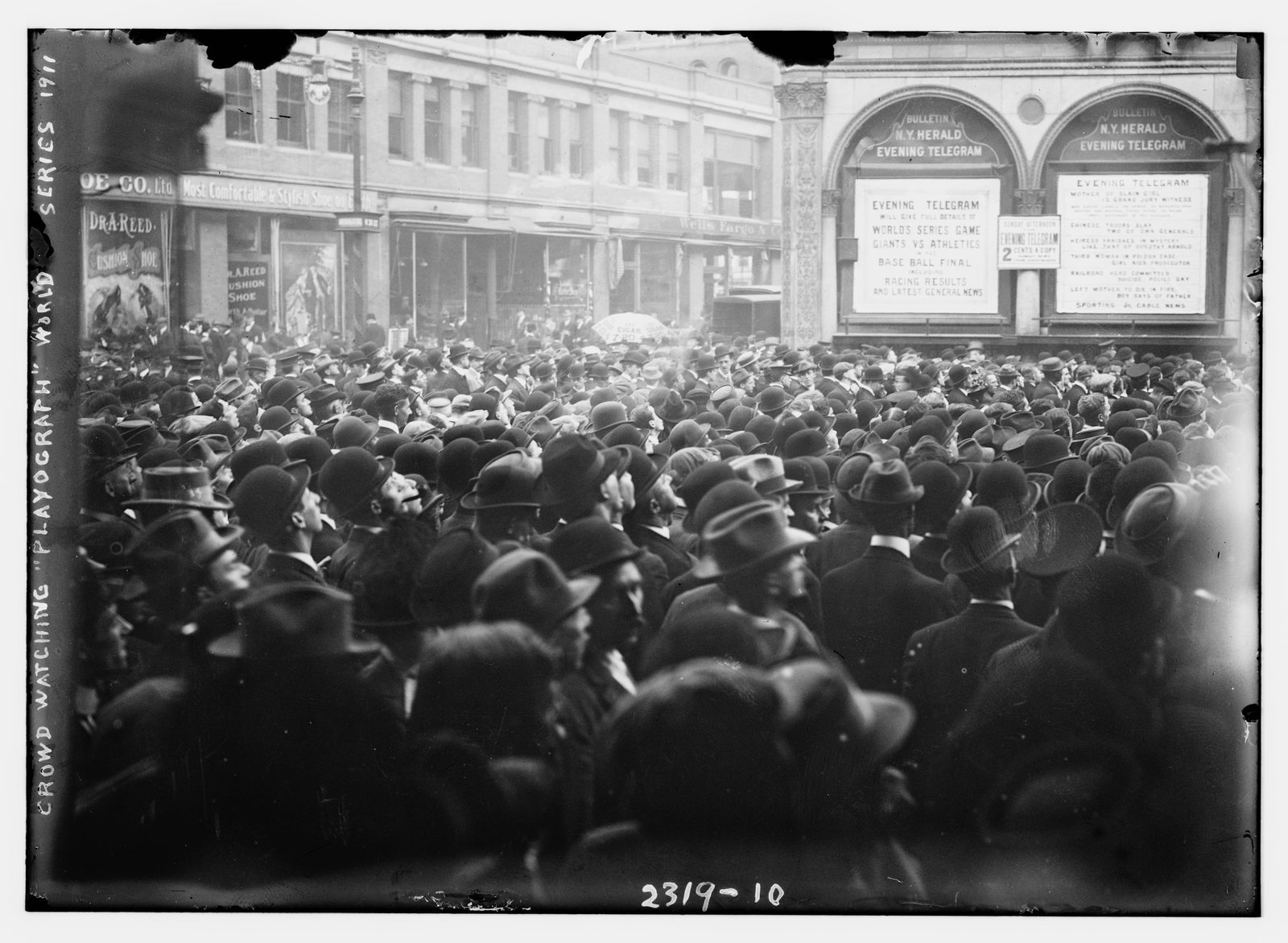
The short version: On Oct. 8, 1911 — 115 years ago today — baseball's National Commission sold the motion-picture rights to the World Series for $3,500, a sevenfold jump from the year before. Then the players found out about the money, demanded a cut, and the Commission killed the deal rather than share it. A film of the 1911 Series still circulated anyway, and the fight set a template baseball is still living with.
This is the story of the first time baseball treated its players like bystanders in its own media business. It would not be the last.
The fight over the rooftop
To understand the 1911 deal, you have to understand the war that produced it. Baseball had been licensing World Series highlight films since 1906 — the National Commission, the joint body the leagues formed after their 1903 peace pact, licensed summaries and newsreels as a way to box out the "fake" filmmakers who shot the games from rooftops and stitched in footage from earlier years' licensed pictures. The 1910 Series rights went for $500. A year later, the price escalated to $3,500 — confirmed in the academic record, including Adam Marcus's Georgetown thesis, which pegs the exact figures: $500 for 1910, $3,500 for 1911.
Then the players learned the number. According to the Pinstripe Alley history that revived this story, they demanded a share of the money. The Commission's answer was to cancel the deal outright — no film deal, no money, no argument. A few years later the issue came back in a different form: a 1913 deal for $8,000 that did set aside a players' pool. (That 1913 deal, like the cancellation itself, is attributed to the Pinstripe Alley reporting; the dollar escalation is the part the academic record confirms.)
Here's the wrinkle that keeps this honest: a 1911 World Series film demonstrably circulated. The Internet Movie Database records the Essanay Film Manufacturing Company of Chicago's "Athletics vs. Giants in the World's Championship Baseball Series of 1911," its fourth consecutive Series film, released Oct. 25, 1911. If the Commission really canceled the licensed deal, this film got made anyway — possibly unlicensed, possibly through a separate route. The baseball film historian Rob Edelman and MLB's official historian John Thorn both confirm that unauthorized 1911 filming happened; what nobody has fully resolved is how Essanay's film fits. The history is messier than the morality play.
The Series itself
The 1911 World Series was worth filming. Connie Mack's Philadelphia Athletics against John McGraw's New York Giants — a rematch of 1905 — played Oct. 14 through 26 at the Polo Grounds and Shibe Park, with the A's winning in six for their second straight title. Frank "Home Run" Baker, 25 years old, hit .375 and launched two of the most famous homers of the dead-ball era, off Rube Marquard and Christy Mathewson. Chief Bender threw the Game 6 clincher; the A's staff held the Giants to a .175 team average. Behind the plate, the Giants' Chief Meyers set a record with 12 caught-stealing assists in the Series. 179,851 fans attended. The winners' share was $3,655 — about $155 more than the film rights had fetched.
Why it still matters
The players-want-a-cut episode landed in an era when players had no leverage at all. The reserve clause bound them to their teams; there was no union, no free agency, no mechanism to demand anything. The Commission's response — cancel the deal rather than share — reads like an early draft of a century of labor relations. It would be another 55 years before the players formed the MLBPA in 1966 and began clawing at the media-money question in earnest.
The archival cost was real, too. Nitrate stock decayed, licensing fights discouraged filming, and rooftop pirates produced junk. Very little pre-1920 World Series footage survives. The complete, official World Series highlight archive as fans know it starts in 1943 — three decades after Baker's homers. Some of what survives was rescued by accident: filmmaker Bill Morrison rebuilt the 1919 and 1920 Series films from reels found in Dawson City permafrost. In 2014, the Library of Congress found and photochemically preserved a lost film of the Washington Senators winning the 1924 Series — the kind of discovery that keeps archivists digging.
And the media-rights argument never ended. It just got bigger. The 1911 players wanted a cut of $3,500. Today's players negotiate over broadcast deals worth billions, and the 2026 season's labor turbulence — the lockout talk, the ESPN Sunday Night Baseball opt-out chatter that frames the modern half of the Pinstripe Alley piece — is the same fight with more zeros. The Commission's instinct in 1911 was to treat the players as the audience rather than the talent. Baseball has spent 115 years unlearning it, incompletely.
Previously's New York culture desk covers the games behind the games. Read more local culture and sports from every state.
Sources
- Pinstripe Alley, The Fight Over the 1911 World Series Film, and Its Effects Today, Oct 8, 2026
- John Thorn (Official MLB Historian), Early Baseball Film, Our Game (MLB.com), Aug 22, 2022
- Adam Marcus, academic thesis, Georgetown University repository (1910: $500, 1911: $3,500 rights figures)
- IMDb, Athletics vs. Giants in the World’s Championship Baseball Series of 1911 (Essanay, released Oct 25, 1911)
- Library of Congress, Film of the Washington Senators winning the 1924 World Series found, Now See Hear blog, 2014
- Wikipedia, 1911 World Series (series facts: A’s over Giants 4-2, Oct 14-26, 1911)