The short version: One hundred fifteen years ago this month, baseball's owners struck a deal to license the motion picture rights to the World Series for $3,500 — seven times what they'd gotten the year before. When the players asked for a cut, the owners canceled the deal entirely. It was 1911's version of a streaming war, and baseball has been fighting the same fight ever since.
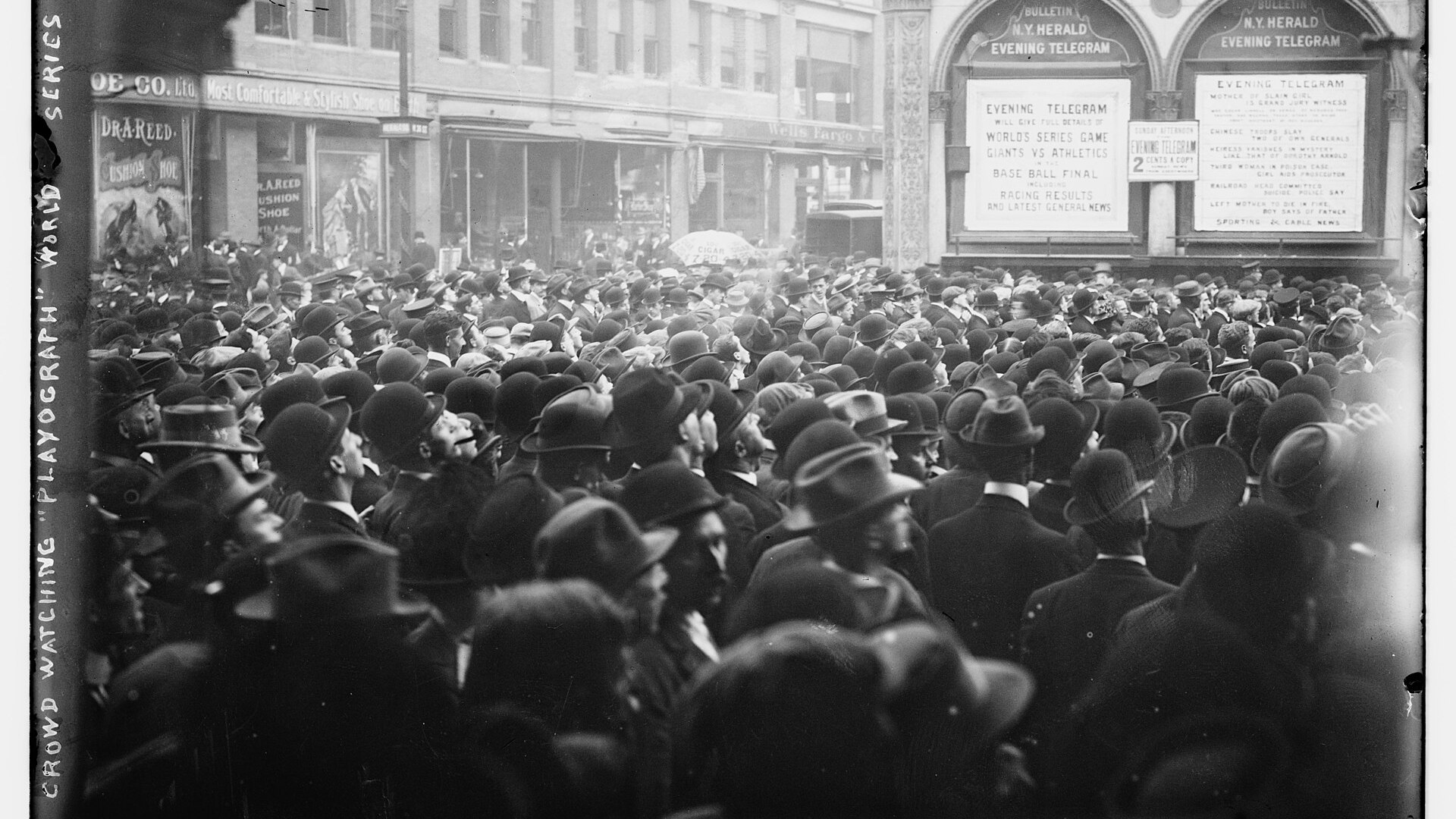
The year is 1911. The World Series is only in its eighth year. The Philadelphia Athletics are about to face the New York Giants in a rematch of the 1905 Series, and for the first time, the men running baseball understand that the games are worth something beyond the tickets sold at the gate.
The National Commission — the three-man body that ran the sport after the National and American Leagues joined forces in 1903, the predecessor to the Commissioner's Office that would replace it after the Black Sox Scandal — had been working with the new film companies since 1906 to produce World Series highlight reels. The first deals were tiny, about $500, worth roughly $17,000 in today's money. The point wasn't really the cash; it was control. Illegal films of games were already circulating, and the Commission wanted the official product in the market. Bootlegging, it turns out, is as old as the movies themselves.
Then, in October 1911 — 115 years ago this month — the Commission completed a deal to license the motion picture rights for that year's Series for $3,500. Seven times the previous fee. Roughly $120,000 in today's dollars. For a sport still finding its national footing, that was real money, and everybody in both clubhouses knew it.
So the players did the natural thing: they asked for a share.
The Commission's answer was to kill the deal. Rather than give the players a cut of a new revenue stream, baseball's owners walked away from the revenue stream entirely.
Read that again, because the pettiness is the point. The owners didn't negotiate. They didn't offer a token percentage. They canceled a sevenfold increase in media money on principle — the principle being that players must never get the idea they were entitled to a share of anything beyond the gate.
The film still got made, in the end. The Essanay Film Manufacturing Company of Chicago produced its highlights reel of the 1911 Series — "Athletics vs. Giants in the World's Championship Baseball Series of 1911" — its fourth consecutive year filming the Fall Classic, released to theaters on October 25, 1911, the day before Chief Bender threw a four-hitter at Shibe Park to clinch the Athletics' second straight championship. The movies existed in a legal gray zone anyway: until 1912, motion pictures weren't even subject to copyright, so film companies deposited strips of photo frames with the copyright office and claimed the images as photographs. The law hadn't caught up to the technology, and baseball hadn't caught up to the business.
Two years later, the Commission came back to the table. The 1913 deal was worth $8,000 — about $270,000 today — and this time it included a pool of money for the players in the Series. The precedent the owners had killed a deal to avoid was set anyway. During World War I, highlight reels were cut and shipped to soldiers overseas, and from there the filming of baseball only grew until nearly every game played is available to watch.
Here's why a 115-year-old contract fight still matters. The players who won that 1911 Series split $3,655 apiece from the gate; the losing Giants got $2,436 each. Those were the stakes the owners were protecting — and they torpedoed a $3,500 league-wide media deal to keep the players from touching a dime of new money. It was never about the amount. It was about who gets to say the money is theirs.
Baseball has been relitigating that question for a century. The owners feared radio in the 1920s — the first live broadcast didn't happen until 1920, and in the early 1930s owners actually toyed with banning it, terrified fans would listen for free instead of buying tickets. Radio didn't become a regular thing in New York until 1939. Every new medium gets the same treatment: fear, resistance, a fight over the split, and eventually a deal that makes everyone rich.
Sound familiar? It should. The modern version plays out in every round of media-rights negotiations, every blackout fight, every argument about who owns the highlights you watch on your phone. The details change — film reels become streaming windows, the National Commission becomes a commissioner's office — but the story is the same one from October 1911: the people who play the game asking for their share, and the people who own the game deciding how much of a fight that's worth.
One hundred fifteen years later, we're still watching that negotiation play out. The 1911 owners chose to leave money on the table rather than share it. Baseball has been trying to get that money back ever since.
Previously's culture desk digs into the stories behind the games. For today's baseball, see the sports hub.
Sources
- Pinstripe Alley (SB Nation), The Fight Over the 1911 World Series Film, and Its Effects Today, Oct 2026
- EH.net, The Economic History of Major League Baseball: Baseball and the Media
- IMDb, Athletics vs. Giants in the World's Championship Baseball Series of 1911 (Essanay, released Oct 25, 1911)
- Library of Congress Copyright Office, Photos Are Evidence of a Tale of Pugilism, Copyright Piracy
- Wikipedia, 1911 World Series, accessed Oct 6, 2026