FOOD · DUBAI
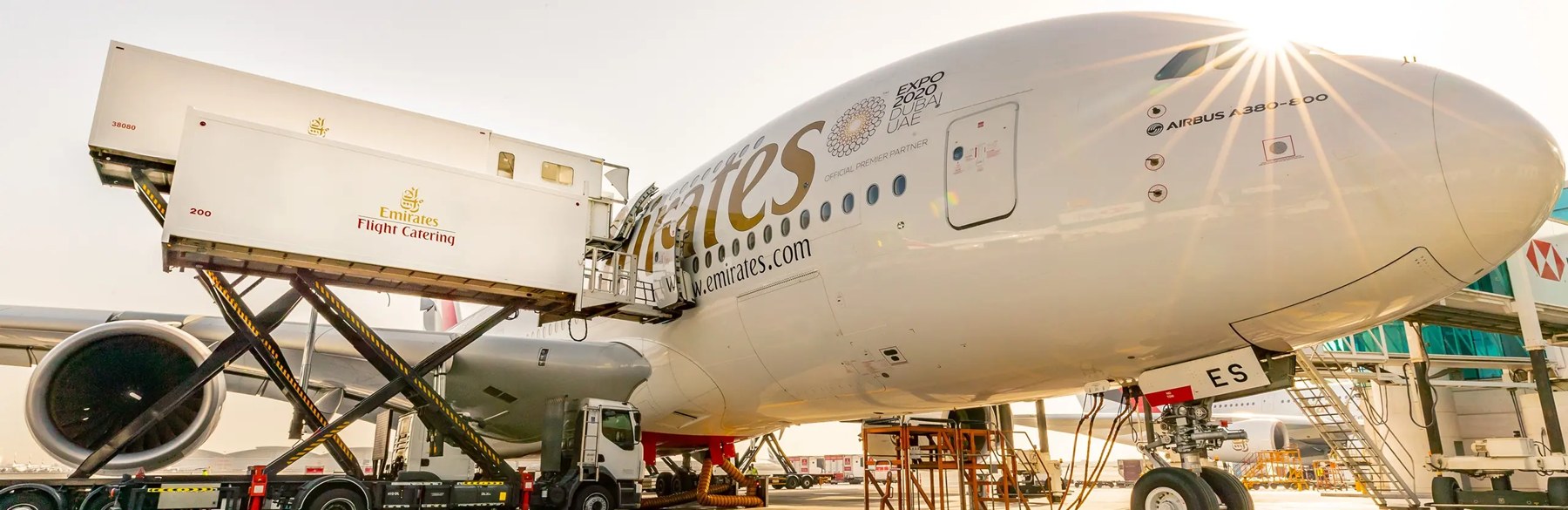
An elegant meal on an aircraft begins somewhere much less intimate: an industrial catering operation where timing, hygiene and logistics matter more than presentation alone. Emirates Flight Catering, usually shortened to EKFC, is one of the clearest examples of what happens when restaurant work is rebuilt at airport scale.
The scale requires careful labelling
EKFC says it produces an average of 225,000 meals a day from Dubai. A Dubai Government Media Office report published in April 2025 put the average higher, at 250,000 meals daily. The figures are not necessarily contradictory: they come from different dates and may count production and uplift differently.
The Emirates Group annual report gives the harder annual total: 79 million meals uplifted in 2025–26. Its busiest day reached 276,779 meals, on 20 December.
Nor is EKFC simply another name for Emirates airline. The caterer says it supplies Emirates, flydubai and other airlines from Dubai. It has also moved beyond aircraft trays into airport food and beverage, lounges, events and related hospitality.
A very large kitchen, organised like a transport system
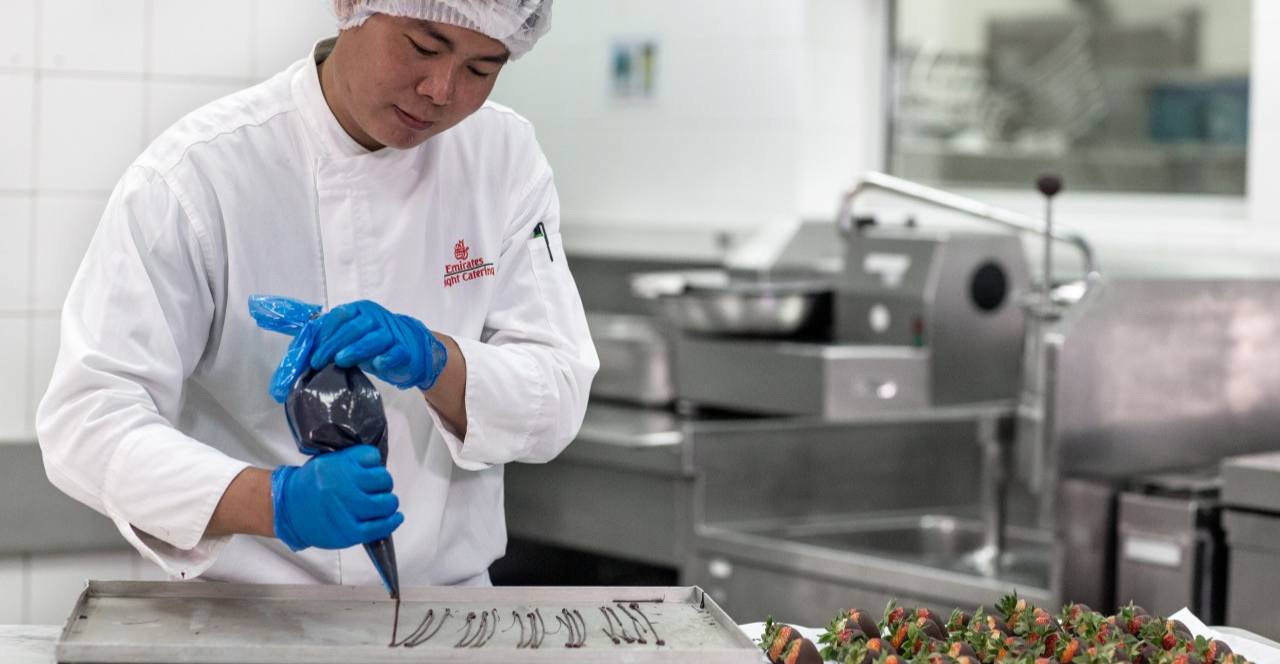
Returned trolleys and equipment enter the operation, are emptied and washed, then move through cleaning and preparation. Sam Chui's documented tour shows cleaned equipment travelling by monorail to the food-preparation area. EKFC says the monorail covers 2.55 kilometres.
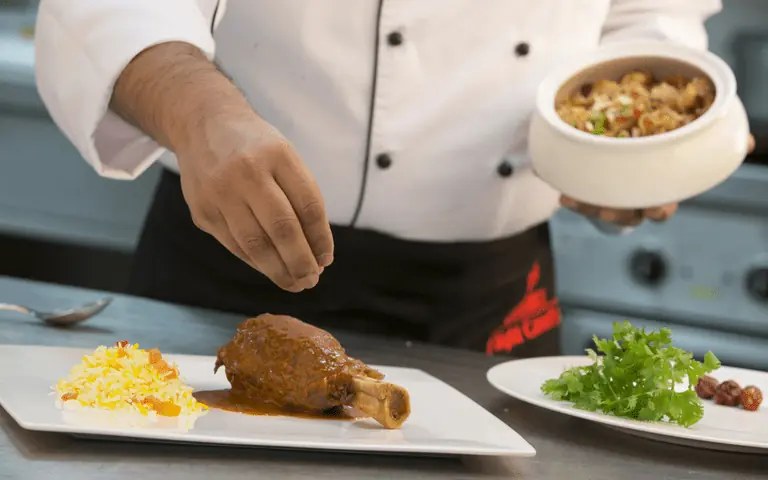
Separate hot-kitchen sections handled Western, Asian, Arabic and Indian food. Finished dishes were rapidly chilled, portioned by weight, assembled into trays and sent towards aircraft loading.
Ingredients arrive at industrial volume
The caterer's procurement figures give the process a material weight. An earlier Emirates Group annual report listed one tonne of Angus tenderloin per day and 120 tonnes of Basmati rice per month, sourced through a supply network covering 26 countries and 130 locations. Those are dated procurement figures, not a claim about today's exact purchasing.
363 vehicles and food-safety support around the clock
EKFC lists a fleet of 363 vehicles, including more than 280 high-loader trucks. It also describes an on-site food-analysis laboratory and food-safety support operating 24 hours a day.
One figure needs particular care: 375,000 pieces is the stated daily cutlery-processing capacity in the annual report, not proof that exactly 375,000 pieces pass through every day.
Waste has become part of the operation
In February 2026 EKFC said it had commissioned a large Power Knot biodigester. Food waste is treated aerobically, using oxygen, heat and microorganisms, and the resulting grey water is reused for non-potable purposes.
Since the system entered operation in December 2025, EKFC says it has processed an average of up to 3.5 tonnes of waste a day. Its projected treatment capacity is around six tonnes a day, with an aim of cutting more than 2,000 tonnes of carbon-dioxide equivalent a year once the system matures.
The waste work also leads back to the menu. EKFC says 47 recipes have been developed using production trimmings.
That is the real subject of the operation's scale. The airline meal looks like a small, contained object; the system behind it runs from global purchasing to a monorail, a laboratory and a machine that treats what passengers leave behind.
Sources · 7 sources
- EKFC — Airline and airport services
- EKFC — company site and quick facts
- Dubai Government Media Office — EKFC report, 19 April 2025
- The Emirates Group Annual Report 2025–26 (PDF)
- The Emirates Group Annual Report 2024–25 (PDF)
- EKFC — biodigester commissioning release, 5 February 2026
- Sam Chui — World's Largest Airline Kitchen (2023), the film embedded above