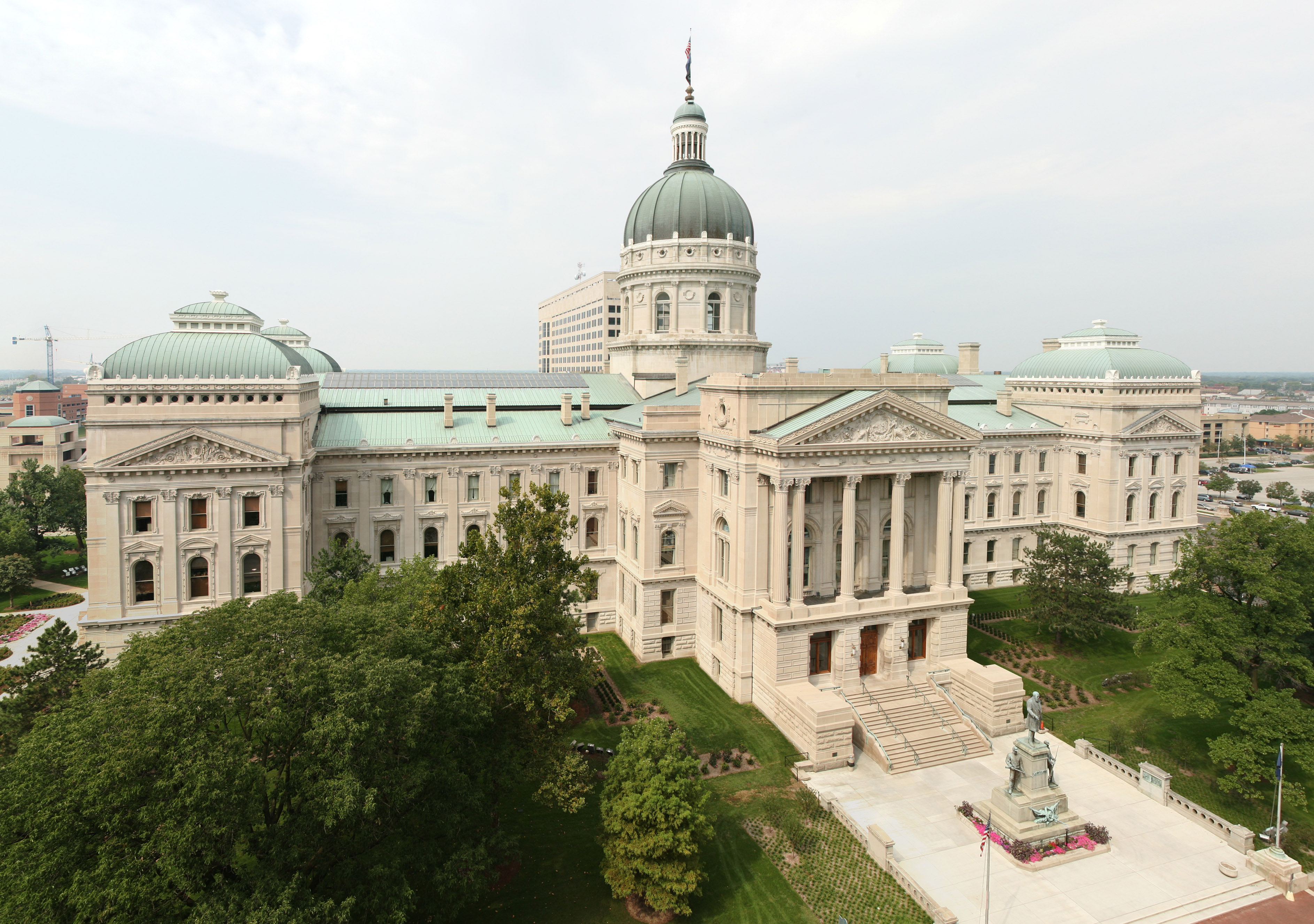
- The Indiana Debate Commission hosted the second secretary of state debate Wednesday, 7 to 8 p.m. ET, at WFYI's studios in downtown Indianapolis — no live audience, aired on Indiana PBS stations, YouTube and partner stations. Moderator: Laura Merrifield Wilson.
- Democrat Beau Bayh, Republican Max Engling, independent (Lincoln Party) Greg Ballard and Libertarian Lauri Shillings took part. Incumbent Diego Morales lost his convention bid and wasn't on stage, but his tenure dominated the discussion.
- The tone was sharper than August's first debate: Ballard called Engling's election-integrity claim "ludicrous"; Bayh called him "ridiculous" and accused him of "making stuff up."
- National observers rate the race a "pure toss-up." Competing internal polls disagree on the leader (HLA poll: Engling 38, Bayh 37; Bayh's own poll: 42-36); voter registration closed Monday; early in-person voting began Tuesday; Election Day is Nov. 3.
INDIANAPOLIS — One empty chair, four candidates, and an incumbent who kept showing up in every answer. The Indiana Debate Commission's second secretary of state debate, held Wednesday night inside WFYI's downtown Indianapolis studios, gave the four contenders for Indiana's top elections office a full hour in front of the cameras — and gave the absent Diego Morales, the Republican incumbent who lost his convention bid, a starring role he never asked for.
Democrat Beau Bayh, Republican Max Engling, independent Lincoln Party candidate Greg Ballard and Libertarian Lauri Shillings debated for an hour with no live audience, moderated by Laura Merrifield Wilson, a professor of political science at the University of Indianapolis who hosts Positively Politics on WICR. The feed went to WFYI television, YouTube and partner stations statewide, according to the Indiana Broadcasters Association's station advisory. It was the second meeting of the four, following their first debate in August, and IndyStar's reporters noted the tone was noticeably sharper this time.
The man who wasn't there
Morales' conduct in office colored the first debate, and it colored this one too. Bayh used the incumbent as a cudgel against Engling throughout the night, accusing the Republican of glossing over the last four years. "Max wants to pretend like the last four years of corruption, that you witnessed, never happened," Bayh said at the debate, as reported by IndyStar. Bayh also turned a question about supporting small businesses — which must register with the secretary of state's office — into another jab, calling Morales' office "not a good faith partner" for businesses.
Morales is not running for reelection — he lost his party's convention bid — but the shadow of his tenure gave Bayh a running argument and gave Engling, his party's replacement nominee, a constant defensive posture.
The sharpest exchanges: election integrity
The night's most heated stretch came on election integrity, after Engling asserted — for the second debate in a row — that he is the only candidate committed to verifying that only U.S. citizens can vote, and urged viewers to "rewind the tape" from the August debate. Ballard shot back that it was "a ludicrous assertion," and later added, "That's not even close to true." Bayh accused Engling of "making stuff up" and called him "ridiculous" for offering no anti-corruption policies after Morales' tenure. Engling doubled down, telling viewers to "rewind" to the previous debate.
Bayh then brought Attorney General Todd Rokita into the exchange, saying Engling and his "buddy" should investigate the 21 cases of non-citizen voting that a federal review of Indiana elections found last year. Ballard then said, "Not to mention that your faction of the party wants to subpoena voters" — a reference, IndyStar reported, to recent attempts to throw out state Sen. Spencer Deery's May primary victory by subpoenaing voters who made certain social media posts. Ballard said the Indiana Election Commission should meet to hear the complaint filed over the incident. All of the exchanges were reported in detail by IndyStar's Kayla Dwyer and Marissa Meador, who covered the debate live.
Concrete ideas on turnout
Asked for specific ways to increase voter participation in a state that ranks among the lowest in the nation, all four candidates offered substantive proposals, IndyStar reported. Shillings said the office should text voters through mobile platforms carrying ballot information, and pitched curbside voting for people with mobility issues. Ballard plugged his paper voter guide — which he says should be mailed to every voting-age resident — and said it could be made mobile "very quickly," adding that 17-year-olds should be able to register while still in high school. Bayh proposed ending straight-ticket voting and enabling citizen-led ballot initiatives, both of which would require legislative action. Engling said there is "bloat" in the voter rolls that should be cleaned up first, then proposed partnering with community organizations and foundations on registration efforts.
The business side of the office
The secretary of state is Indiana's chief elections officer and also oversees business services, securities regulation and campaign finance reporting — which is why a question about small businesses, which register through the office, drew blunt answers. Ballard called the office's website "horrible" and suggested businesses be allowed to update registrations every three to four years instead of every two. Shillings said the state should reduce unnecessary licensing burdens. Engling touted his experience working for small businesses and filing his own registrations, while Bayh cited his legal practice helping people set up businesses — and again used the opening to criticize Morales' office.
Why the nation is watching
National observers have labeled the race a "pure toss-up" — the headline of IndyStar's September profile of the contest — and the University of Virginia's Sabato's Crystal Ball has kept it in toss-up territory, the Hoosier Enquirer reported this week. Since the August debate, Gov. Mike Braun directed $1 million toward getting Engling ads on air, while Bayh had previously been the only candidate with television ads up; two of the new ads attack Bayh and Ballard, IndyStar reported ahead of the debate.
The polling is muddy, which is the point. A Banks-linked HLA poll put Engling at 38 and Bayh at 37, while Bayh's own September poll had him up 42-36 — two competing, interested-party surveys that agree on roughly one thing: this race could be close. Kalshi-linked prediction markets priced Bayh slightly ahead in a low-volume market as of early October, though that's a soft read, not a substitute for a public poll. Until an independent public survey lands, those are the numbers Indiana has on paper, the Hoosier Enquirer noted.
Voter registration for the Nov. 3 election closed Monday, and early in-person voting began Tuesday. The four candidates have now debated twice, and the Indiana Debate Commission's August announcement — covered at the time by the Indiana Capital Chronicle — set the expectation that this format would be the substantive one. Wednesday delivered: an hour, four candidates, no audience, and a race that remains anybody's.
For more on this week's debates, see our recap of Arizona's debate night.
Sources
- IndyStar · "Indiana secretary of state debate takeaways: 'Ridiculous' jabs, concrete ideas," Oct 7, 2026
- IndyStar · "Debate recap: Diego Morales wasn't on stage, but candidates kept talking about him" (live updates, Kayla Dwyer and Marissa Meador), Oct 7, 2026
- Hoosier Enquirer · "Banks-Linked Poll Puts Engling 38–Bayh 37 — Ballard Calls It Dark-Money Spin," Oct 2026
- Indiana Capital Chronicle · "Two Indiana secretary of state debates planned," Aug 17, 2026
- Indiana Broadcasters Association · "How to Carry Next Wednesday's Indiana Secretary of State Debate: Instructions for Radio and TV stations," Oct 2026