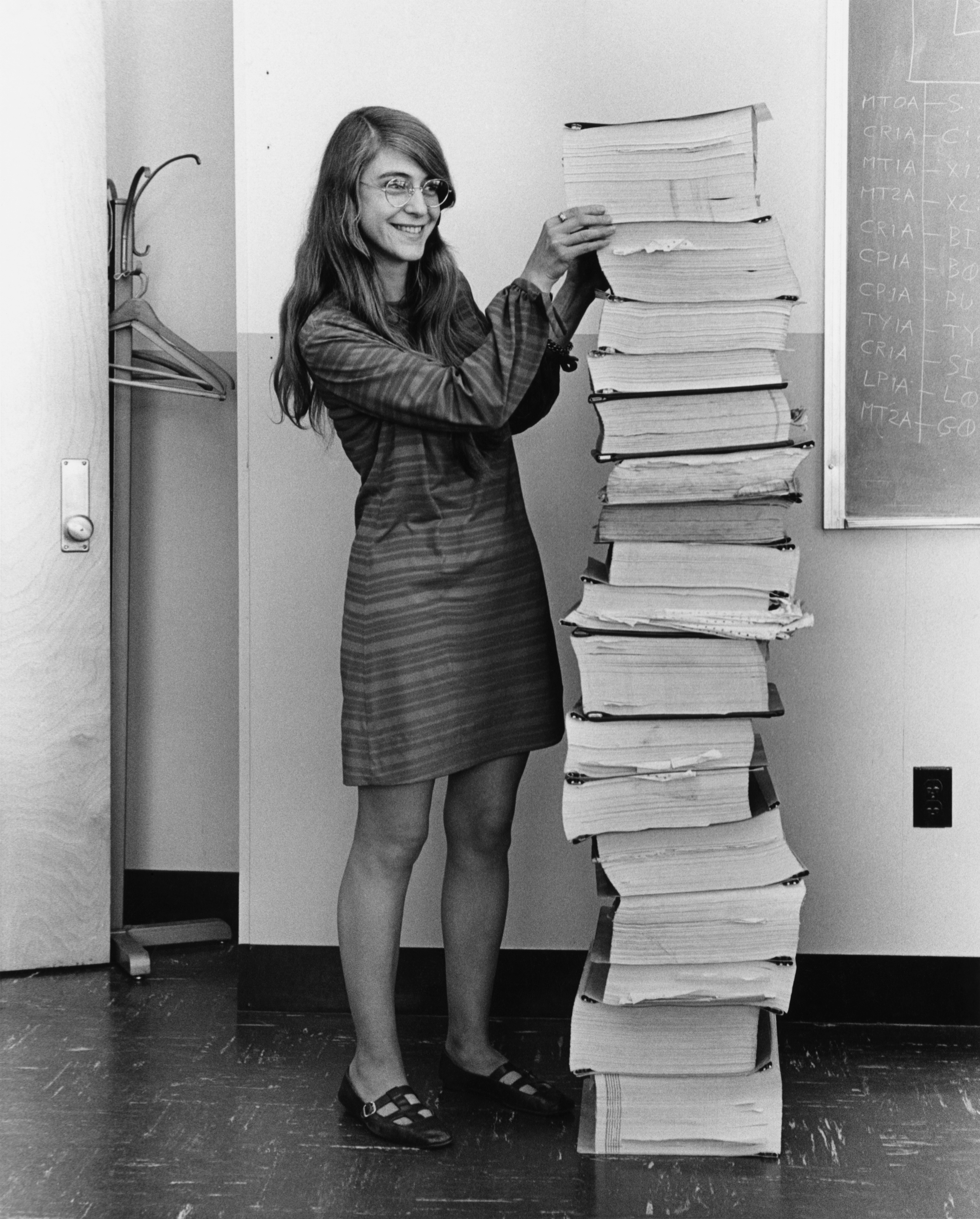
- Margaret Hamilton, the MIT computer scientist who led the Software Engineering Division that wrote Apollo 11's flight software, has died at 90.
- She is credited with coining the term software engineering — insisting that building flight code deserved the same rigor as any other engineering discipline.
- Her team's code saved the first moon landing: when the Apollo Guidance Computer threw 1201 and 1202 program alarms during descent, the software prioritized critical tasks and kept flying. Mission Control trusted it and told the crew to proceed.
- She received the Presidential Medal of Freedom from Barack Obama in 2016 for her contributions to the space program.
CAMBRIDGE, Mass. — Margaret Hamilton, whose code carried the first astronauts to the surface of the moon, has died at 90. Hamilton led the Software Engineering Division of the MIT Instrumentation Laboratory, the team that wrote the onboard flight software for NASA's Apollo program — and in doing so, she gave the field its name.
The news was confirmed by MIT News, CNN, and the BBC. Hamilton had become one of the most celebrated figures in computing history in her later years, her 1969 photograph standing beside a stack of printed Apollo code listings — taller than she was — becoming one of the defining images of the space age.
The alarms that almost ended Apollo 11
On July 20, 1969, as the lunar module Eagle descended toward the moon, the Apollo Guidance Computer began flashing 1201 and 1202 program alarms — warnings that the computer was overloaded. For a few terrifying moments, Mission Control faced a go/no-go decision with the world watching.
They said go. The reason was Hamilton's software.
Her team had designed the flight code with asynchronous, priority-driven scheduling: when the computer was overwhelmed — in this case by a rendezvous radar switch left in the wrong position, flooding the system with unnecessary data — the software shed low-priority tasks and kept the critical landing computations running. The alarms were the system working exactly as designed, telling everyone it was compensating. As Hamilton later told the Smithsonian, the software was not only flagging a hardware problem but actively compensating for it — and Mission Control trusted it.
With about 30 seconds of fuel remaining, Neil Armstrong reported: the Eagle has landed.
She named the discipline
When Hamilton started the work in the early 1960s, software engineering wasn't a term anyone used — software was treated as an afterthought to hardware. She coined the phrase deliberately to give the work the legitimacy and rigor it demanded, distinguishing it from hardware and other kinds of engineering.
The Apollo software was written for a machine with 72 kilobytes of memory — roughly a million times less storage than a modern phone. Programmers worked with punch cards and room-sized computers. Hamilton's team pioneered concepts — error detection and recovery, priority scheduling, human-in-the-loop systems — that underpin every reliable software system built since.
A late-blooming legend
Born Margaret Heafield in 1936 in Paoli, Indiana, she earned a mathematics degree from Earlham College and joined MIT in 1960, initially working on weather-prediction software with Edward Lorenz. When MIT won the Apollo contract in 1961, she joined the Instrumentation Laboratory and rose to lead the software division.
For decades her contributions were little known outside the field. That changed in the 2010s as the famous code-stack photograph spread online and historians reassessed Apollo's unsung architects. In 2016, President Barack Obama awarded her the Presidential Medal of Freedom, the nation's highest civilian honor. The complete Apollo 11 guidance software — some 145,000 lines — was published on GitHub, where it remains one of the most studied codebases in history.
Hamilton went on to found Hamilton Technologies, where she continued working on systems engineering and the Universal Systems Language she developed. She is survived by her family.
The code she wrote still flies — not just in history books, but in the DNA of every system that has to work the first time, with no second chances.
Sources
- MIT News · Margaret Hamilton obituary, Oct 2026
- CNN · Margaret Hamilton obituary, Oct 2026
- BBC · Margaret Hamilton obituary, Oct 2026
- NASA · Margaret Hamilton (Maia Weinstock, MIT News Office)
- Smithsonian Magazine · Margaret Hamilton Led the NASA Software Team That Landed Astronauts on the Moon