
Two men who had never worked together
MB&F is built on a habit: Maximilian Büsser collects watchmakers the way other brands collect ambassadors, then gets them into a room. For the Legacy Machine Thunderdome, the room held two men who had never worked together, and who approach a movement from opposite ends.
Eric Coudray, from the Vallée de Joux, is watchmaking's engineer of the impossible — the innovator behind Jaeger-LeCoultre's Gyrotourbillon, a man whose reputation rests on making regulating mechanisms do things they were not supposed to do. Kari Voutilainen, based in Môtiers, is its conscience: a finisher whose workshop guards its techniques like family recipes, and whose name on a movement is a promise about the parts a customer may never see. Put the maximalist in charge of the mechanism and the traditionalist in charge of everything it looks and feels like, and the risk is obvious. Each could have diluted the other. Büsser's wager was that neither would.
A brief with one sentence in it
Büsser's brief to Coudray was one sentence long: make the craziest, most cinematic three-axis tourbillon ever. Coudray answered with a mechanism MB&F calls TriAx, and it goes beyond the tourbillon it was asked for.
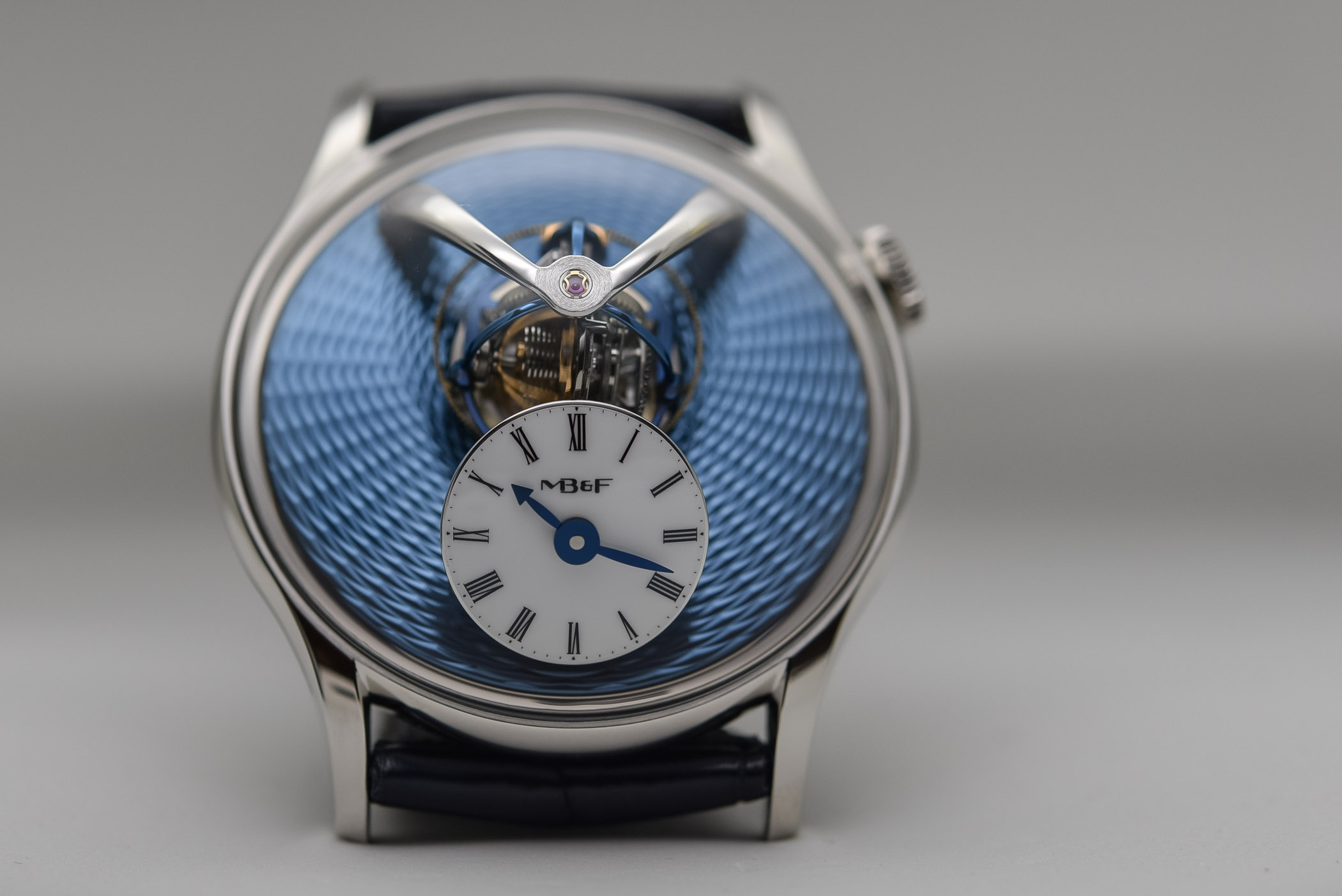
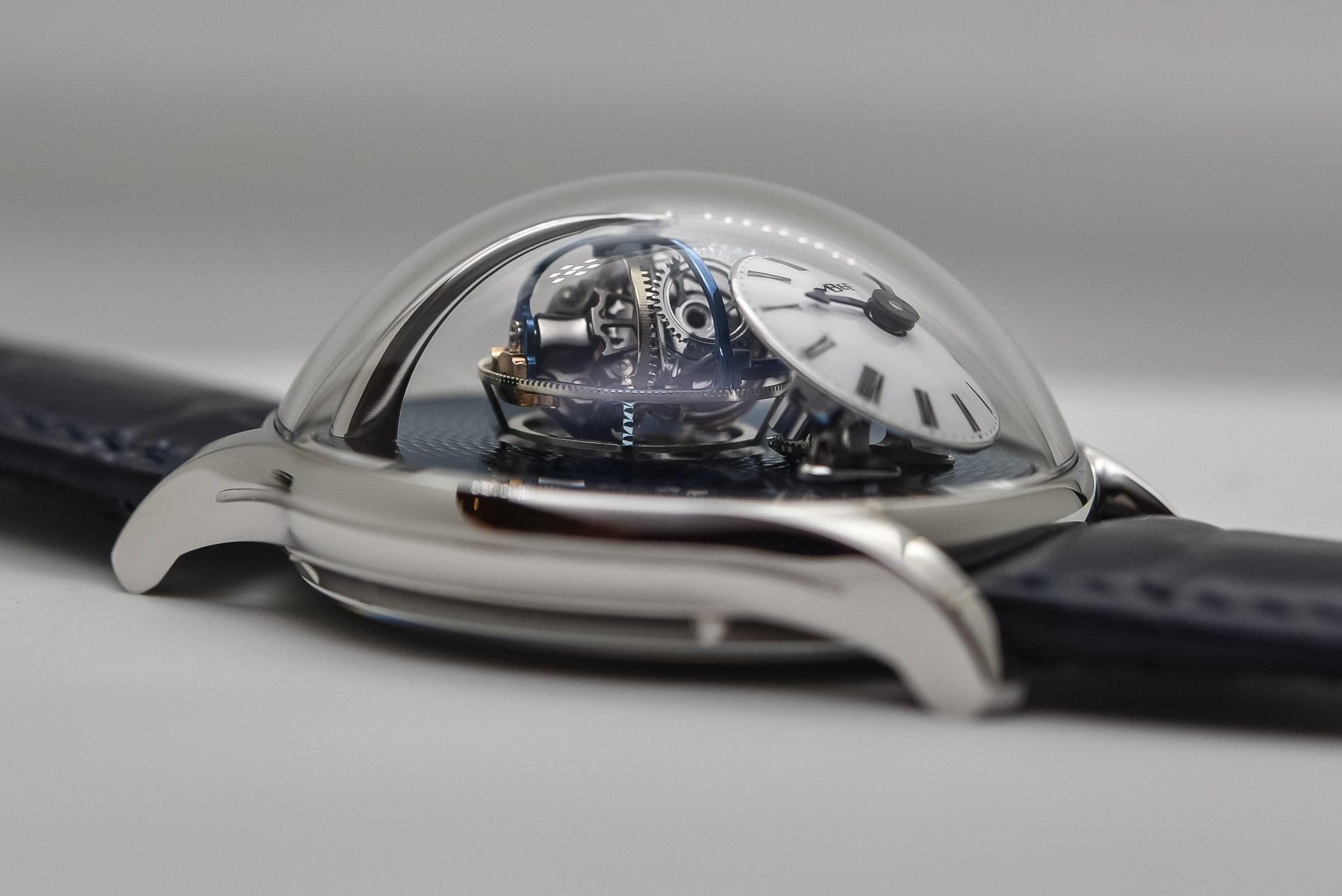
The regulating organ turns on three axes at three speeds, on different planes. The innermost structure completes a turn in eight seconds, the intermediate cage in twelve, the outermost in twenty. MB&F bills the combination as the world's fastest triple-axis regulating mechanism. Just as important is what Coudray left out: the assembly uses a stripped-down two-cage construction, so the motion stays visible instead of disappearing inside its own scaffolding. A three-axis mechanism that hides itself would have failed the brief. This one performs in the open, under a tall sapphire dome, and time itself is pushed to the edge of the watch to clear the stage — hours and minutes are read on a small white lacquer subdial tilted at 58 degrees, turned up toward the wearer.
Speed is the engineering problem
Those rotation speeds are not a styling choice. They are the problem the rest of the movement had to solve.
A mechanism turning that fast consumes energy voraciously, in MB&F's own words, so the movement carries three mainspring barrels to feed it. The escapement had to change, too. Coudray used a rare Potter escapement, with a fixed escape wheel — integrating a fixed escape wheel inside a tri-axial mechanism had never been done before. The fixed wheel frees space inside the cages and tolerates the pace the brief demanded. The balance wheel is hemispherical, wrapping around a helical hairspring, a configuration without precedent in modern or classical watchmaking: the regulating organ is shaped like a bowl, with the hairspring coiled inside it.
The finished movement is manual-winding, with 413 components and 63 jewels, beating at 3Hz for a 45-hour reserve, the indicator for that reserve placed on the reverse where it will not interrupt the show. The case around it is 44mm across and 22.2mm tall — most of that height is the dome — built from 20 components in platinum or tantalum, with sapphire crystals front and back and water resistance of 30 metres. On paper those are modest, almost classical specifications. That is the point. The extravagance is concentrated in one place, and everything else is engineered to serve it.
Turn it over, and the storm stops
The reverse is Voutilainen's territory, and the temperature drops.
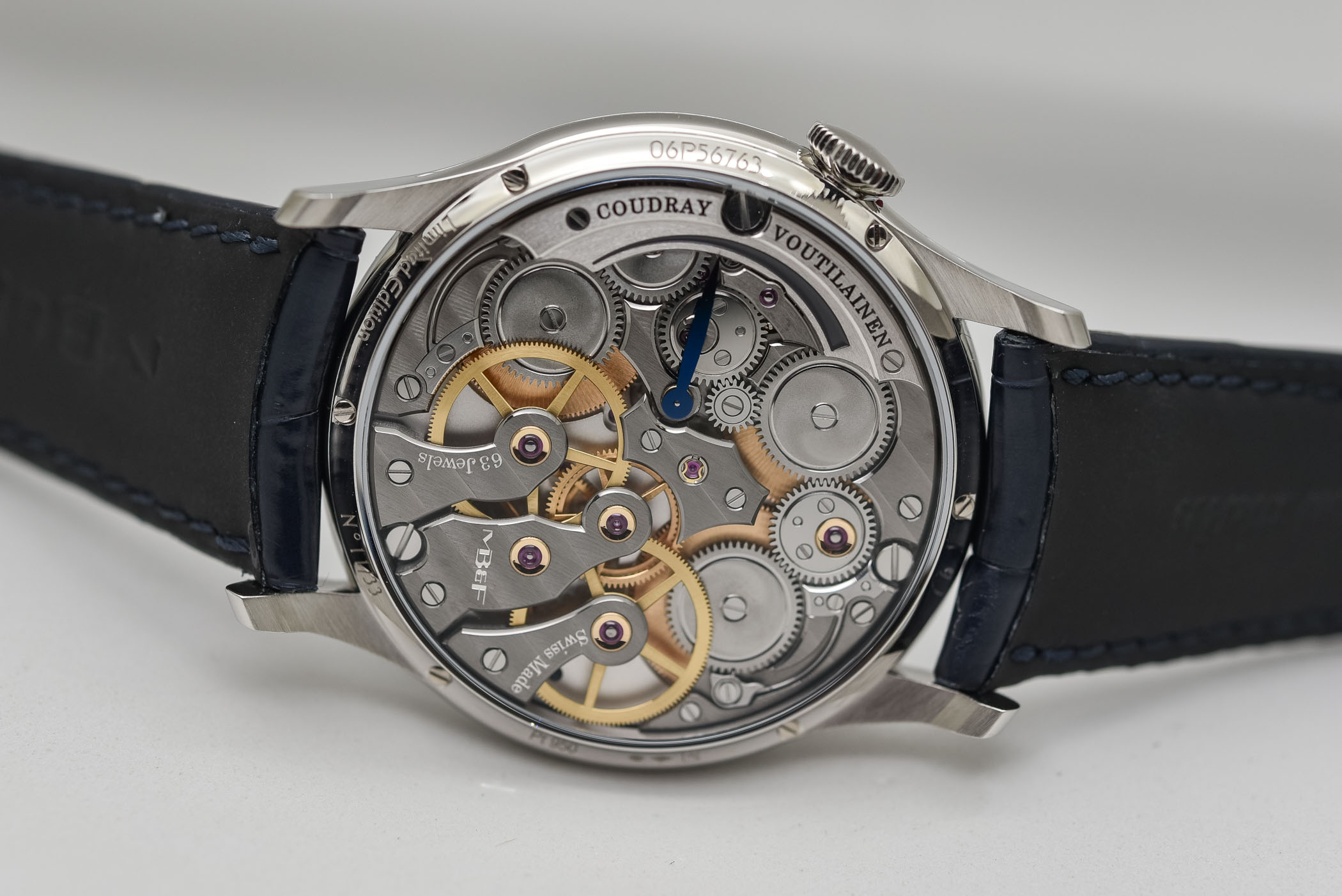
Voutilainen took responsibility for the movement's aesthetics and finish, and he stayed close to the work in a literal sense: he hand-drew the movement, to keep his own connection with its balance and tolerances. What that produces, seen through the back, is rounded bridges with sharp, hand-bevelled internal angles — a combination that cannot be hurried, because a soft outside edge and a crisp inside corner on the same bridge are two different disciplines meeting on one piece of metal. For the first time on an MB&F, the ratchet wheels carry his proprietary finish, a surface that catches light in slow, serpentine waves.
His work is on the front as well. The guilloché dial plate beneath the mechanism was made in his workshop, engine-turned in the traditional way, so even the stage the TriAx performs on is hand-finished. And around the movement, both men's names are hand-engraved: Coudray's on the mechanism he invented, Voutilainen's on the finish he imposed on it. A collaboration is usually asserted in a press release. Here it is cut into the object, one name for each side of the watch.
Small numbers, strict limits
The launch edition is platinum 950 with the light-blue guilloché plate, limited to 33 pieces. A tantalum edition for The Hour Glass runs to ten pieces, split between aventurine and dark-blue guilloché dials. The platinum edition was priced at CHF 270,000 before taxes.
Those limits are not scarcity theatre. A movement with this much hand-finishing, from a workshop culture that treats its techniques as inheritance, cannot be scaled without becoming something else. Thirty-three platinum watches is what the two signatures on the caseback can honestly stand behind.
Previously's Take
Most watchmaking collaborations are marketing with a shared logo; Thunderdome is the other kind — two opposed philosophies, each given a side of the watch and told to be fully itself. A front that shows off, a back that shows restraint, both signatures engraved by hand: one object earning both descriptions is why it will outlast louder novelties.
The numbers
Sources · 5 sources
- MB&F — Legacy Machine Thunderdome product page (collaboration, TriAx timings, specifications)
- Monochrome Watches, December 3, 2019 — hands-on review, live photography (editions, CHF 270,000 price, finishing)
- Professional Watches, December 2019 — launch report ($280,000 US price)
- Hodinkee, December 2019 — "Introducing: The MB&F Legacy Machine Thunderdome" (live photographs; Voutilainen hand-drew the movement)
- Bryan Lehmann (cinematographer) — Thunderdome film project page; film hosted on MB&F's official YouTube channel
Photographs: Monochrome Watches · Monochrome Watches · Monochrome Watches