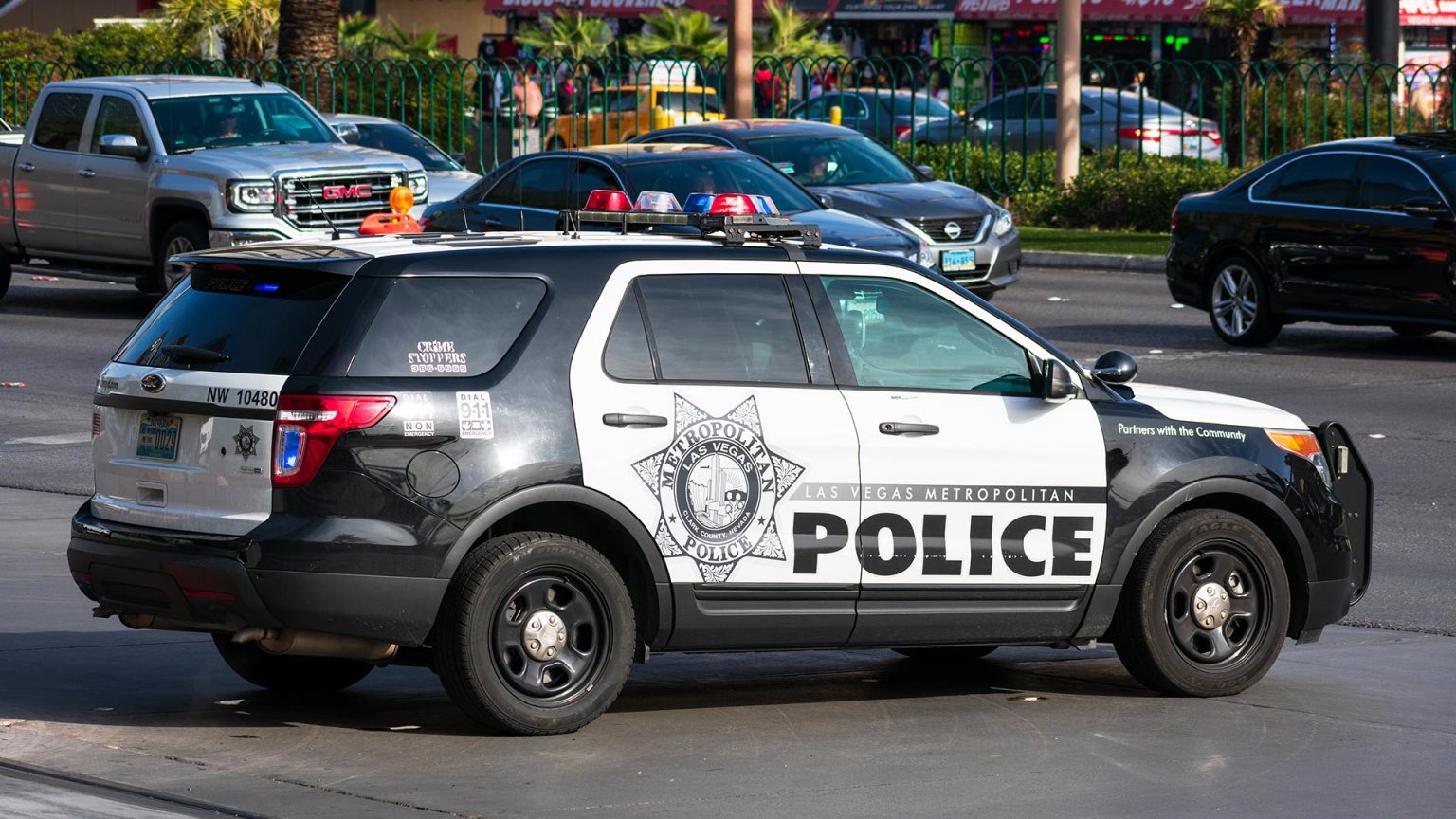
LAS VEGAS — A Las Vegas Metropolitan Police Department officer “negligently discharged his firearm” on the afternoon of September 25 while responding to a stolen vehicle call in the west valley, according to the department. No one was hit. The suspect got away, rammed two patrol cars, and was later arrested with a minor injury.
That much, Metro will tell you. What the department won’t say: the officer’s name. What the body-camera footage shows. Whether the officer has been disciplined, reassigned, or returned to duty. There will be no press conference, no 48-hour briefing, none of the transparency choreography that normally follows when a Metro officer fires a weapon.
The reason, according to a department spokesperson: the case “is now an Internal Affairs investigation and, per NRS, those are not shared.”
That single sentence — citing Nevada Revised Statutes — is doing an enormous amount of work. It’s the difference between a police shooting the public gets to scrutinize and one it doesn’t. And it raises a question worth sitting with: when an officer’s gun goes off and a bullet flies through a Las Vegas neighborhood, at what point does the public’s right to know kick in?
What Happened on West Charleston
The department did hold one briefing, on the afternoon of the incident itself. Metro Capt. Adam Seely told reporters that officers received reports of a stolen vehicle in the 9500 block of West Charleston Boulevard, near South Hualapai Way, around 12:40 p.m. on Friday, September 25.
An officer located the vehicle just to the northeast, in the 8200 block of Silver Sky Drive, off Westcliff Drive east of North Durango Drive. The officer approached, drew his firearm, and ordered the suspect out of the vehicle. Instead, Seely said, the suspect began to drive away — and the officer fired one round.
The bullet didn’t hit the suspect. The suspect hit the gas, rammed two Metro patrol vehicles, and fled. Officers later caught up, made an arrest, and the suspect was taken to a hospital with what police described as a minor injury.
Seely drew a careful distinction at the briefing: this was not, in the department’s taxonomy, an officer-involved shooting. An officer-involved shooting means the officer intentionally fired. A negligent discharge means the firing was accidental. Because it was classified as the latter, Seely said, “the LVMPD Internal Affairs Bureau responded and is now leading the investigation.”
He declined to provide additional details.
Two Tracks of Transparency
Here’s where the story gets uncomfortable. Metro has a well-established playbook for officer-involved shootings, and it’s one of the more transparent in American policing: the department typically releases the officer’s name within 48 hours, then holds a full briefing — often with body-camera footage — walking the public through what happened and why.
That playbook exists because the community demanded it, over years, after shootings where the official account didn’t match what witnesses saw. The 48-hour briefing is a hard-won accountability mechanism. It says: when the state’s agents use lethal force, the public gets answers, quickly, on the record.
A negligent discharge short-circuits all of it. Same gun. Same officer. Same neighborhood. A bullet in the air. But because the firing is classified as accidental rather than intentional, the case goes to Internal Affairs — and under Metro’s reading of Nevada law, Internal Affairs investigations are confidential. No name. No footage. No briefing. No timeline for when, if ever, the public learns what the investigation found.
The distinction is legally coherent and, from a community-trust standpoint, difficult to defend. The danger to the public doesn’t depend on the officer’s intent. A negligently fired round in a residential neighborhood — near West Charleston and Hualapai, not exactly empty desert — carries the same physics as an intentionally fired one. The only thing the classification changes is how much the public gets to know.
What NRS Actually Says
Metro’s spokesperson cited Nevada Revised Statutes as the basis for withholding the investigation. Nevada law does provide confidentiality protections for certain personnel investigations, and police unions have historically argued — successfully, in many jurisdictions — that Internal Affairs files are personnel records shielded from public disclosure.
But the application here deserves scrutiny. The 48-hour OIS briefing practice isn’t required by statute either — it’s a department policy, adopted voluntarily. Which means the department has already decided, as a matter of policy, that the public interest in officer shootings outweighs the confidentiality interest. The question is why that judgment flips entirely when the shooting is accidental.
Civil liberties advocates have long argued that the intentional/accidental distinction is a loophole that swallows the transparency rule. If the classification decision itself is made by the department, behind closed doors, with no outside review, then the department effectively controls which shootings get sunlight and which ones don’t — simply by choosing the label.
Metro has not said who made the classification decision in this case, what criteria were applied, or whether any outside entity reviewed it.
The Pattern
This isn’t the first time a Metro negligent discharge has raised these questions. In October 2017, during the response to the Route 91 Harvest festival mass shooting, a Metro officer accidentally discharged his weapon inside the gunman’s Mandalay Bay suite after the breach. Then-Sheriff Joe Lombardo confirmed it, said “nobody was struck,” and said the department was investigating it “just like we do with any officer-involved use of force.” The officer was never named.
Nine years later, the playbook hasn’t changed: confirm the discharge, confirm nobody was hit, decline to name the officer, close the file to the public.
What has changed is the context. Las Vegas has spent the years since 2017 building one of the more robust police-transparency frameworks in the West — the 48-hour briefings, the routine bodycam releases, a sheriff who has repeatedly said sunlight is the policy. The negligent-discharge carve-out sits uneasily alongside all of it, a reminder that transparency systems are only as strong as their exceptions.
What Comes Next
The Internal Affairs investigation is ongoing. Metro has not provided a timeline for its completion or said whether any findings will be made public. The officer involved has not been named. The body-camera footage — which almost certainly exists, given Metro’s near-universal bodycam deployment — has not been released and, under the department’s current position, won’t be.
The suspect in the stolen vehicle case was arrested and faces whatever charges arise from the theft and the ramming of the patrol cars. That part of the story will play out in public, in court, on the record.
The part about the officer’s bullet — where it went, why the gun fired, whether discipline followed — will play out in a file the public can’t see, under a statute the department won’t explain further, on a timeline nobody has shared.
That’s the story. Not just that a gun went off, but that the system for finding out why has a door marked “Internal Affairs,” and the public isn’t allowed through it.
Sources
- Las Vegas Review-Journal, “Police: No injuries after Las Vegas officer ‘negligently’ fired weapon,” September 25, 2026.
- FOX5 Vegas (KVVU), “Las Vegas police investigating ‘negligent shooting’ in stolen vehicle response,” September 2026.
- KTNV Channel 13, “LVMPD officer accidentally fires gun during stolen vehicle incident in Las Vegas,” September 2026.