
The table is the last thing decided
Every furniture maker buys lumber. The Nakashima studio, in New Hope, Pennsylvania, does something closer to matchmaking. The firm's own design-process record lays out the sequence plainly: first a conversation about the intended setting, your preferences on size and materials, and your budget — and only then does the studio prepare a selection of up to three boards from its stack of custom-sawn lumber for you to review, in person, with Mira Nakashima and her design team. The table is the last thing decided. The board is the first.
That order is the whole philosophy. A commission at New Hope is not picked from a catalogue and customised at the margins; it is built backwards from a single piece of wood that two parties — maker and client — have agreed deserves to become furniture. Everything downstream, the dimensions, the base, the finish, answers to what that board already is.
A board is a biography
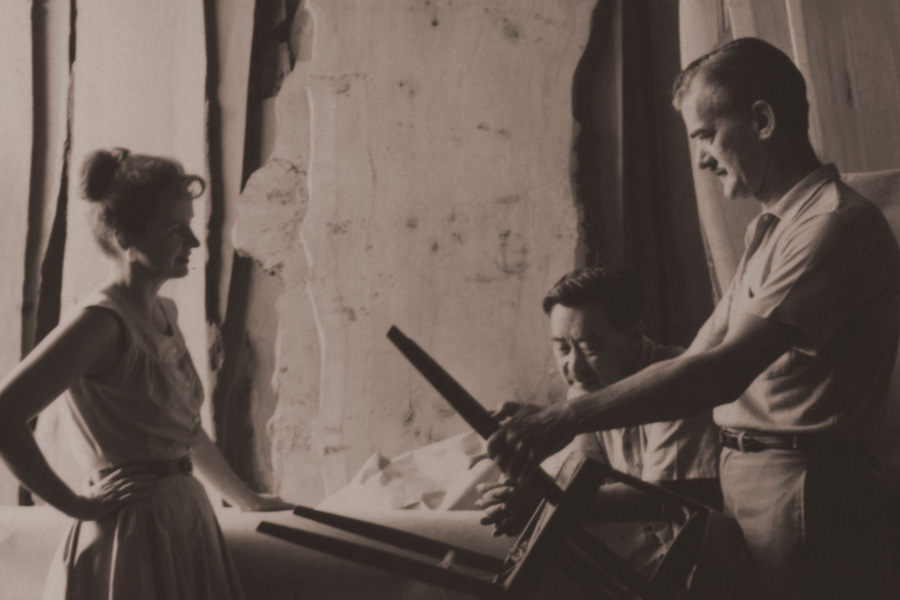
George Nakashima, who founded the studio after the Second World War and ran it until his death in 1990, treated a board as a record of a specific tree's life — its grain, burls and cracks the biography, not defects to be milled away. Where conventional sawyers cut off a tree's irregularities, George went to the sawmill himself and oversaw the milling of each log so the natural forms survived.
The studio still works that way. The lumber behind its furniture comes from great trees that have reached or passed their prime, almost all of it custom-sawn by George or by Mira herself, and the milling is still overseen personally so that nothing the tree did in a century of growing gets planed off for tidiness. Burls — the dense, swirling growths where a tree mended its own wounds — are prized rather than rejected, read as the most eloquent part of the board.
The crack is held, not hidden
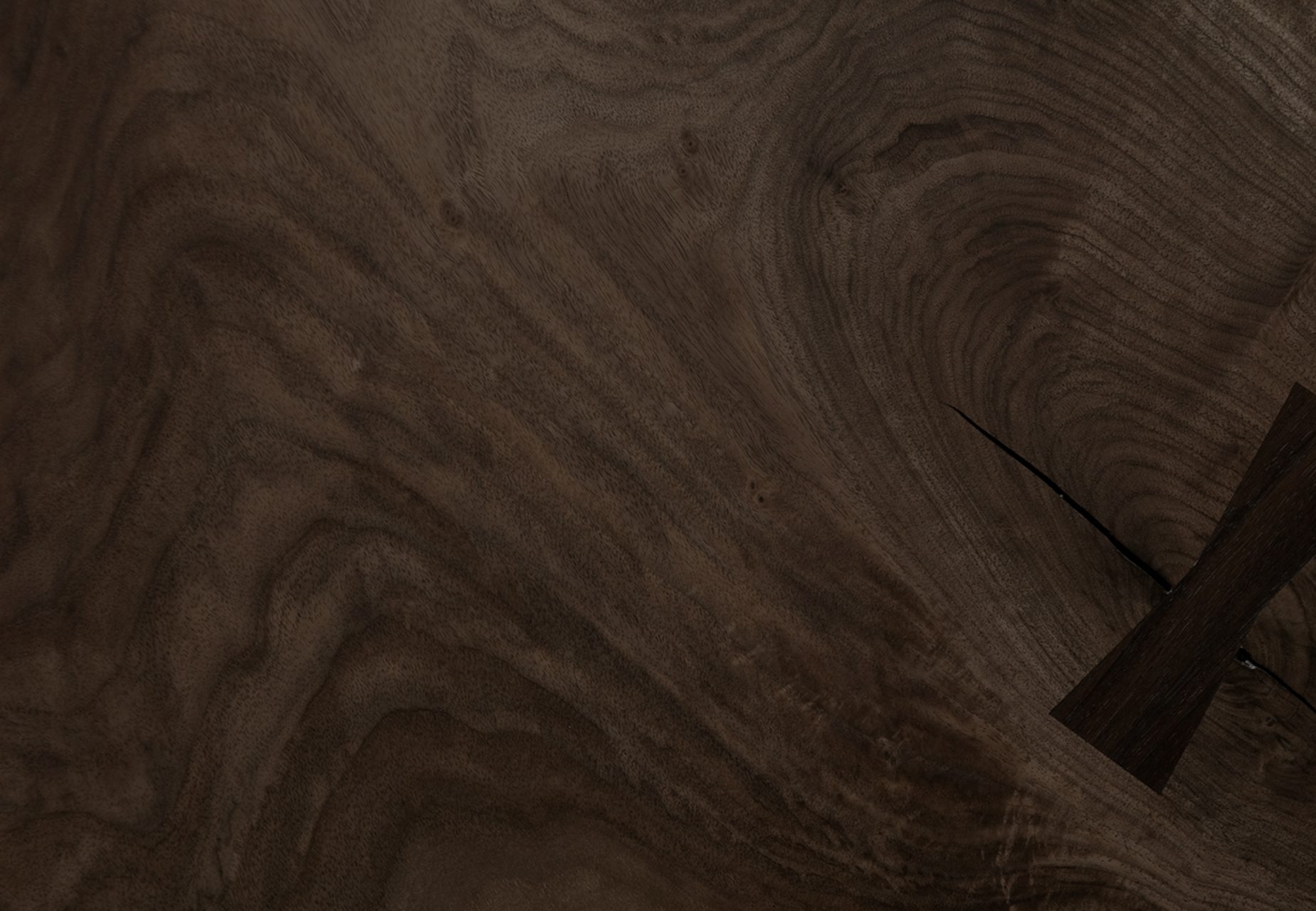
The famous details follow from that respect. A crack is not filled and disguised; it is bridged with a butterfly joint and left visible, the repair turned into a signature — the walnut board in this story's lead photograph carries one, holding a split the way a stitch holds cloth. A live edge is not a style applied afterwards; it is the tree's own outline, kept.
Under a hand-rubbed oil finish, as Mira puts it in her father's words, the wood "lives and breathes." The finish is maintained rather than sealed away, one more way the piece stays in conversation with the people who live with it instead of becoming a museum object in their dining room.
Drawn by hand, on the board itself
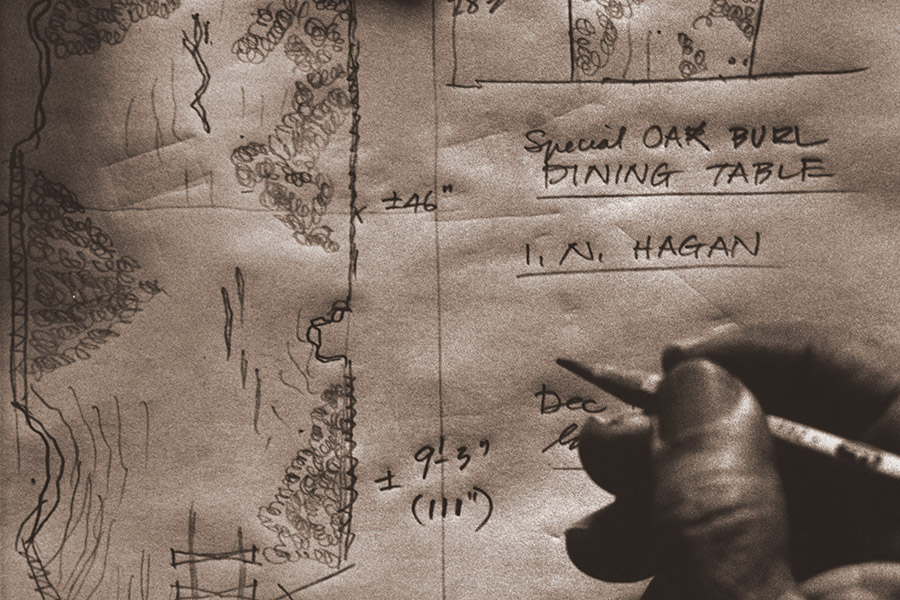
The hand stays in the process at every stage. Designs are still sketched in pencil and chalk, in direct contact with the material, because the studio believes the board speaks differently to a hand than to a screen. The studio's own photograph of the practice shows a real commission mid-reading: a sheet headed "Special Oak Burl Dining Table," drawn for a named client, the burl's contours traced and its dimensions noted — roughly 46 inches across, a little over nine feet long. That is not a rendering of a product. It is a portrait of one board, taken before anyone agreed what it would become.
Clients are invited into that conversation rather than handed a finished design: sit with the boards, feel which one pulls at you, and let that instinct guide the piece. It is slower than ordering furniture is supposed to be. That is rather the point.
An unbroken line
There is a family weight to all of this that no imitator can copy. George built the New Hope complex — the studio grounds he raised from the 1940s are now a designated National Historic Landmark — after a life that ran from architecture training at MIT, through work in Japan and India, to incarceration at Minidoka during the war, where the master carpenter Gentaro Hikogawa deepened his craft. The man who would become America's defining woodworker learned some of his joinery behind barbed wire, from a craftsman his own country had imprisoned alongside him. The patience in the furniture has a history.
Mira joined the studio in 1970, apprenticed under her father for twenty years, and has directed it since 1990, designing her own pieces alongside his. A commission today buys into that unbroken line: the same lumber stacks, the same sawing philosophy, the same refusal to let the material be anonymous — carried now by the daughter who learned it at the bench, one board at a time.
Previously's Take
Plenty of workshops will sell you a live-edge table this week. What Nakashima sells is slower and stranger: a relationship with one particular board, chosen with the maker's daughter — the grain was never decoration, it was the design brief all along, and the studio has the patience to read it.
The numbers
Sources · 3 sources
- George Nakashima Woodworkers — official design-process page (wood selection, board review, sketching, sawing philosophy; George and Mira Nakashima quotations)
- Metropolis — "Root System" (Mira Nakashima's stewardship of the New Hope studio; George's death in 1990)
- Homes + Studios / George Nakashima Woodworker Complex records (New Hope complex history; National Historic Landmark designation, 2014)
Photographs: George Nakashima Woodworkers · George Nakashima Woodworkers · George Nakashima Woodworkers