
An idiom before it is a pen
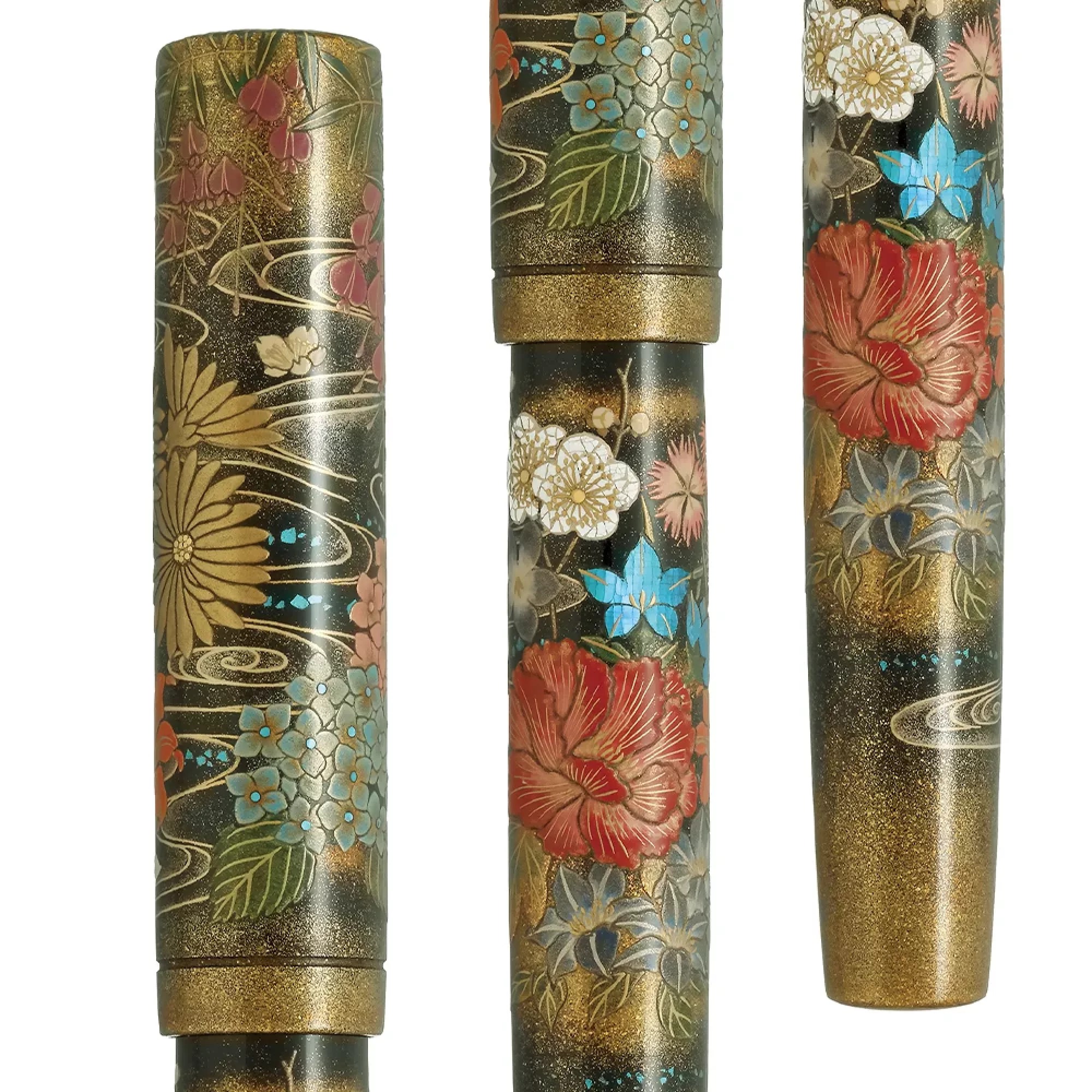
The name is an idiom before it is a pen. Hyakka ryōran — a profusion of flowers in bloom — is a Japanese expression for talents flowering all at once, and Namiki took it literally for its 2025 Limited Edition Emperor. Eleven flowers from across the four seasons share one ebonite body: the year's calendar, arranged so something is always in bloom somewhere on the pen.
For the artisan who made it, Yutaka Sato of the Kokkokai, the idiom is also a description of how the pen gets made. Sato has said the techniques chosen allow every bloom to hold its own character while creating movement across the surface — the flowers standing for the flourishing of many, the talents of each artisan uniting to bring the pen to life. It is not his first statement piece for the house: his earlier Namiki editions include the 2011 Golden Flower and the 2019 Shoki.

The pen the earthquake delayed
The edition was originally set for release in 2024. Its completion was delayed after the Noto earthquake devastated parts of Ishikawa Prefecture, a region where many Kokkokai artisans live and work. In the aftermath, the artisans chose to continue creating, and the finished pen carries that decision in its history: a celebration of flowers in full bloom, completed by a community that had just been through a disaster, on the far side of it. The delay is part of the edition's record, not a footnote to it — a 2025 pen whose making was interrupted by the ground moving, and finished anyway.
Eleven flowers, five ways of making them
No two of them are made the same way, and that is the point of the edition. Maki-e — "sprinkled picture" — is a family of techniques, and this pen runs the family in a single composition. Some flowers are painted flat and polished smooth (Hira maki-e). Others are built up in relief so the petals carry real height (Taka maki-e). Others are polished back down through layer after layer of lacquer and metal powder until the image sits level with the surface (Togidashi maki-e). Mother-of-pearl is inlaid where a petal needs to shimmer (Raden), and fragments of quail eggshell are set where a flower needs texture no powder can give (Rankaku).
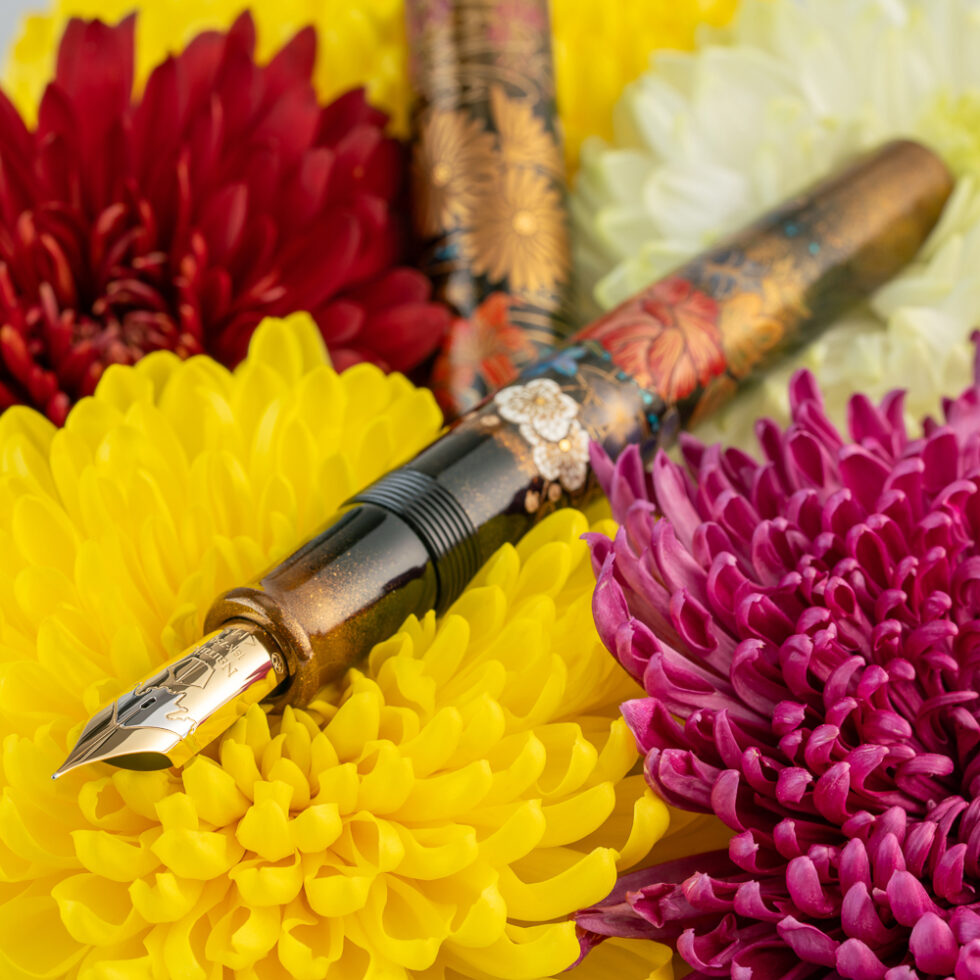
The seasons assign the techniques. Spring opens with cherry blossom, violets and wisteria in Hira maki-e, built from repeated layering, sprinkling, sealing and burnishing of gold and silver powders. Summer follows with clematis and sweet lily, the hydrangea worked in Raden — slivers of abalone shell giving the flower its iridescence. Autumn mixes three techniques on one stretch of barrel: dianthus in Hira maki-e, bellflowers glowing with Raden inlay, chrysanthemums rising in sculptural Taka maki-e. Winter brings the pen's most arresting passage: plum blossom in Rankaku, fragments of eggshell placed to give the flower a soft, naturalistic finish, and the winter peony back in raised Taka maki-e. All of it rests on a ground of earth and flowing water made in Togidashi-Taka maki-e, lacquer layered and polished until depth, shadow and reflected light move under the blooms.
One signature, a season of work
The pen was made by Yutaka Sato of the Kokkokai, the maki-e artisan group formed in 1931 around Gonroku Matsuda, the master who taught Namiki's first lacquer artists; Namiki has made maki-e pens since 1925. Each piece is signed by Sato and ships with his artisan card. Although each pen is led by a single artisan, its creation calls on many hands — the idiom again, this time as workshop practice.
The Kokkokai's rhythm explains why editions like this stay small: a fine maki-e pen can take up to three months to finish, the cycle of lacquering, drawing, sprinkling and polishing repeated — on the most demanding pieces — as many as 130 times. Lacquer has to harden between passes. There is no shift pattern that hurries it.
The largest canvas Namiki makes
Under the garden sits the largest canvas Namiki makes. The Emperor is the flagship form — an oversized ebonite body built around the No. 50 nib, the jumbo size Namiki first produced in the early 1930s. Here the nib is 18-karat gold with rhodium accents and the engraved image of Mount Fuji, in medium or broad. The edition is numbered to 99 pieces worldwide, priced at $26,000 in the United States, and presented in a wooden box with black ink, a polishing cloth, a serial-number plate and a certificate. Namiki calls it the most ambitious Emperor it has produced. Count the techniques, then count the months, and the claim checks itself.
Previously's Take
Most limited editions limit the number and call it rarity; this one limits itself the older way — one artisan, one signature, a process that takes a season to cross a single pen. Ninety-nine people will own one, and nobody will own a fast one: the garden is the visible part, but the real specification is time.
The numbers
Sources · 6 sources
- Pilot / Namiki — Emperor collection and maki-e technique records
- Dromgoole's — 2025 Limited Edition Emperor announcement (specifications)
- Fountain Pen Hospital; Pen Boutique; Atlas Stationers; Goldspot Pens — authorised dealer listings (price, edition, box contents)
- Bonhams — Namiki/Kokkokai background (group formed 1931; maki-e pens since 1925)
- PORTFOLIO Magazine — "Namiki's Blooming Flowers in Profusion Pen is in Full Bloom" (seasonal technique mapping; Sato's earlier editions, 2011 Golden Flower and 2019 Shoki; the Noto earthquake delay)
- Chatterley Luxuries; Sakura Fountain Pen Gallery — dealer photography
Photographs: Namiki / Pilot · Namiki / Pilot · Namiki / Pilot