
Most third acts try to outdo
Most third acts try to outdo. Pagani's tried to subtract.
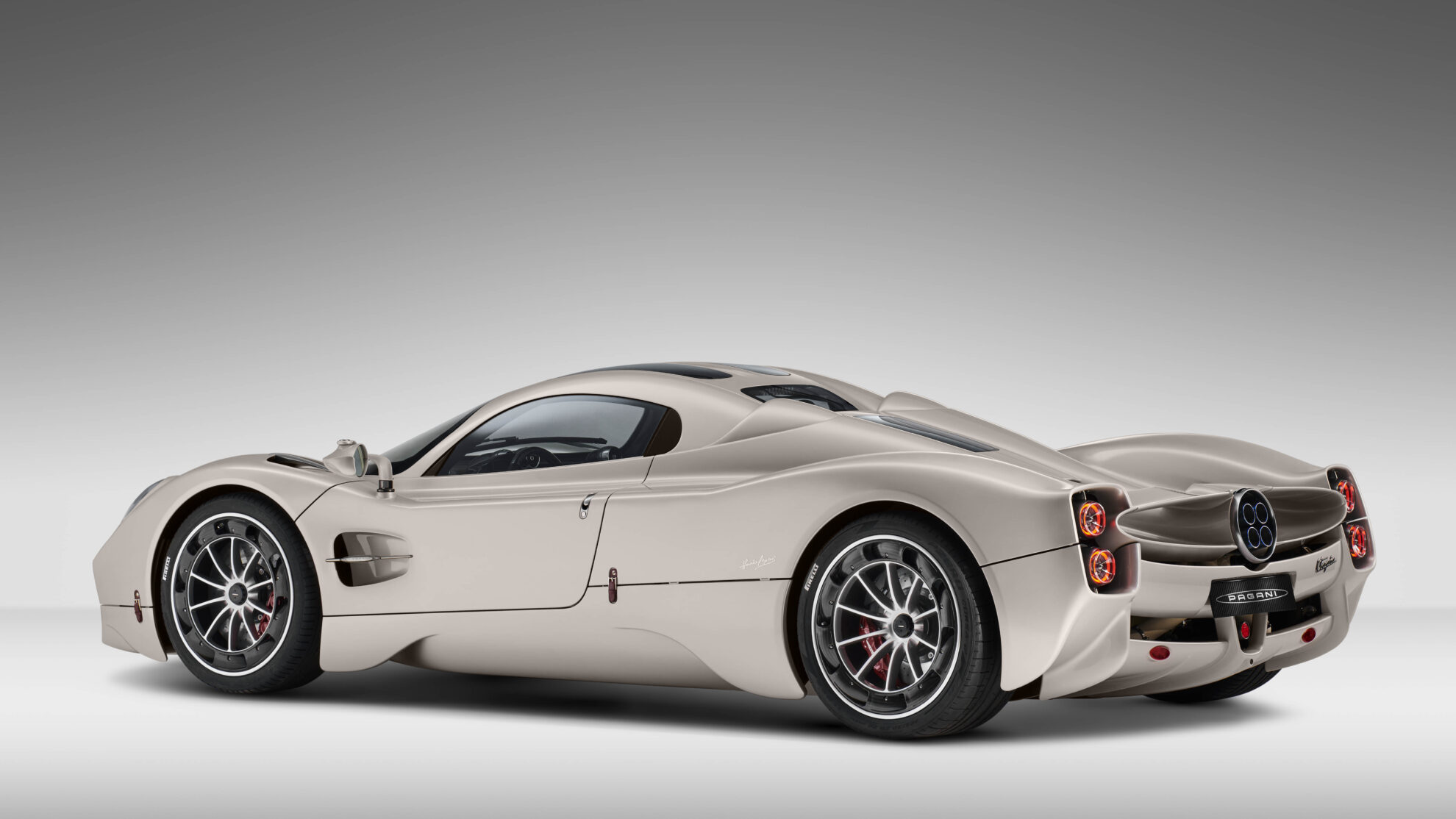
The Utopia — codename C10, the company's third model after the Zonda and the Huayra — was presented on September 12, 2022, at the Teatro Lirico in Milan. A theatre, not a motor show stand: the company understood that what it was unveiling was less a specification than a position, and it chose a room built for performances to say so in.
The position began with a question. Horacio Pagani asked his closest clients a dangerous thing: you already own exceptionally fast, exceptionally beautiful cars, so what are you still missing? Pagani's own account says three terms came back almost every time: simplicity, lightness, and the pleasure of driving. In 2022, in an industry sprinting toward hybrid assistance and dual-clutch everything, the brief was to go the other way.
Six years of drawings, models and prototypes
Getting to simple turned out to be the most complicated project in the company's history. In Pagani's own words: "More than four thousand stylistic drawings, ten scale models, one wind tunnel model, two 1:1 scale models and countless ideas, research and experiments on eight complete prototypes for a team effort that lasted more than six years."
Read that list as a sequence, not a boast. The drawings and scale models are where a shape gets argued over at a size a team can walk around and afford to discard. The wind-tunnel model is where the argument meets physics. The two full-scale models are where it has to survive at the size a customer will actually judge. And the eight complete prototypes are where all of it stops being representation and becomes a car that can break. Three of those prototypes were given over largely to engine testing, about two years on its own — a third of the whole programme spent proving the one component Pagani did not intend to change its mind about.
The shape was frozen only after years of wind-tunnel work, chasing a body that does its aerodynamic work in its lines rather than in bolted-on appendages — more downforce, less drag, almost nothing stuck on. Subtraction, it turns out, has to be engineered as hard as addition. A wing produces downforce on the first try. A clean body that produces the same downforce takes years.
A real manual, or none
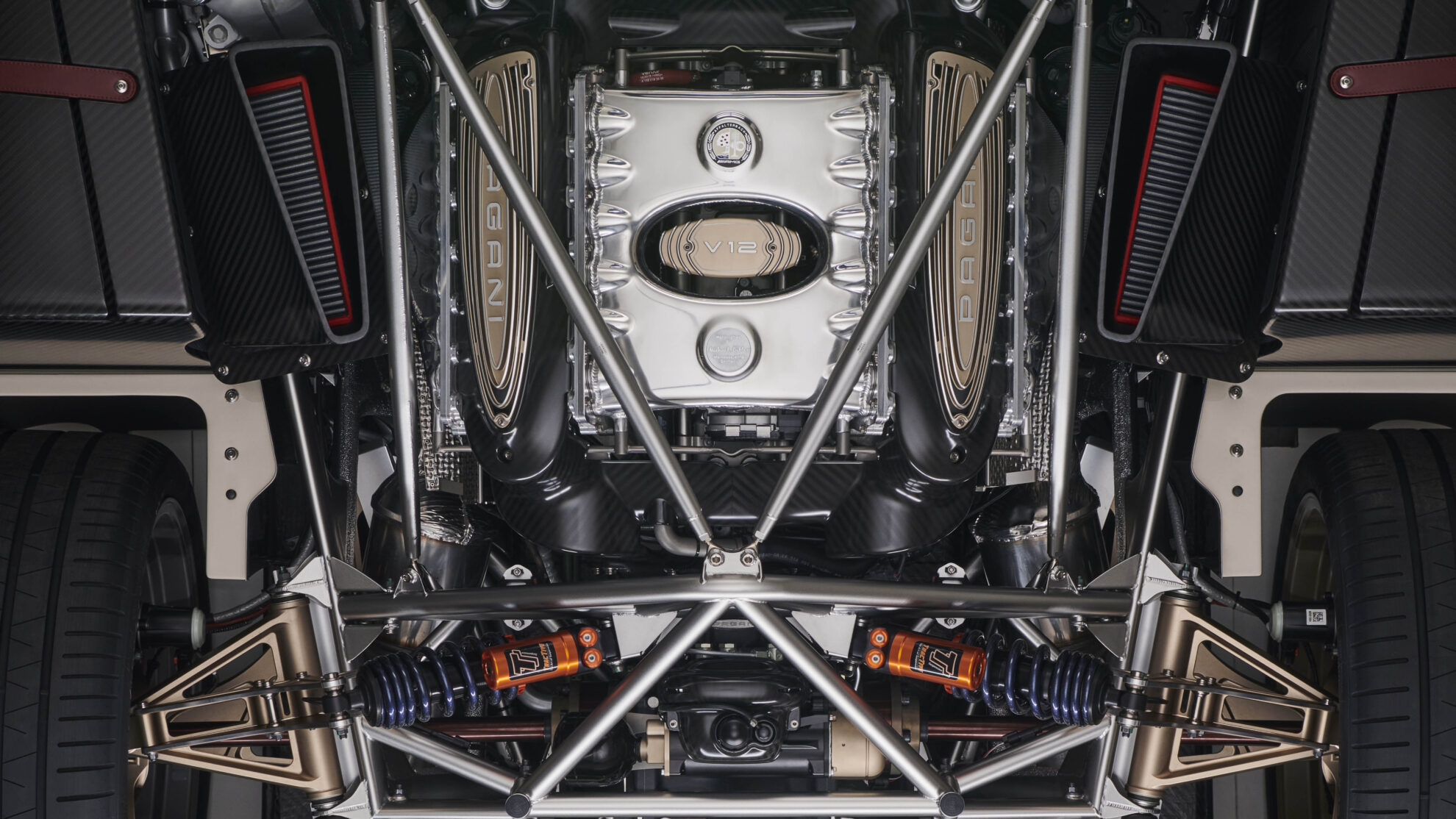
The mechanical choices follow the same creed. The engine is a 6.0-litre twin-turbo V12 built by Mercedes-AMG for Pagani, making 852 hp (864 PS) at 6,000 rpm and 1,100 Nm of torque, held across a plateau from 2,800 to 5,900 rpm. The engine itself weighs 262 kg dry, and the whole car is quoted at 1,280 kg — the lightness the clients asked for, delivered as a number rather than a promise. There is no hybrid system. The only notable electric motor, as Hagerty put it at launch, is the one that fires it up.
And there is no dual-clutch gearbox. Pagani calls the dual-clutch efficient but heavy, and says it robs the driver of setting the pace. Instead, Xtrac developed a transverse seven-speed, mounted with an electro-mechanical differential and a triple-plate clutch, offered as an automated manual or as a true manual: synchroniser rings, an exposed linkage, and a gear lever engineered to live with all 1,100 Nm. Pagani is blunt about why a simulated manual would not do — its customers asked for a real one, so a real one had to be invented at hypercar torque levels. That invention is the programme in miniature. The easy version of every decision on this car existed, was cheaper, and was rejected on the record.
The cabin argues the same case
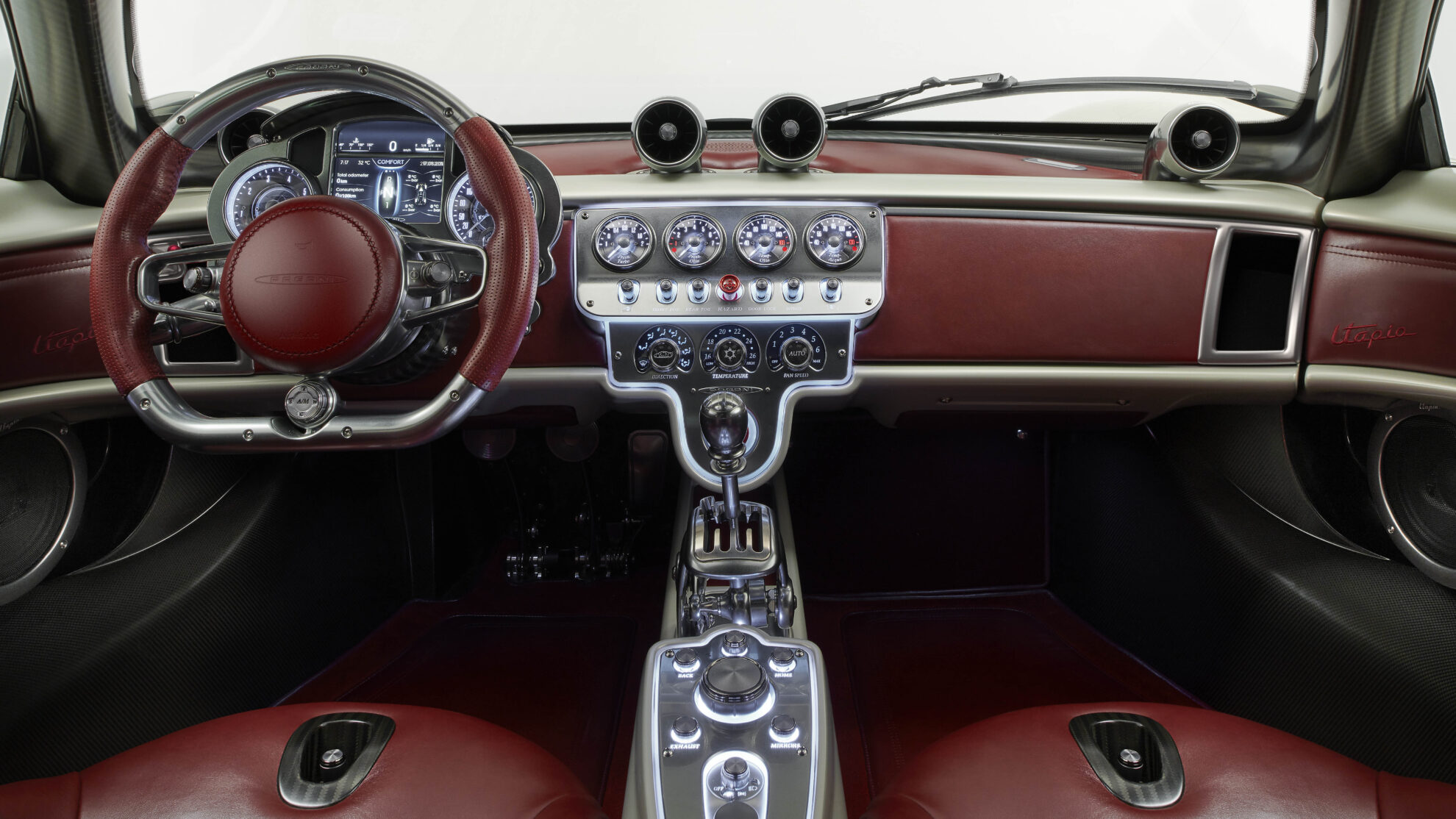
The cabin argues the same case. Apart from a small display ahead of the driver there are no screens; the instruments are analogue, their dials cut away to show pieces of their own mechanisms, and the steering wheel is milled from a single block of aluminium. The open gate of the manual gear lever sits at the centre of the console with its mechanism exposed — the one piece of theatre in the interior, and it is a working machine part.
Underneath, the structure is a carbon-fibre monocoque with aerospace-grade aluminium double-wishbone suspension, the bodywork in a new A-class carbon fibre that adds a claimed 38 percent more stiffness at the same density, developed for aesthetic applications as much as structural ones. And Pagani put the car through more than 50 severe crash tests to certify it globally, rather than hiding behind the low-volume exemptions available to a maker of 99 cars. Simplicity for the driver was never allowed to mean simplicity for the engineers. The crash programme alone is the receipt.
Ninety-nine cars, all spoken for
Ninety-nine coupés were planned, every one assigned to a customer before the first delivery in October 2023. The reported starting price was $2.19 million — Pagani itself does not publish a list price, so treat that figure as the launch-era report it is, before options and before the personalisation that no two of these cars escape.
A sell-out before first delivery is usually read as a marketing result. Here it reads differently: the clients who wrote the brief, in effect, bought the answer. The people who asked for simplicity, lightness and driving pleasure were the same people waiting at the end of the six years to collect it, which makes the Utopia a rare thing in the hypercar world — a car specified by its owners, built to their stated dissatisfaction, and delivered without the industry talking them out of it on the way.
Previously's Take
Six years, eight prototypes and four thousand drawings to arrive at a car whose big ideas are a gear lever and the absence of screens — complexity is easy to add and brutal to remove. The Utopia is what it costs, in time, when a maker decides the driver is the technology.
The numbers
Sources · 4 sources
- Pagani Automobili — official Utopia model and development account, 2022 (client brief, Horacio Pagani development quote, gearbox philosophy, materials, crash testing)
- Hagerty, September 2022 — independent launch coverage (manual gearbox, development figures, 864 PS V12)
- Carscoops, July 2025 — Utopia starting price of $2.19 million and sell-out status
- Wikipedia — Pagani Utopia (development period, prototype count, first delivery October 2023), corroborating the maker's account
Photographs: Pagani Automobili · Pagani Automobili · Pagani Automobili