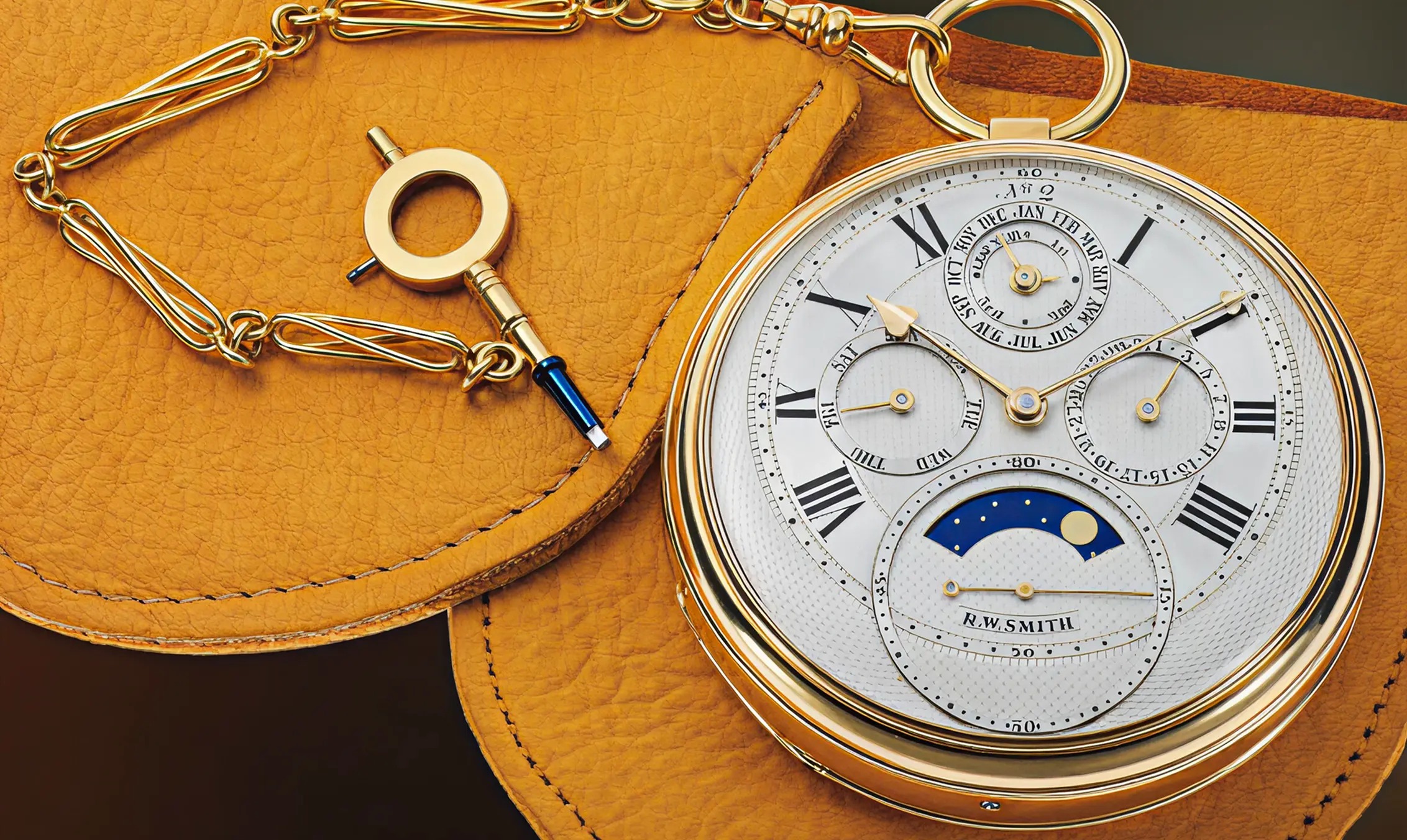

Too handmade
Roger Smith left school at sixteen for the Manchester School of Horology, excelled there, and took the British Horological Institute's Bronze Medal as its top-performing student. He went to work as a watch technician for Duval Ltd — and recognised, in his own account, that life as a repairer was not for him. A college visit by George Daniels had set the ambition: to make a watch by hand, the Daniels way, in which one watchmaker makes every single part himself.
So, at 22, he carried his first pocket watch to the Isle of Man. He had spent eighteen months making it by hand — a one-minute tourbillon with a detent escapement and a regulator-style dial, built by following George Daniels' book Watchmaking — and he wanted the only verdict that mattered. Daniels gave it: the watch looked "too handmade." A watch made by hand, Daniels believed, should look as if it had been created, as if it had simply come into being.
Made, remade, remade again
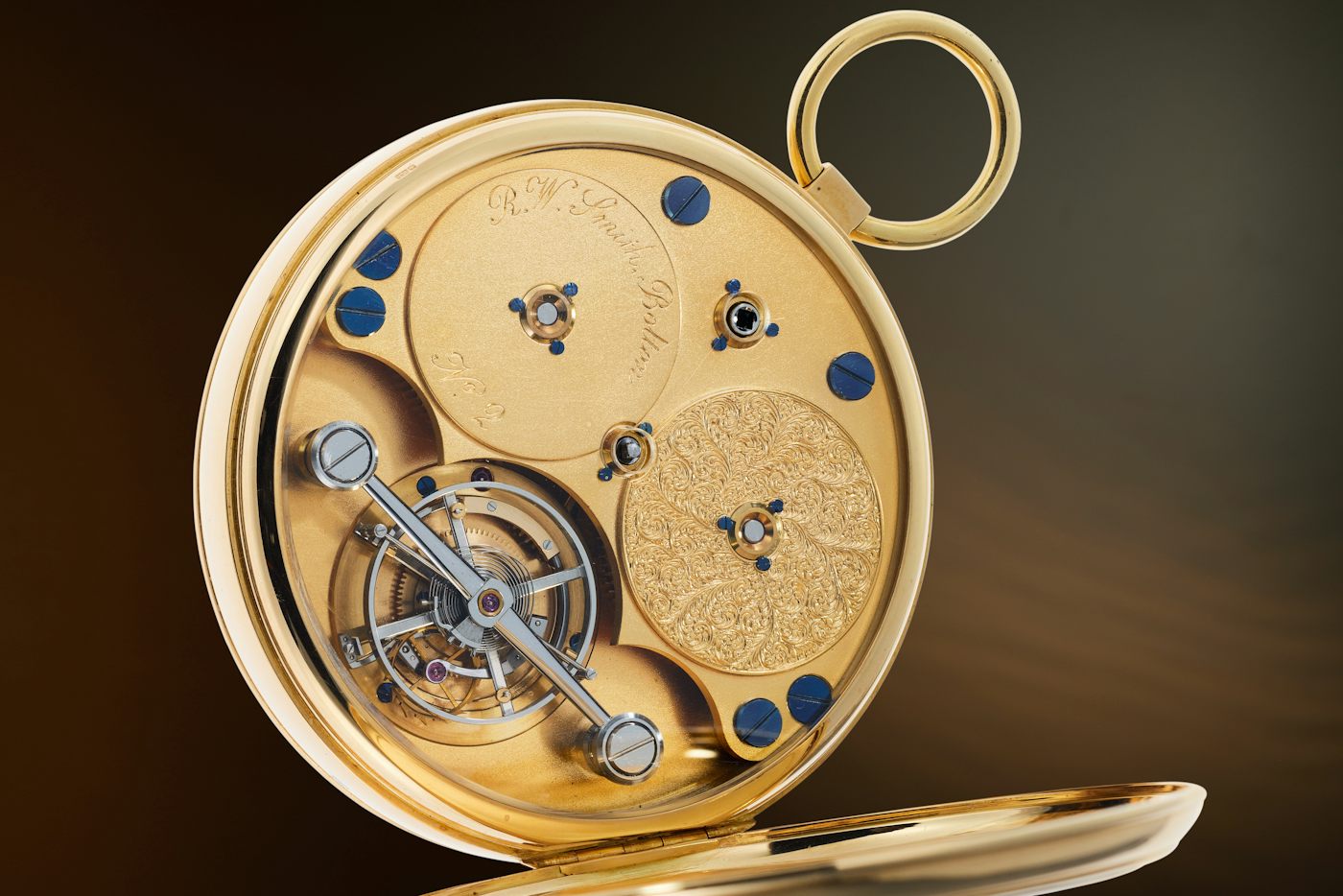
Smith went home to Bolton and started again, funding the work with watch repair and restoration. The second watch would be harder than the first: a one-minute tourbillon with a spring detent escapement, a four-year perpetual calendar and a moonphase, in a three-part case that began as a single bar of gold and ended at 66.5 mm of 18-karat gold. Every component — movement, case, dial, hands — was to be made from raw materials by Smith himself. The movement was finished in the traditional English manner: gilded, frosted plates, purple-blue hand-heated screws, gold chatons.
Here is where the story stops being about talent. As Smith's skills grew, the parts he had made earliest stopped meeting the standard of his later work — so he remade them. His own chronology records it plainly: made and remade four times, over five and a half years, completed in early 1997. Only then did he go back.
The dial he kept improving
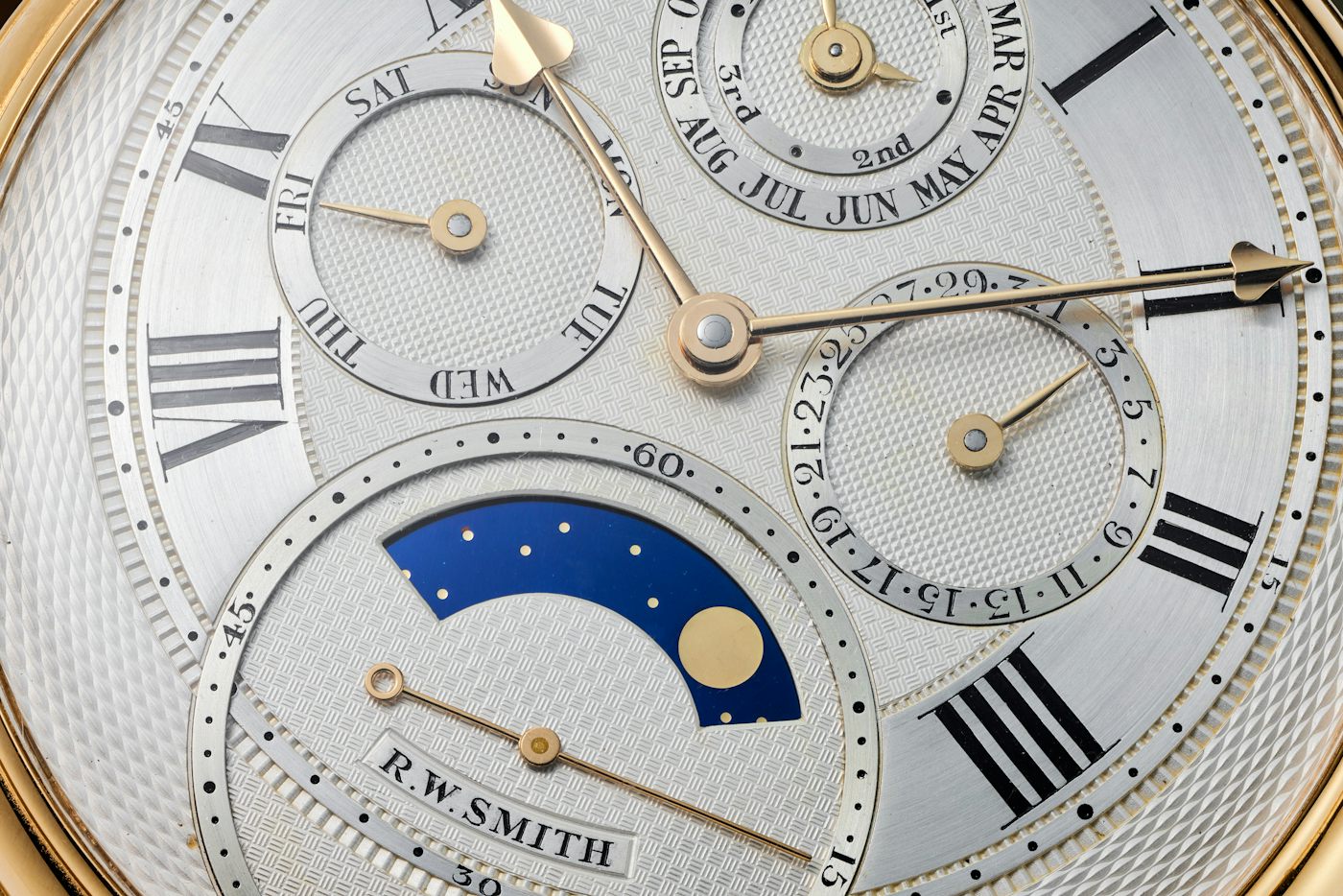
The dial alone shows what those remakings were for. Phillips' description of the watch counts four distinct types of hand engine turning across it: barleycorn on the outer main dial, basket weave on the seconds dial that carries the moonphase, clous de Paris inside the calendar dials, and a wave-and-trough pattern across the hours and minutes. It reads, as Phillips noted, as a young maker working through every skill Daniels' book describes — and refusing to leave any of them at his first attempt's level.
Even approval did not end the revisions. Before Smith parted with the watch in 2004, he had been back into it once more: new hands in the style that became his trademark, and a new dial. The watch Phillips eventually photographed and sold is that definitive version — the audition piece, still being improved by its maker years after it had already passed.
"Congratulations! You're now a watchmaker"
Daniels inspected the watch and asked, component by component, who had made each one. "I did," Smith answered, every time. Then Daniels delivered the sentence Smith had spent most of a decade chasing: "Congratulations! You're now a watchmaker." Smith became Daniels' only apprentice.
What followed was the Millennium project: Daniels invited him to the Isle of Man to collaborate on the wristwatches celebrating Omega's acceptance of Daniels' co-axial escapement — 56 pieces in the end, the last delivered in 2001. Smith calls that period the finest finishing school he could have wished for. In 2001 he founded his own company, Roger W. Smith Ltd, in a converted bedroom of his Manx cottage. The lineage survives in the workshop itself: when Daniels died in 2011, his workshop collection was bequeathed to Smith, and that equipment is still used on the Isle of Man alongside modern technology.
The watch comes back
That discipline became the founding rule of the company the watch went on to fund. Smith designed the Series 2 to be made completely in-house — in the formulation his chronology later made famous, raw materials entering one end of the workshop and a finished watch leaving the other. Pocket Watch No. 2 is where that rule was first proved, on a single object, by a single pair of hands, before there was a company to apply it to.
Smith kept the watch until 2004, when he sold it to finance his own Series 2 wristwatches. He did not see it again for nearly two decades. In June 2023 it surfaced publicly for the first time — toured by Phillips through London, Singapore, Los Angeles, Geneva and Hong Kong with an estimate in excess of $1 million — and sold in New York for $4.9 million, a record for a British timepiece. Smith calls it the most important watch he has ever made.
The film below is his workshop as it runs today.
Previously's Take
Plenty of craftspeople can tell you about a mentor's high standards; Smith's story is rarer — the standard was applied by Smith himself, to his own finished work, four times over, at his own expense. Pocket Watch No. 2 is valuable not because it passed Daniels' inspection, but because of how many times its maker failed it first.
The numbers
Sources · 4 sources
- Roger W. Smith — Evolution chronology and Workshop pages (maker's first-person record)
- Hodinkee — "Roger Smith Pocket Watch No. 2 To Be Auctioned By Phillips New York," April 11, 2023
- Phillips — New York Watch Auction: EIGHT results, June 2023 (sale price and British record)
- Wristcheck — "Inside Watchmaker Roger W. Smith's Workshop" (film)
Photographs: Roger W. Smith · Hodinkee · Hodinkee