
Nineteen minutes
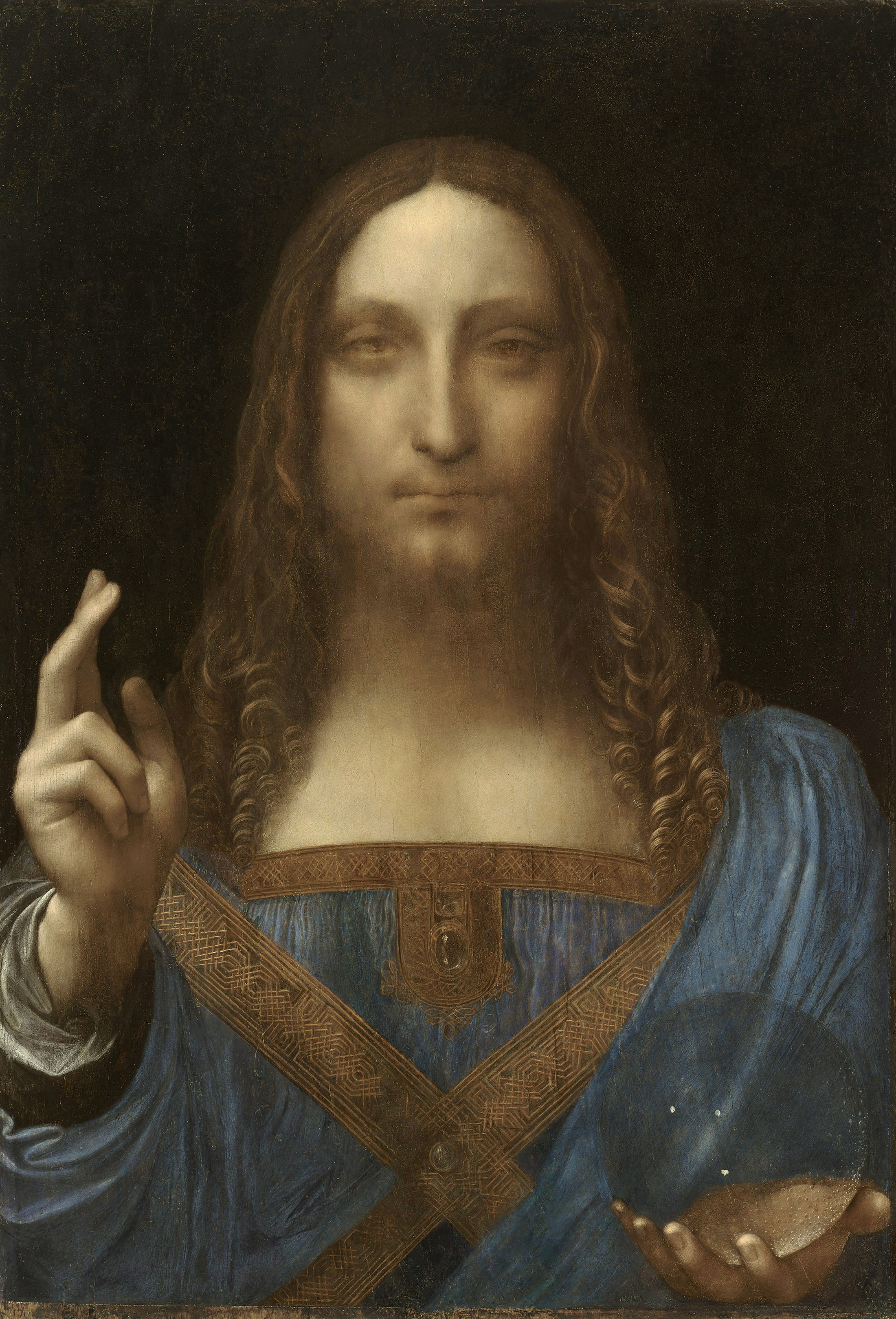
The documented part is short. On 15 November 2017, Christie's offered Salvator Mundi — Christ as Saviour of the World, oil on walnut panel, 65.7 by 45.7 centimetres, dated to around 1500 — as Lot 9B of its New York Post-War and Contemporary Evening Sale. The estimate was around $100 million. Auctioneer Jussi Pylkkanen opened the bidding at $75 million and took at least 45 bids from the room and the phones before the contest narrowed to two telephone clients, bid for by Christie's own Alex Rotter and François de Poortere. At the $400 million mark de Poortere bowed out. After nineteen minutes of bidding, the price realised was $450,312,500 including buyer's premium: the highest price ever paid for a work of art at auction.
The object itself is small and direct: a half-length Christ facing the viewer, right hand raised in blessing, a transparent crystal orb resting in his left hand, in robes of lapis and crimson with embroidered crossed bands. Note where Christie's chose to sell it — not in an Old Masters sale, but as a lot in the Post-War and Contemporary evening sale, a c. 1500 panel sequenced among modern works. The placement was part of the event, and the event is part of what the price records.
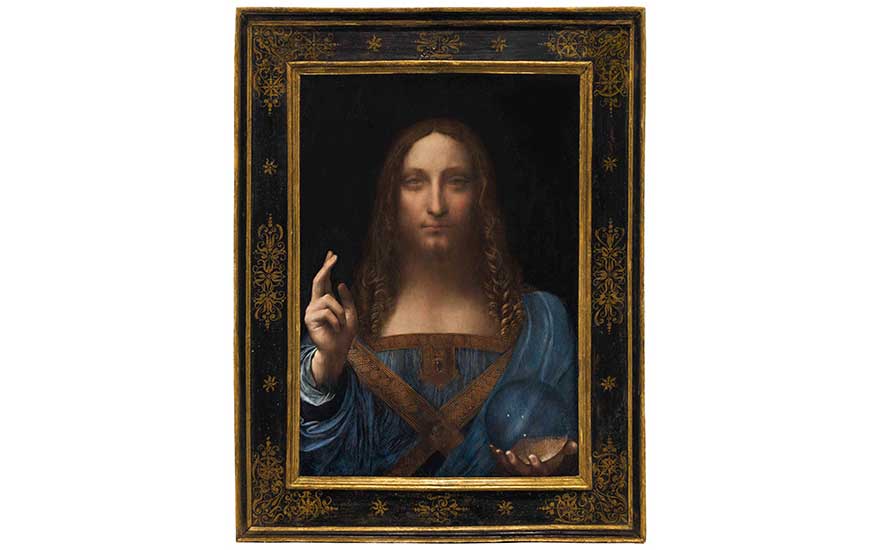
That is what an auction result proves — that on one night, in one room, the bidding reached that number. Everything beyond it has to be argued, and the argument is the real story.
A century as somebody else's painting
For most of its modern life the panel was not treated as a Leonardo at all. Christie's traces it to 1900, when Sir Charles Robinson acquired it for the Cook collection at Doughty House, Richmond, as a work by Leonardo's follower Bernardino Luini — by then its origins had been forgotten, and Christ's face and hair were overpainted. It hung in that collection, darkened and overpainted, catalogued in the circle of Leonardo's pupil Boltraffio, and when the Cook collection was dispersed it sold at Sotheby's in London in 1958 for £45.
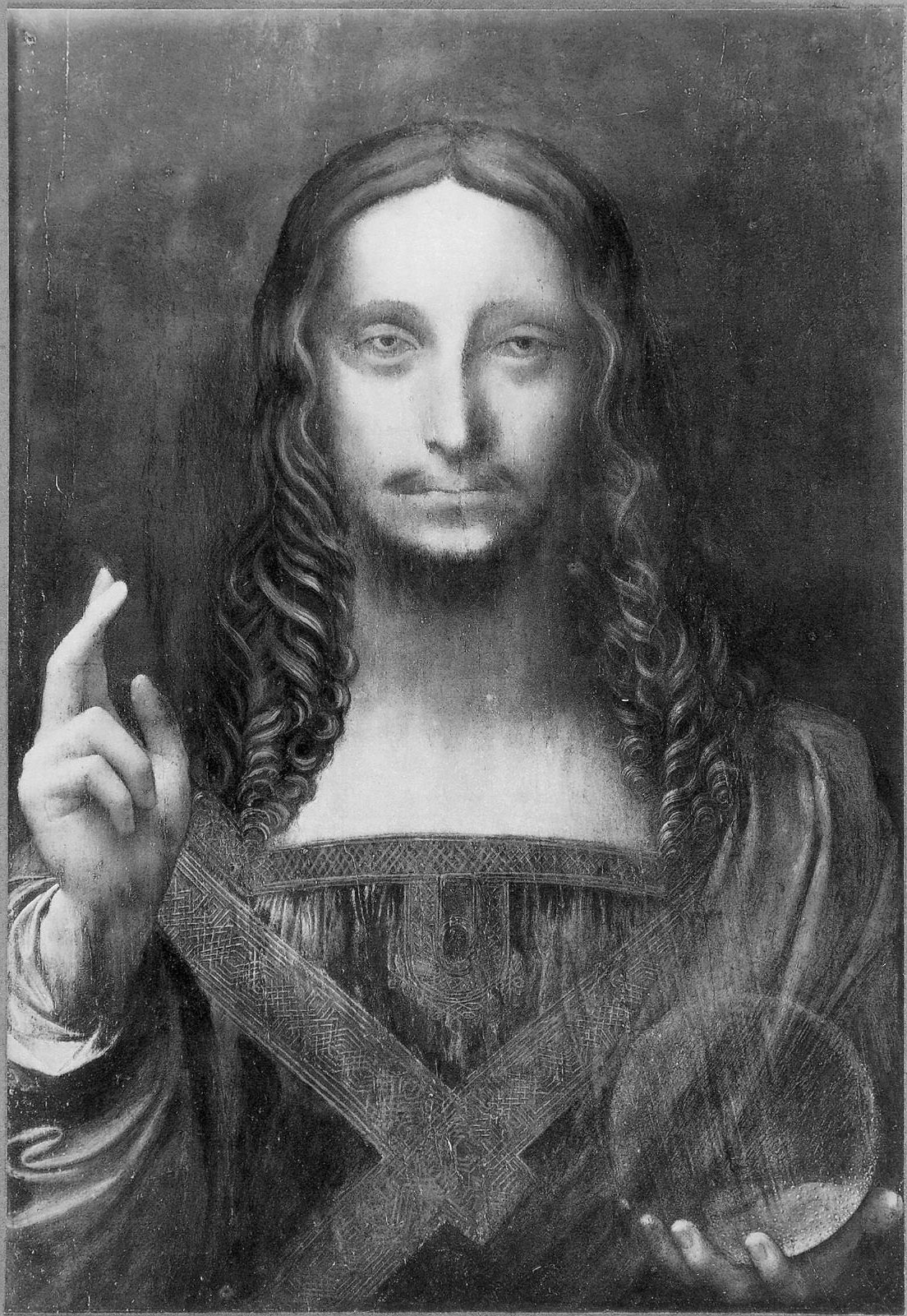
Then it disappeared again, for nearly fifty years. In 2005 it changed hands in New Orleans for $1,175, bought as a copy by a consortium including dealers Alexander Parish and Robert Simon. Three sale prices across half a century tell the attribution story by themselves: the market was not pricing a Leonardo, because almost nobody believed it was looking at one.
The thumb that argued back
Conservator Dianne Modestini then spent years removing overpaint. Under infrared, the blessing hand showed a pentimento — an earlier thumb position, changed mid-work. Copies do not usually revise themselves; a copyist reproduces a finished surface, not a decision its maker changed his mind about. That became a pillar of the case for an original.
In 2011 the National Gallery in London hung it in its Leonardo exhibition as a work by the master, and Christie's sold it six years later on the same basis: one of fewer than twenty Leonardo paintings known to survive, and the only one in private hands. Before the sale the house showed it in Hong Kong, San Francisco, London and New York — the first public viewings in Asia and the Americas. Oxford's Martin Kemp is the attribution's most prominent defender.
The case against certainty
Serious scholars have also declined to agree. Carmen Bambach, the Metropolitan Museum's Leonardo specialist, examined the panel stripped during conservation and concluded that much of the original surface may be by Boltraffio, with Leonardo responsible for passages rather than the whole — in her reading, the blessing hand, portions of the sleeve, the left hand and the crystal orb. Frank Zöllner has argued the painting's condition and provenance gaps make a confident attribution impossible; he questioned even the proportions of the nose for a perfectionist of Leonardo's order.
The honest state of the evidence is a spectrum — wholly Leonardo, Leonardo with workshop, workshop with Leonardo's hand in places — and restoration fuels the disagreement: where damage was extensive, viewers partly judge a conservator's reconstruction. That is not a flaw in the argument. It is the argument, and it remains unresolved.
The disappearance
After the sale, Christie's said the painting would go on display at the Louvre Abu Dhabi. That display never took place as announced, and the panel has not been on view since. Reports about where it is kept have never been confirmed by the owner, and this article does not repeat them as fact.
Previously's Take
The $450 million is real — the one thing about Salvator Mundi that needed no expertise to establish. Authorship is proof built from paint layers, documents and comparison, and on that evidence this remains the most contested attribution in art: a price can certify the world wanted it to be a Leonardo, never that it is one.
The numbers
Sources · 3 sources
- Christie's — Salvator Mundi sale story and evening-sale results, 15 November 2017
- artnet News, November 2017 — sale-night report (19-minute bidding)
- The Guardian reporting (via Frieze, 2019) — Bambach on the attribution; ArtWatch UK — scholarly reception survey
Photographs: Wikimedia Commons · Christie's · Wikimedia Commons