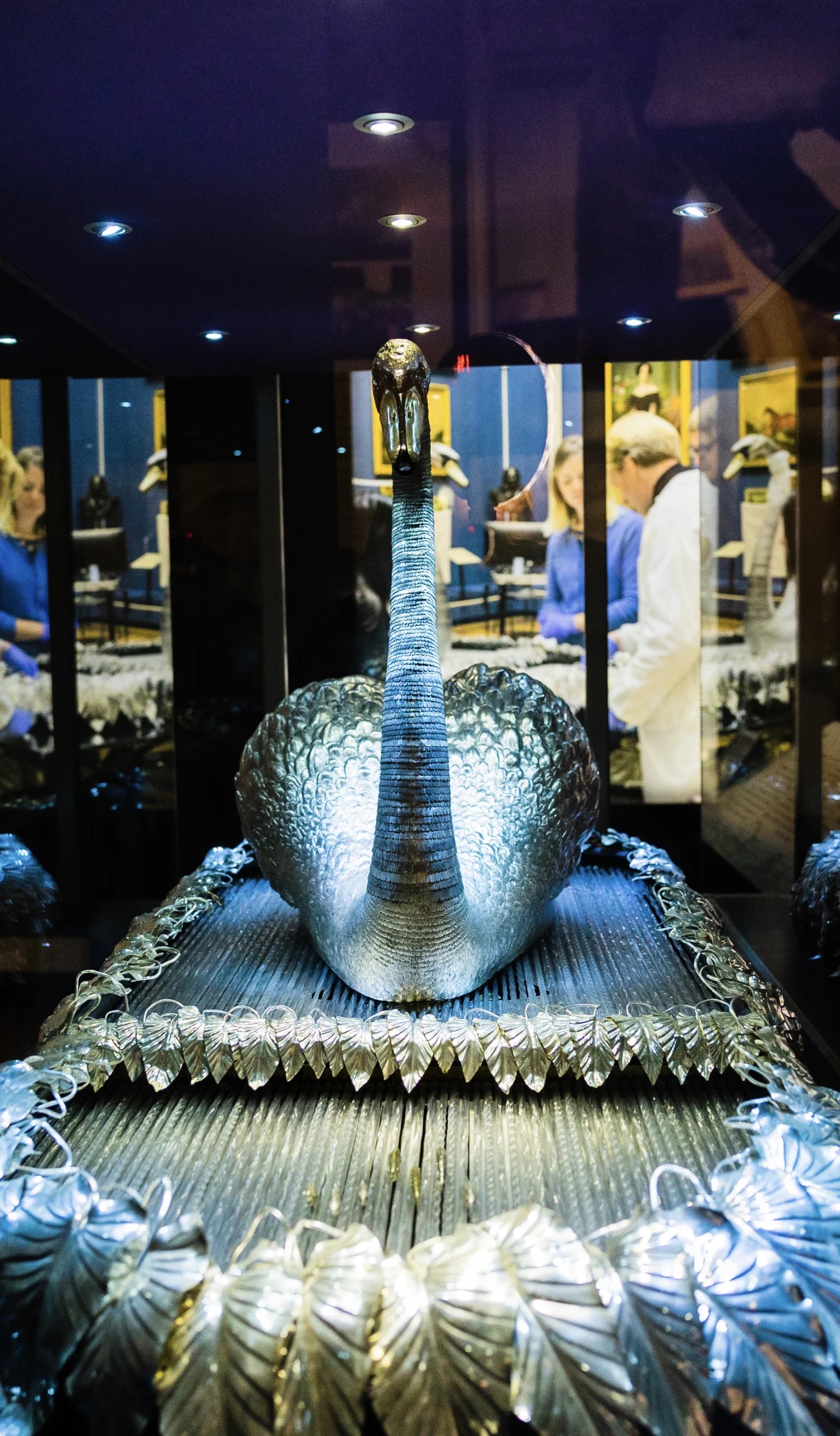

Built to stop a room
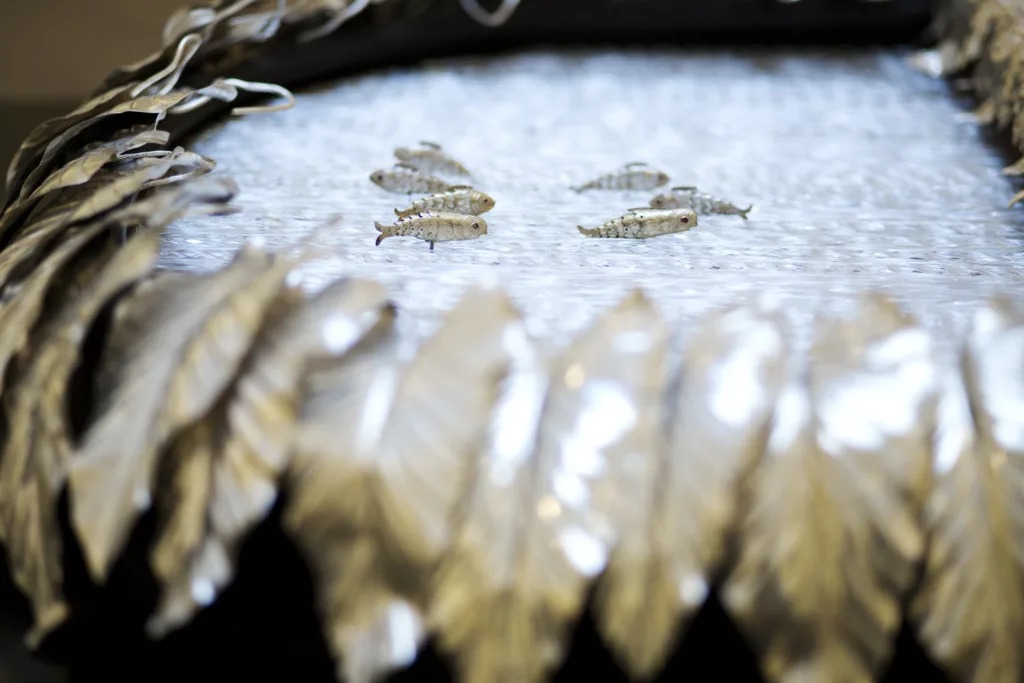
The Silver Swan was built to stop a room. She first appeared in 1773 in James Cox's Mechanical Museum in London — Cox was a jeweller and showman, and the life-size solid-silver swan, her mechanism designed by the inventor John Joseph Merlin, was his crowd-puller. She sits on a stream of twisted glass rods, and when the clockwork runs she bends her neck, catches a silver fish, and raises her head to swallow it.
That little performance is the whole machine in miniature. The neck does not flex the way a real swan's does; it articulates, ring by ring, driven from inside — 113 neck rings among more than 2,000 moving parts, with 139 glass rods making the water she appears to swim on. Every element of the scene is mechanical: the stream, the fish, the catch, the swallow. In 1773, before film, before electricity in the home, a machine that could imitate a living gesture this gracefully was not a toy. It was a demonstration of what mechanism could do, dressed in solid silver.
Mark Twain watched her at the Paris International Exhibition of 1867 and wrote that she moved with "a living grace." Joséphine and John Bowes saw her there too, and in 1872 John Bowes paid £200 for her — the only price this piece will quote, because it is the only one the museum records; no current valuation exists for the only one of its kind. She has been at Barnard Castle ever since, in the museum the Bowes founded, and the question her keepers have faced ever since is not what she is worth. It is how she is kept.
Two thousand parts, and every one a decision
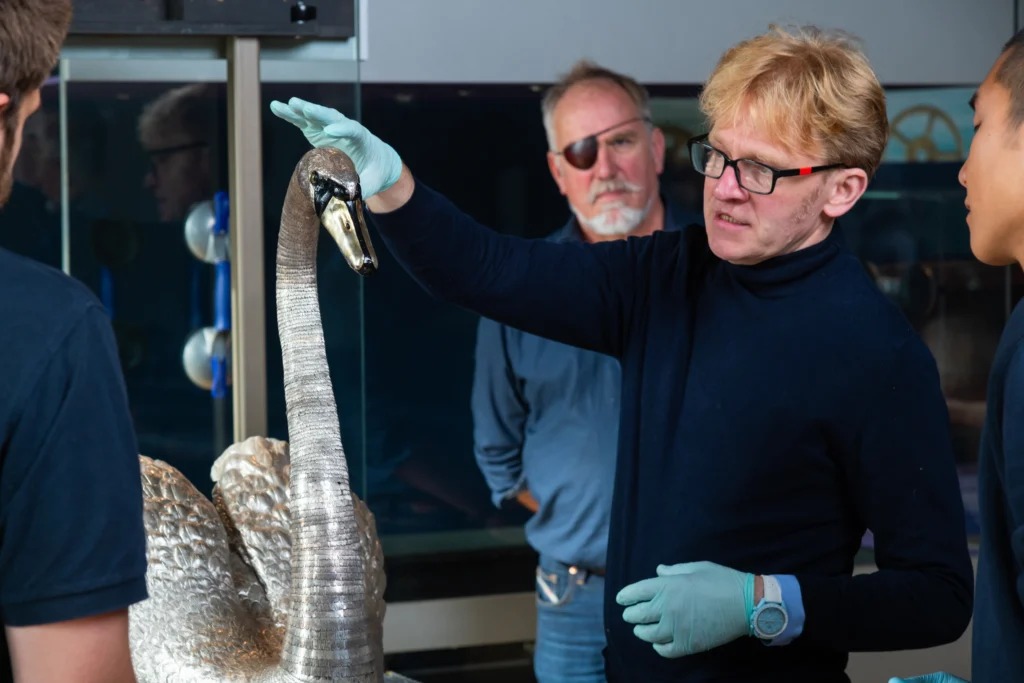
A machine that complicated does not survive two and a half centuries by being left alone — it survives because generation after generation of specialists decided which worn components to preserve, which to replace, and which to stop moving before they failed. Those are three different judgements, and they pull against each other. Preserve everything and the machine eventually tears itself apart on its own worn parts. Replace freely and, decade by decade, the object in the case stops being the object Merlin built. The Swan's history is the record of that argument being had, carefully, over and over.
The record of those calls is unusually well kept. The Swan stood static from the museum's opening in 1892, was packed away during the Second World War, and was restored to working order in the late 1940s. In 2008 came the first major conservation project in a generation: clockmaker and conservator Matthew Read stripped the mechanism down and cleaned and recorded every component.
The part that failed was not the old part
A later service turned up the detail that tells you how this work actually goes — the one dry, worn bearing found belonged not to Merlin's original mechanism but to a replacement fitted during the 1960s repairs. The eighteenth-century work was holding up better than the twentieth-century fix.
Sit with that for a moment, because it reverses the assumption most people bring to old machines. Time is not the Swan's main enemy; intervention is. The original work, made by hand to tolerances its makers understood intimately, had outlasted a newer part fitted by people working faster, or to a different standard, two centuries later. For a conservator, that finding is an instruction: the lightest touch that keeps her running is usually the right one, and every replacement part is a promise the future will have to keep — or, as here, quietly fail to.
What happens when she stops being run
Then she stopped — seized during the Covid closure, when the museum was shut and she simply wasn't being run. A clockwork machine needs its exercise. Left still, lubricants dry, tolerances settle, and a mechanism designed to move begins to suffer from the one treatment that sounds safest: nothing at all.
In 2021 a team led by Read took her apart for a two-week study and wrote down precisely what she would need. The work ran through 2023 into 2024: the Cumbria Clock Company, with the museum's conservators and clockmaking interns, spent more than 1,500 hours on her, funded by the National Lottery Heritage Fund and a crowdfunding campaign that passed its target. Note who did the work: not a contractor working alone, but the museum's own conservators and interns alongside the specialists — the knowledge of how she comes apart and goes back together stays in the building, ready for the next generation that will have to make these calls.
Back on stage, on a ration
She is back now, performing daily at 2pm — often enough to keep the mechanism alive, rare enough not to wear it out performing. That schedule is itself a conservation decision, the preserve-versus-use argument settled in the form of a timetable. Run her constantly and the performance spends the machine; never run her and stillness does the damage instead. Once a day is the negotiated answer, with an extra performance on school holidays and bank holidays, when the crowds are largest.
It means the Swan is something almost no museum object gets to be: not a relic of a performance, but the performance itself, still running on a mechanism older than the museum that houses it. Every afternoon at two, the neck bends, the fish is caught, and 250 years of careful decisions hold for one more day.
Previously's Take
Plenty of museums own objects older than the Swan; almost none own a machine they are still obliged to run — and every run spends a little of her. The Bowes Museum's answer, across 150 years: document everything, replace only what wear forces, and let her keep catching her fish.
The numbers
Sources · 3 sources
- The Bowes Museum — The Silver Swan Story; The Silver Swan, collections page; Silver Swan maintenance record
- This Is Durham, March 20, 2024 — return to performance after more than 1,500 hours of restoration work
- Museums Association, Museums Journal, March 2024 — restoration and funding corroboration
Photographs: The Bowes Museum · The Bowes Museum · The Bowes Museum