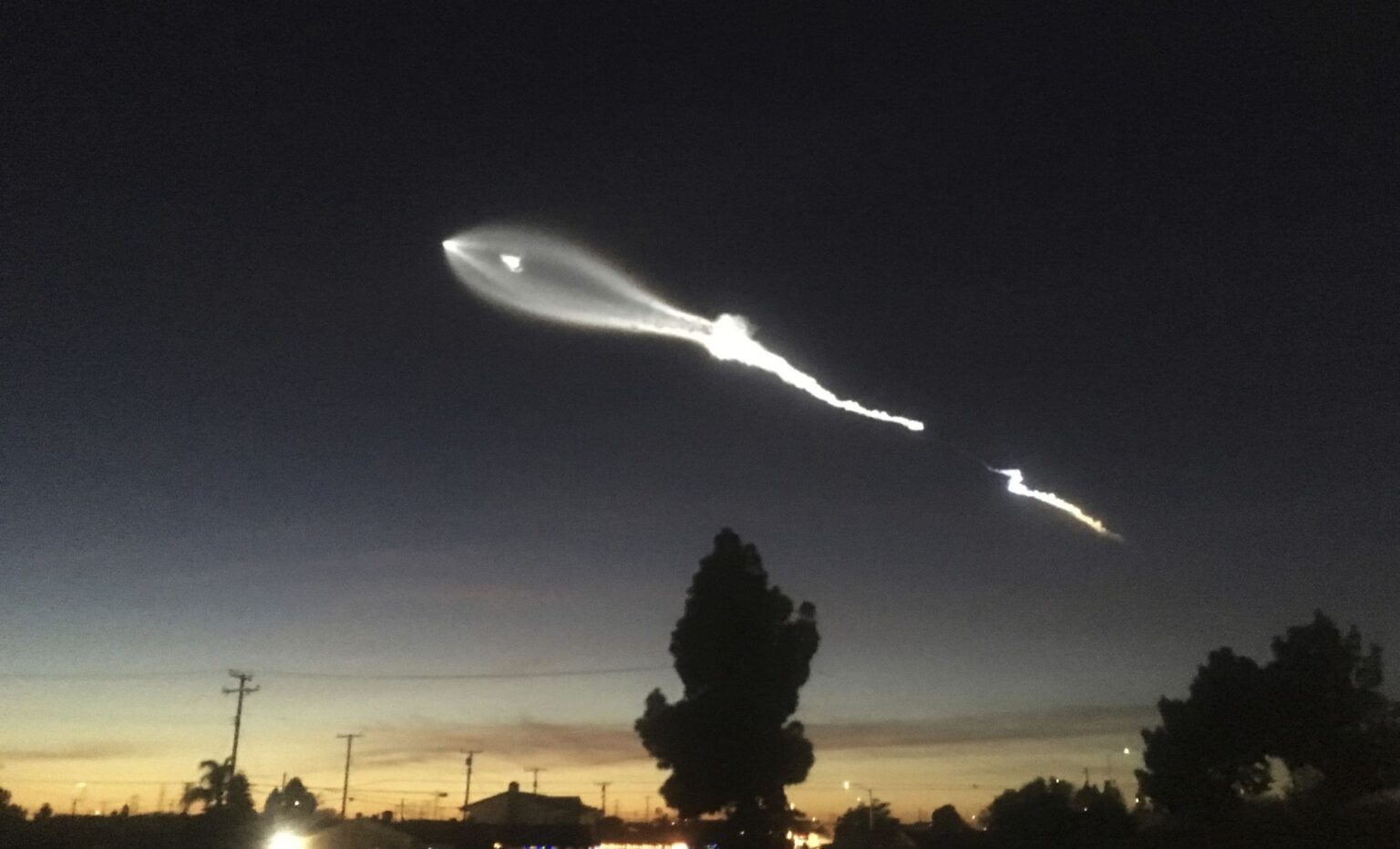
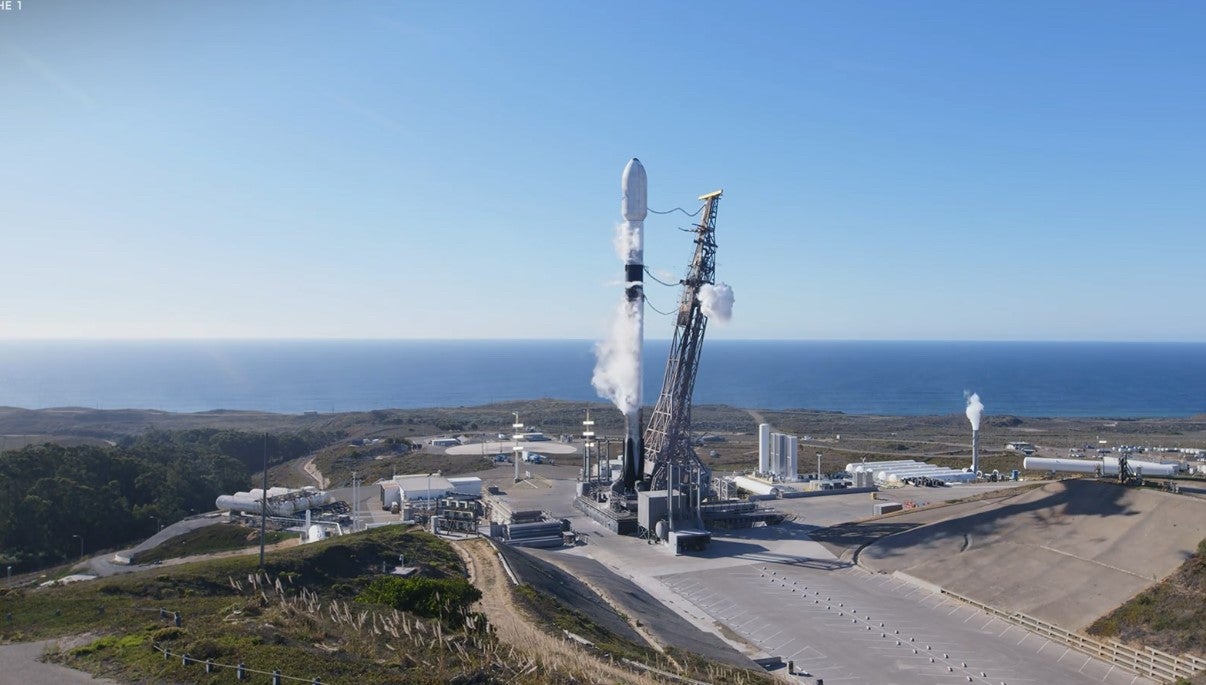
SUNDAY, OCTOBER 4, 2026 — SpaceX is set to launch a Falcon 9 rocket carrying 21 military satellites at 1:17 a.m. PT on Monday, Oct. 5, from Space Launch Complex 4-East at Vandenberg Space Force Base in Santa Barbara County, Calif. The flight is the fourth of nine planned batches for the Space Development Agency's Tranche 1 network, and it will place another set of data-transport satellites into low-Earth orbit as the Pentagon builds out a layered constellation it expects to begin operational service in 2027. SpaceX plans to livestream the launch on its website.
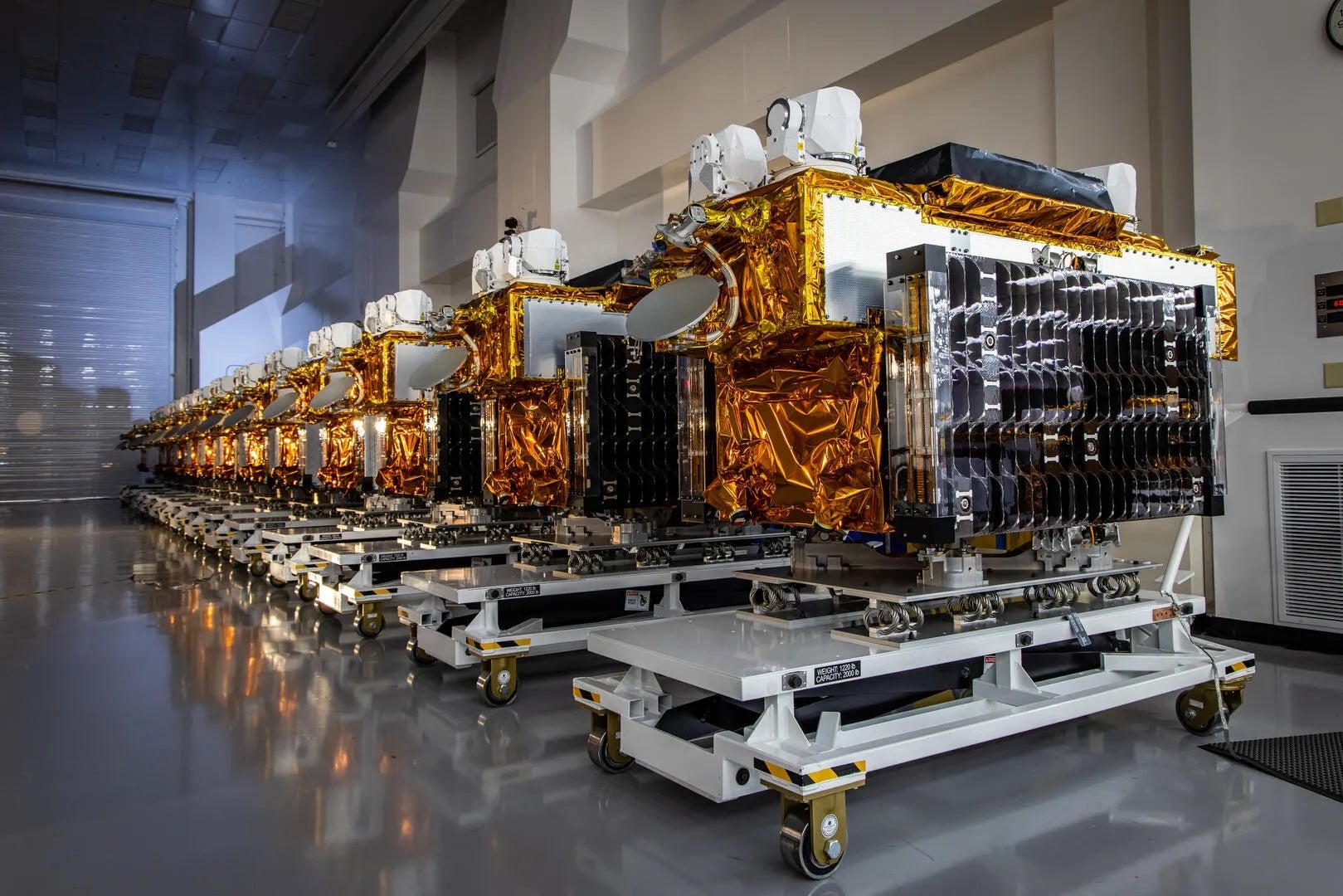
The 21 satellites aboard Monday's flight were built by Northrop Grumman and delivered to Vandenberg late last month, according to the company. The rocket will lift off from the SpaceX-leased SLC-4E pad on the Central Coast and fly on a southern trajectory, the pattern these military launches have typically followed this year. A Federal Aviation Administration operations plan advisory lists a backup launch opportunity the following day if weather, the range, or a technical issue scrubs Monday's attempt.
The Falcon 9 is the world's most active rocket — a two-stage, 230-foot vehicle that has launched hundreds of times from Florida and California. For this mission, the plan calls for the first-stage booster to fly back to Vandenberg and land at Landing Zone 4 after stage separation, so it can be refurbished and reused on a future flight. That return-to-launch-site landing means residents of Santa Barbara, San Luis Obispo and Ventura counties should expect sonic booms: the booster falls back through the atmosphere still traveling at supersonic speeds, generating shock waves that sound like loud thunder on the ground, possibly for up to 10 minutes after liftoff.
What is “Tranche 1”?
The Space Development Agency — the arm of the U.S. Space Force tasked with building military space technology — was established as an independent agency in 2019 and became part of the Space Force in October 2022. Its centerpiece is the Proliferated Warfighter Space Architecture, or PWSA: a large constellation of government-owned satellites in low-Earth orbit, built out in stages called “tranches” under the agency's spiral development model, which delivers new technology to the constellation roughly every two years.
Tranche 0 was the proof of concept. Those satellites launched in 2023 and 2024 and demonstrated the building blocks — including laser communications between satellites, with the ground, and with a terminal installed on an aircraft in flight. Tranche 1 is the first tranche intended to conduct real military operations, and it began arriving last year.
The buildout so far: a SpaceX Falcon 9 launched the first 21 Tranche 1 satellites on Sept. 10, 2025 — York Space Systems-built transport satellites. A second batch of 21 followed in June 2026, and a third launched on July 15, 2026, bringing the total to 63. Monday's flight is batch four, and it is the first of the batch to fly satellites built by Northrop Grumman rather than York. Six Transport Layer missions are planned in all, contributing 126 satellites — 42 from Northrop Grumman, 42 from York Space Systems, and 42 from Lockheed Martin. Tranche 1 also includes 28 tracking-layer satellites for missile warning and tracking, plus four missile-defense demonstration spacecraft — nine SpaceX batches in total toward the 154-satellite layered network.
The layered network, in plain English
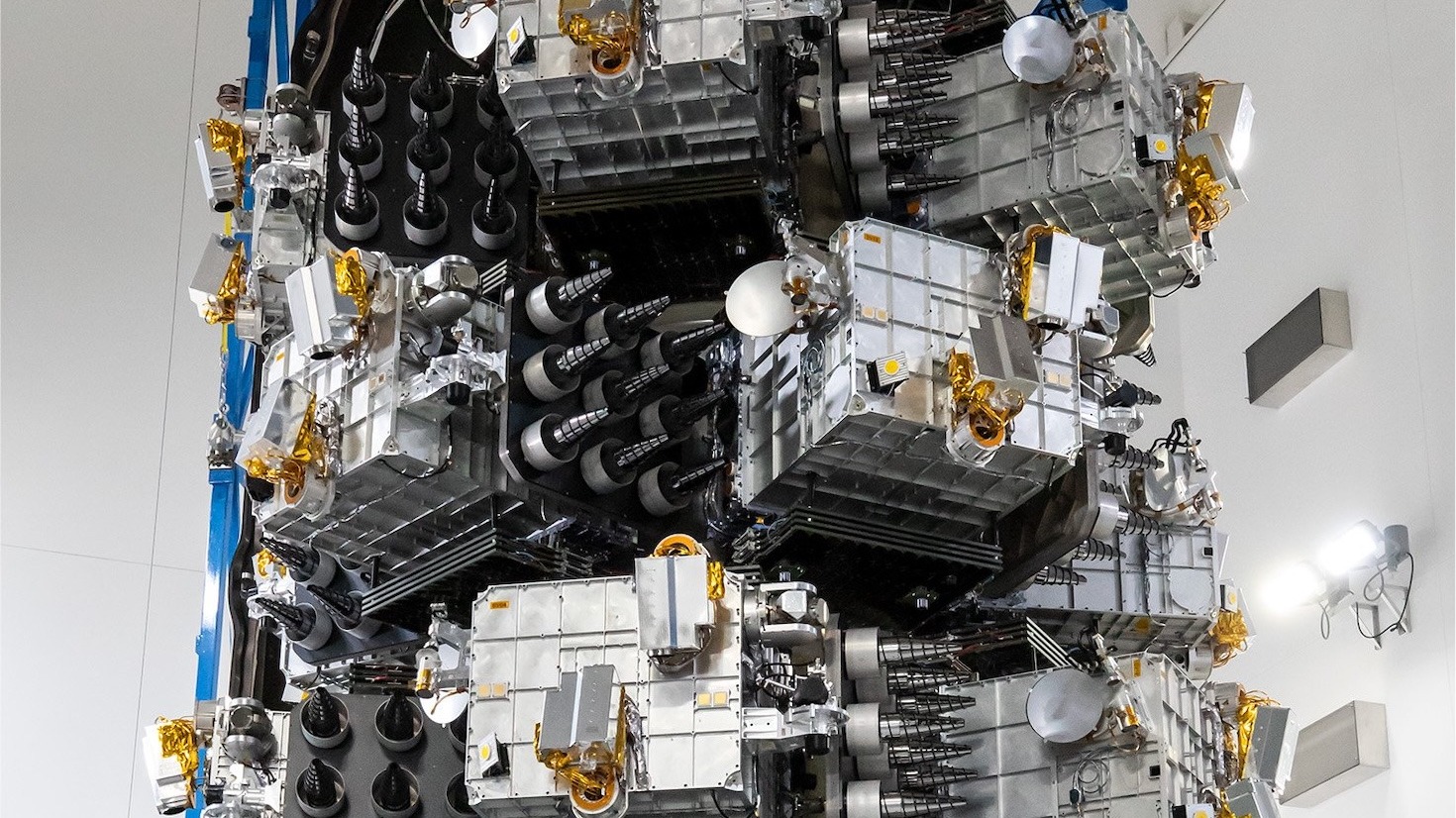
Two jobs, two layers. The transport layer is essentially a military data network in orbit: satellites at roughly 1,000 kilometers altitude that carry tactical communications — including Link 16, the data link military aircraft and ships use to share targeting information — across Ka-band radios. The satellites link to each other with optical inter-satellite links — laser beams instead of radio waves — which are faster, harder to jam, and harder to intercept. That mesh means a warfighter anywhere on the globe gets low-latency, resilient connectivity without relying on a handful of vulnerable relay stations.
The tracking layer does the other job: 28 satellites equipped with infrared sensors that detect, identify and track missile launches, feeding warning and targeting data into missile-defense systems. Together, the layers are meant to give the Pentagon what it calls “proliferated” capability — hundreds of relatively small, mass-produced satellites instead of a few large, expensive, exquisite ones. The logic is resilience: with so many nodes, an adversary can't knock out the network by disabling one or two spacecraft.
That missile-tracking mission sits at the center of current defense planning, from the Indo-Pacific — where the agency says its first group of military users is based — to the battlefields of Europe, where missile and drone threats are a daily reality (read our coverage of this week's strike on Kyiv's Northern Bridge). Beginning in 2027, Tranche 1 is expected to deliver regional Link 16 capability, advanced missile tracking and warning, beyond-line-of-sight targeting, and demonstrations of UHF and S-band tactical satellite communications. The constellation is operated from Grand Forks Air Force Base in North Dakota and Redstone Arsenal in Alabama, supported by a global network of ground stations.
What is a “backup opportunity”?
In launch-speak, a backup opportunity is exactly what it sounds like: a reserved slot on the schedule if the primary attempt doesn't happen. The FAA publishes operations plan advisories for commercial launches, alerting airspace users to the planned window — and in this case, an advisory indicates a backup opportunity the following day. That is routine. Spaceflight scrubs for weather, range conflicts, or technical gremlins are common, and a scrubbed launch is generally re-attempted at the next opportunity, not a sign of anything wrong with the rocket.
The backup window doesn't guarantee an identical launch time or identical conditions; launch providers reassess weather and range availability before committing to the next attempt. Anyone planning to watch — online or in person — should check SpaceX's channels the morning of the launch for confirmation that the countdown is still on.
How to watch the launch live
SpaceX provides a live webcast of its missions on the company's website, typically beginning about 10 minutes before liftoff — so for this flight, expect the stream to start around 1:07 a.m. PT Monday. The company also posts countdown and launch updates on X. Postponements are always possible, so the stream and SpaceX's social feeds are the best real-time source for whether the launch is holding.
For spectators along the Central Coast, overnight launches from Vandenberg are visible from a number of public vantage points — and for a flight in the small hours, the rocket's exhaust plume lit by the engines often glows bright against the dark sky. Those farther afield will have a harder time: this launch flies a southern trajectory, which makes it unlikely to be easily visible from places like Arizona. And if you're anywhere near the launch site, remember the booster is coming back — the low rumble of liftoff, followed minutes later by the sharp crack of sonic booms as the booster descends toward Landing Zone 4.
Why it matters
Tranche 1 is the first warfighting constellation built on the proliferation doctrine — the bet that the military's future in space depends on speed and quantity rather than perfection. Consider the pace: the agency stood up in 2019, and just over six years later it began delivering an operational constellation, a tempo the Space Force credits to commercial manufacturing practices and the spiral development model, with new technology flowing into the constellation every two years.
“As the PWSA begins to support military operations, it will enhance our strategic advantage by serving the joint warfighting force with operational capabilities previously thought infeasible from LEO,” the agency's then-acting director, Gurpartap Sandhoo, said after the first Tranche 1 launch in September 2025. Before that launch, he told reporters the satellites would start providing operational capability to combatant commands within four to six months — “the first time we'll have the space layer fully integrated into our warfare operations.”
The program hasn't been painless. The Tranche 1 effort is more than a year behind its original schedule, largely because of supply-chain holdups in producing the optical communication terminals the satellites need. Northrop Grumman said in a Sept. 29 statement that “dozens” of its satellites are fully integrated with final checkouts in progress, and that “over the next six months, several dozen additional Northrop Grumman-built satellites for the PWSA will be launched into LEO, contributing to both the missile defense and data transport missions.” The Space Development Agency says all of the Transport and Tracking Layer satellites for Tranche 1 should be in orbit within the next six to eight months.
Watch for the streak of light Monday morning, then. It will be gone in minutes — but the network it is building, satellite by satellite, is designed to last.