
It started as one man's own shirt
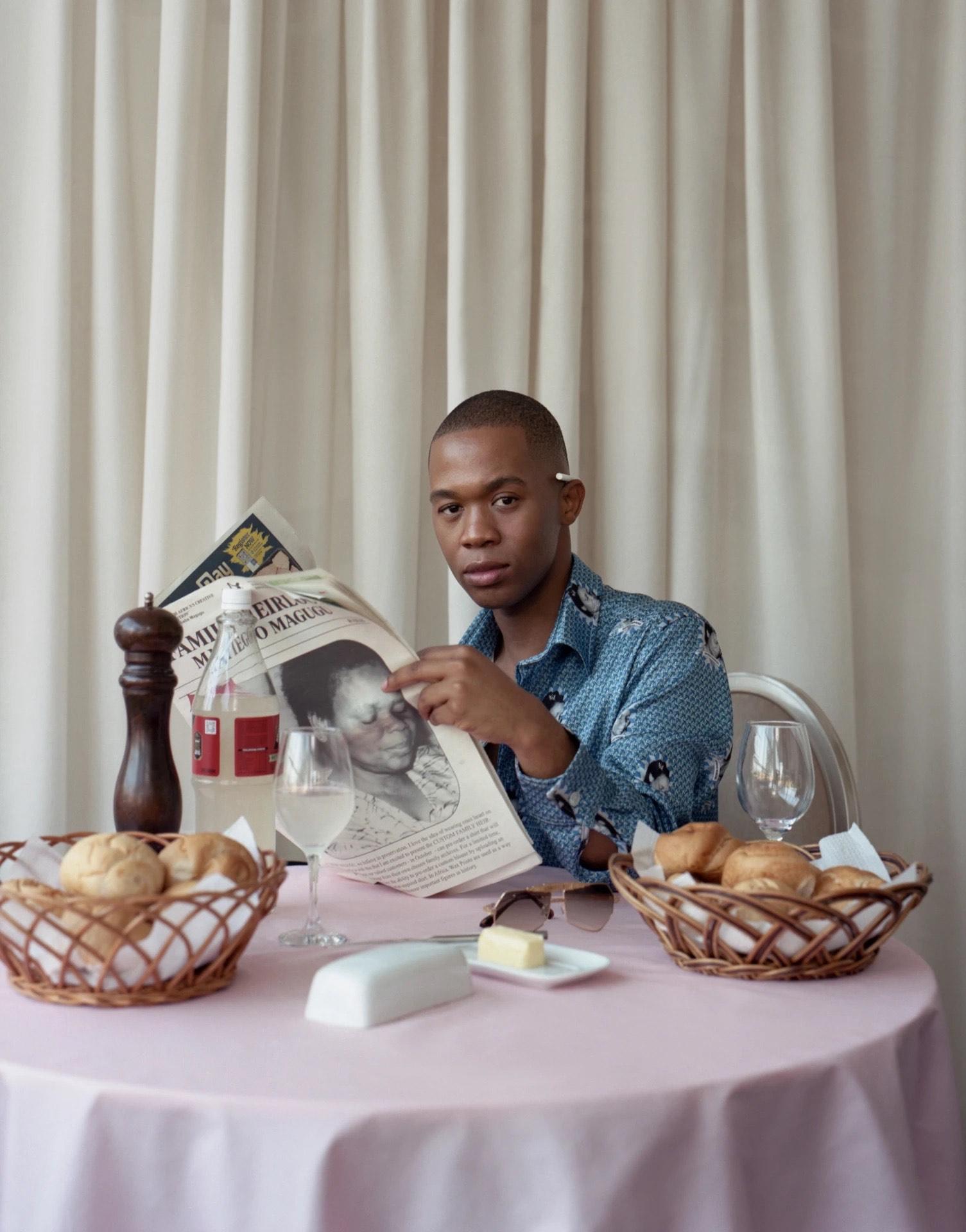
The shirt started as one man's own. For his Genealogy collection, Thebe Magugu had his grandmother's portrait worked into a wax print, the way wax prints in Africa have long carried the faces of presidents and royalty. The choice of face was the argument. Wax print had spent generations putting important strangers on cloth — heads of state, public figures, history as it was handed down. Magugu put his own history there instead.
His grandmother, Matiego Magugu, raised him while his mother worked in a neighbouring city. The portrait shows her praying over his mother at her 21st birthday — three generations held in one image, worn by the fourth. She died in 2009, before the label existed, and she had known about the ambition anyway: he had spoken to her about going into fashion, and she had told him that one day she would be front row. Wearing the shirt, he says, works "almost like a charm, a symbol of strength," and the shirt itself becomes "a public record in a way." "I love the idea of wearing one's heart on the sleeve," he has said, "and this project does that in a way that is both physical and symbolic."
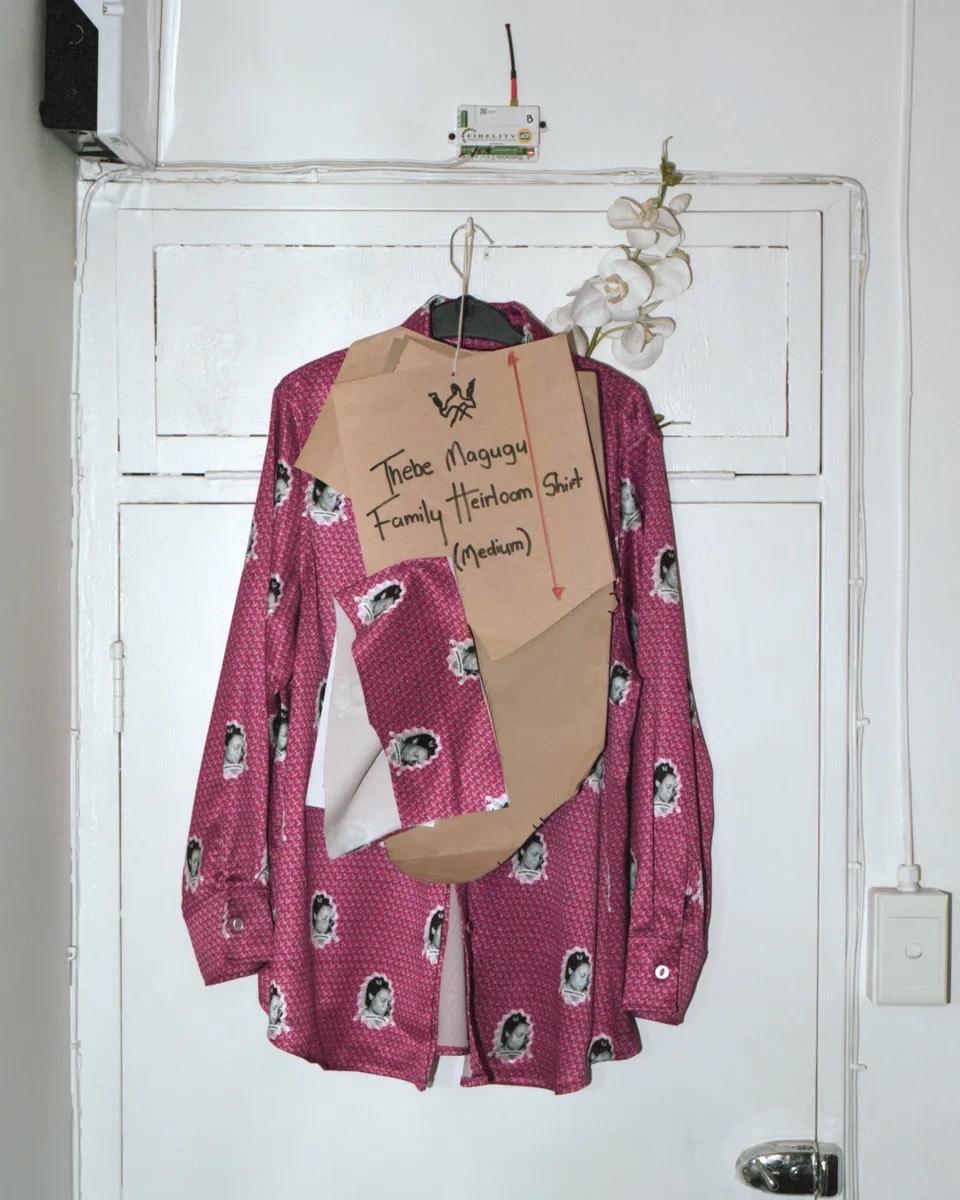
He wore it, and the response was always the same: people wanted one with their person on it.
The window that was supposed to break even
In October 2023 the wish became an order window. From October 6 to 22, anyone could upload a photograph and a name to the house's website and commission a shirt with that face printed into its pattern. The offer was deliberately open about who qualified: anyone who has left an impact on you — "living or transitioned, blood or chosen." The shirts were unisex, in three colourways — sky blue, candy pink and lime green — in sizes from extra small to double extra large, and production was planned at 400 shirts.
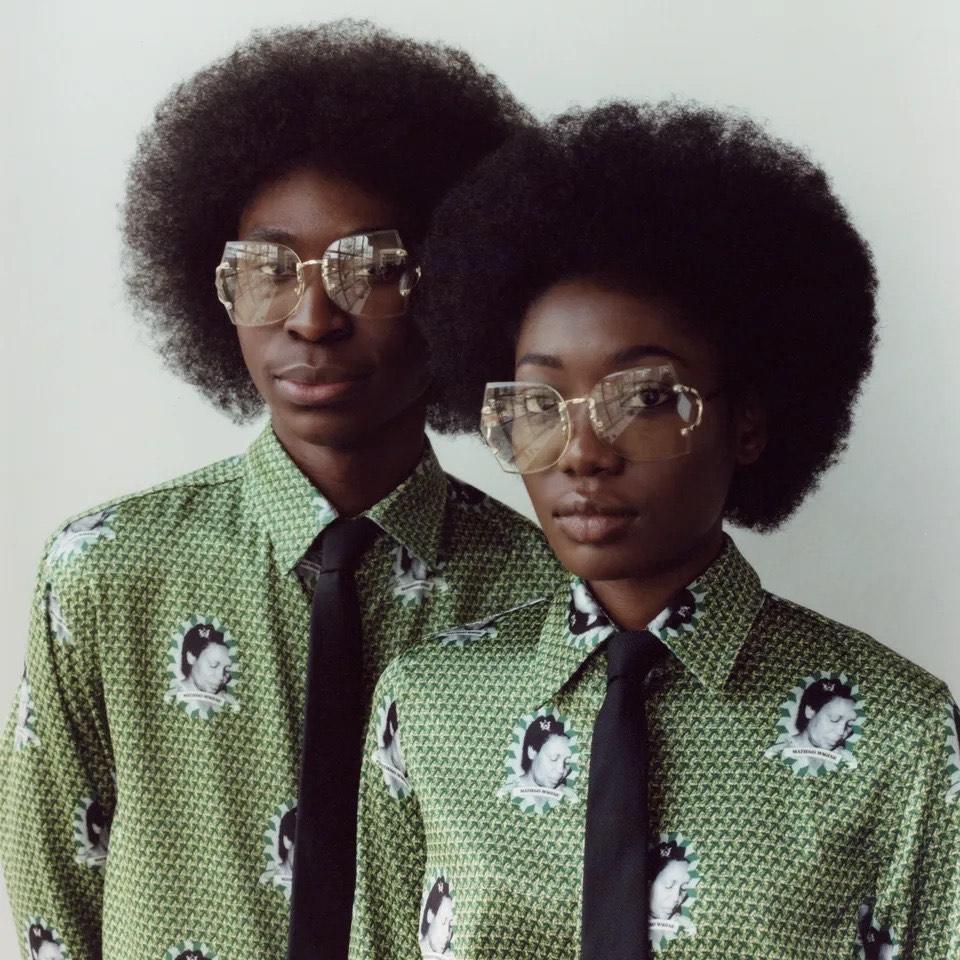
Magugu expected far less. Fifty orders, he figured, would be enough to break even. A few hundred came in, from around the world — among them, the New York Times reported, an order from Michelle Obama, carrying a photograph of her mother, Marian Robinson. The first shirts were delivered that December. A project budgeted as a break-even experiment had to be produced as a success, one unique pattern at a time, with no two commissions alike to hide behind.
What people actually sent
What people sent is the telling part. Most photographs were of people who had died.
That was not the outcome a fashion house would have predicted, or necessarily designed for. A custom-print portal invites novelty — a pet, a joke, a famous face. Magugu had worried someone would treat it as a joke and upload a celebrity; nobody did. Given a surface that could carry anything, customers used it as a memorial. The shirt stopped being a personalisation service and became something closer to a registry: hundreds of families, most of them strangers to the house and to each other, deciding that the person they most wanted carried in public was someone they had lost.
That is also why the designer's own framing held up. He had described the garment's function as a charm — a physical part representing a whole that cannot be held. The orders proved the description was not copywriting. It was the use case.
A shirt with no stock version
An ordinary luxury commission personalises a standard object — initials on leather, a name inside a case. The object stays the same; the mark is an addition. This one reverses the order: the object is a shirt, and the personal element is the entire surface. There is no stock version. Two customers can order the same colour, in the same size, and own nothing alike, because the pattern is a family.
That reversal changes what the house is actually selling. Magugu's workshop is not supplying the meaning and charging for the craft of applying it. The customer supplies the one thing the house cannot design — a face, and everything attached to it — and the house supplies the making. It is a small, repeatable piece of manufacturing built around other people's memory, and it only works because the designer's part stays deliberately in the background.
The project has since returned as Heirloom II, a limited-edition capsule with (RED), carrying the same custom shirt forward. Magugu described his own commission for it in the same terms as the first: his grandmother, "a pillar of strength when I am at my weakest." The format survived its first window because the demand was never for a shirt. It was for the permission to wear the person.
The house the world noticed early
Magugu built his house from Kimberley and Johannesburg, and the world noticed early: in 2019 he won the LVMH Prize, the first African designer to take it. But Heirloom is no prize-season gesture, and it does not behave like one. It was not launched to be photographed on a runway and retired. When the first window closed, customers who had missed the deadline kept writing, and Magugu told the Times he planned to bring the project back as a recurring event with new styles around the same shirt. The house's most personal product became one of its most durable — not despite being built on other people's photographs, but because of it.
Previously's Take
Old luxury inherited its meaning — the watch, the house, the name handed down; Magugu's version starts the inheritance instead of waiting for it. You commission the shirt as an heirloom, with the face already in the cloth, and the family it honours is the one you say it is.
The numbers
Sources · 6 sources
- Thebe Magugu — Heirloom II, official project record (thebemagugu.com/heirloom-ii/)
- (RED) — (THEBE MAGUGU)RED Heirloom II Collection, partner product record
- The New York Times, syndicated as "Family photos have never looked so chic" — Genealogy origin, order numbers, designer quotes
- IQOQO — "Thebe Magugu's giant capsule of African heritage" (2024): the Heirloom Satin Shirt, the upload window, the Matiego portrait
- Apparel Resources / Gazetta — 400-shirt capacity; December 10, 2023 dispatch
- 10 Magazine, September 26, 2023 — launch report (three colourways, unisex sizing, 400-shirt capacity)
Photographs: Thebe Magugu · Thebe Magugu · Thebe Magugu